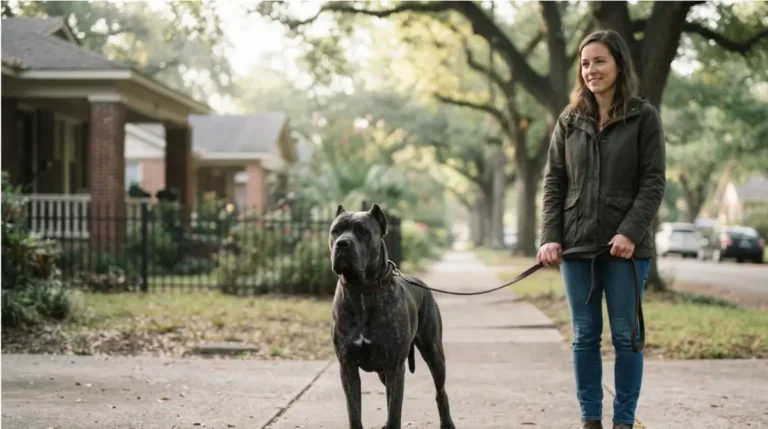
Use a Cane Corso Growth Chart the Right Way

Cane Corso growth chart numbers matter less than the curve: weigh every 2–4 weeks until six months and watch the trend, not one weight.

Table of Contents
Cane Corso weight by month, and why charts disagree
Start here if you have a puppy now
Most Cane Corso growth chart pages hand you numbers without sources, and the numbers don’t match. With a puppy now, the ranges are next and the tracking method follows; still deciding on the breed? Start with whether Cane Corsos are good family dogs.
What the AKC standard says
The AKC standard gives height (25 to 27½ inches for males, 23½ to 26 for females) and weight “proportionate to height.” It names no monthly weight, so every chart is an estimate.
🩺 Vet Note: Growth and feeding needs depend on a puppy’s age, sex, adult size, and health. Treat these ranges as a starting point and confirm your puppy’s growth with your veterinarian, especially if weight jumps, stalls, or drops.
Cane Corso growth chart: male and female weight by month
Published charts put a male Cane Corso puppy at about 30 to 35 pounds at two months and 90 to 100 by eleven, with females 5 to 10 pounds lighter. These come from breed guides, not veterinary studies, and the guides differ by 10 pounds or more at several ages.
Month-by-month weight ranges
| Age | Male (lb) | Female (lb) |
|---|---|---|
| 2 months | 30–35 | 25–30 |
| 3 months | 35–40 | 30–35 |
| 4 months | 40–45 | 35–45 |
| 6 months | 60–65 | 55–60 |
| 8 months | 70–80 | 65–70 |
| 10 months | 85–95 | 75–80 |
| 11 months | 90–100 | 80–90 |
Rounded to the nearest 5 pounds from published breed-guide charts; not a clinical standard. At 12 months, guides range from about 85 to 115 pounds.
Adult weight: standards vs. real dogs
The Canadian Kennel Club standard lists adult males at 92.6 to 110.2 pounds and females at 83.8 to 99.2; some breed guides list males well above that. Because the AKC ties weight to height, a taller dog can weigh more.
Is your puppy too big or too small? Track the curve
One weigh-in tells you little; the pattern tells you a lot. The WALTHAM Puppy Growth Charts, from a Mars Petcare institute and built on 50,000 healthy dogs, show an expected curve by sex and adult size from 12 weeks. A healthy puppy tends to stay on roughly one curve.
A weigh-in routine that works
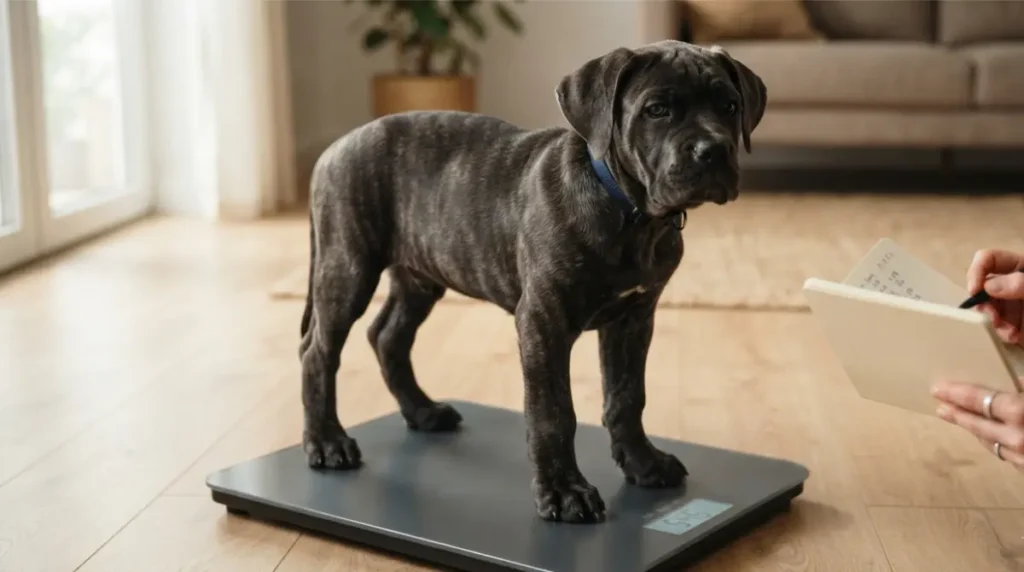
Weigh every 2 to 4 weeks until six months, then every 1 to 3 months until full grown, on the same scale. Weigh yourself, then yourself holding your puppy, and subtract; when lifting gets hard, use your vet clinic’s scale.
Picking the right curve
📊 Tested / Spec: WALTHAM sizes curves by expected adult weight: large is 66–88 lb, giant is 88–105 lb, and above that is a third group.
Most adult Corsos fall near the giant group, some females in the large one. Parents’ weights help; you can switch curves later.
✅ Do This: If your puppy’s weights cross two curves, call your veterinarian and bring your weigh-in log.
When does a Cane Corso stop growing?
How long growth really lasts
Breed guides say a Cane Corso stops growing anywhere from about 15 to 24 months. WALTHAM’s curves put dogs of 66 to 88 pounds at full size around 18 months and giants at nearly two years.
Growth timing and neutering
AAHA’s spay and neuter timing guidance says large-breed dogs should wait until growth stops: about 9 to 15 months for males and 5 to 15 for females. WALTHAM notes neutering can affect growth rates.
✅ Do This: Ask your veterinarian to set the date for your puppy’s size and sex, and ask what they mean by “done growing.”
Feed for steady growth, not maximum size
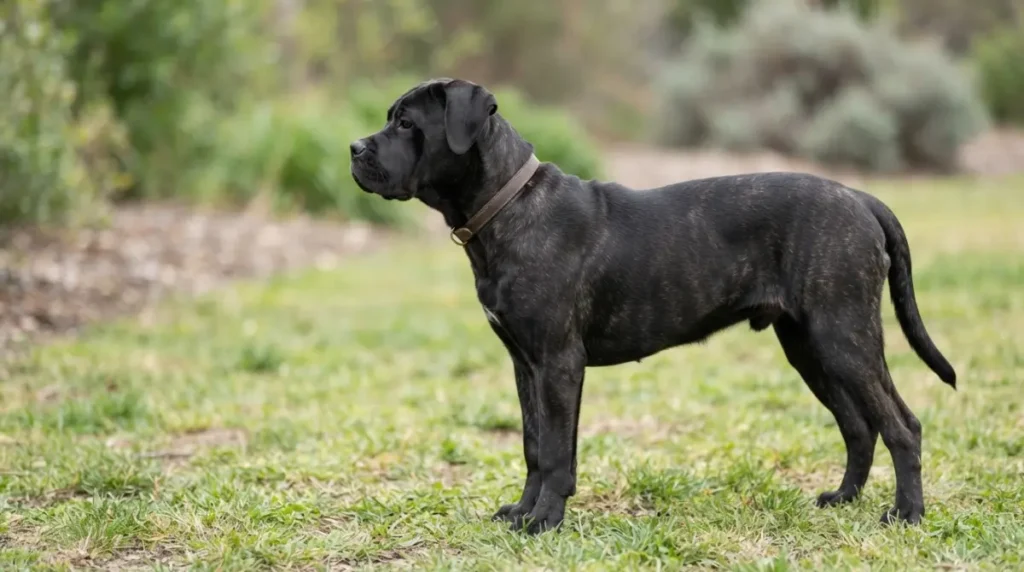
What steady growth looks like
- Choose a large-breed puppy formula, follow its label, then adjust with your veterinarian.
- Count training treats as food.
- Skip “bulking up”; the parent club calls nutrition and avoiding obesity critical for hip health.
- Ask your vet to score your puppy’s body condition and explain what healthy feels like, since scoring is tricky in puppies.
Why faster isn’t better
🔍 Why It Works: Extra calories speed growth, and in large breeds the skeleton can lag behind the added weight. WALTHAM also links puppies that grow too fast to obesity risk.
Most vets keep large-breed puppies on growth food until about 18 months, so ask yours when to switch.
What these weights mean in a house with kids
Supervision at four to six months
At six months, the table puts a Corso at 55 to 65 pounds: a puppy’s judgment in a large dog’s body.
🏡 Family & Home: At that weight, a bump or a jump can knock a small child over by accident. Keep your puppy on a leash or behind a gate around toddlers, keep an adult actively watching whenever child and dog share a room, and never leave any dog alone with a baby or toddler.
Size the crate for the adult dog
Buy the crate for adult size and use a divider while your puppy grows; a two-month crate is outgrown fast. Our crate size chart by measurement shows how to measure.
Growth red flags: when to call your vet
Weight patterns worth a call
Call your vet this week if weights cross two curves, or if a full-grown dog’s weight changes by more than 5 percent.
Limping and joint worries
If your puppy won’t put weight on a leg, or the leg looks swollen, call your vet today. A limp that fades but returns belongs at your next visit, or sooner. The parent club’s health page calls hip dysplasia fairly common in the breed and warns that extensive or inappropriate exercise can damage growing joints, so keep exercise moderate.
✅ Do This: Tell your vet your puppy’s age, your weight log, what and how much your puppy eats, and when the limp started.
FAQ: Cane Corso growth questions
1. How much should a 6-month-old Cane Corso weigh?
Published Cane Corso growth chart ranges put six-month males near 60–65 pounds and females near 55–60; your puppy’s own curve matters more.
2. When is a Cane Corso fully grown?
Breed guides say about 15 to 24 months; WALTHAM puts dogs this size between 18 months and nearly two years. Your vet can confirm.
3. How much does a Cane Corso weigh at one year?
Guides range from roughly 85 to 115 pounds on a Cane Corso growth chart, females lighter, so track your puppy’s curve.
4. Do male Cane Corsos weigh more than females?
Yes. Charts and the Canadian standard list males heavier, and WALTHAM says males grow faster, so use sex-specific growth curves.
5. Is my Cane Corso puppy too big for its age?
Not necessarily. Charts disagree by 10 pounds or more; check whether your puppy stays on one curve, and call your vet if it crosses two.
6. How do I weigh a Cane Corso puppy at home?
Weigh yourself, then yourself holding your puppy, and subtract. When lifting gets hard, use your vet clinic’s scale.
7. How often should I weigh my Cane Corso puppy?
Every 2 to 4 weeks until six months, then every 1 to 3 months until fully grown, always on the same scale.
8. When should a Cane Corso stop eating puppy food?
Most vets keep large-breed puppies on growth formula until about 18 months; ask your veterinarian when to switch your Cane Corso.
9. Does neutering affect Cane Corso growth?
It can. AAHA advises waiting until growth stops for large breeds, about 9 to 15 months for males; your veterinarian sets the date.
10. Can I bulk up my Cane Corso?
No. Extra calories speed growth and raise obesity risk, so follow your vet’s feeding guidance and keep your Cane Corso growth chart steady.
Your next weigh-in
Log today’s weight, repeat on schedule, and watch the trend, not one chart. At your next vet visit, ask when your puppy will be done growing and when to switch foods. Still deciding on the breed? Try our six honest questions or the Cane Corso family-fit guide.
Every figure here is sourced or labeled a breed-guide estimate. We have no veterinarian on staff, so confirm health questions with yours.