Cane Corso Toddlers Need Clear House Rules, Ages 1 to 4

Cane Corso toddlers can share a home with rules. Adding a dog? Consider waiting until your child is older than 4. Already have one? Start here.
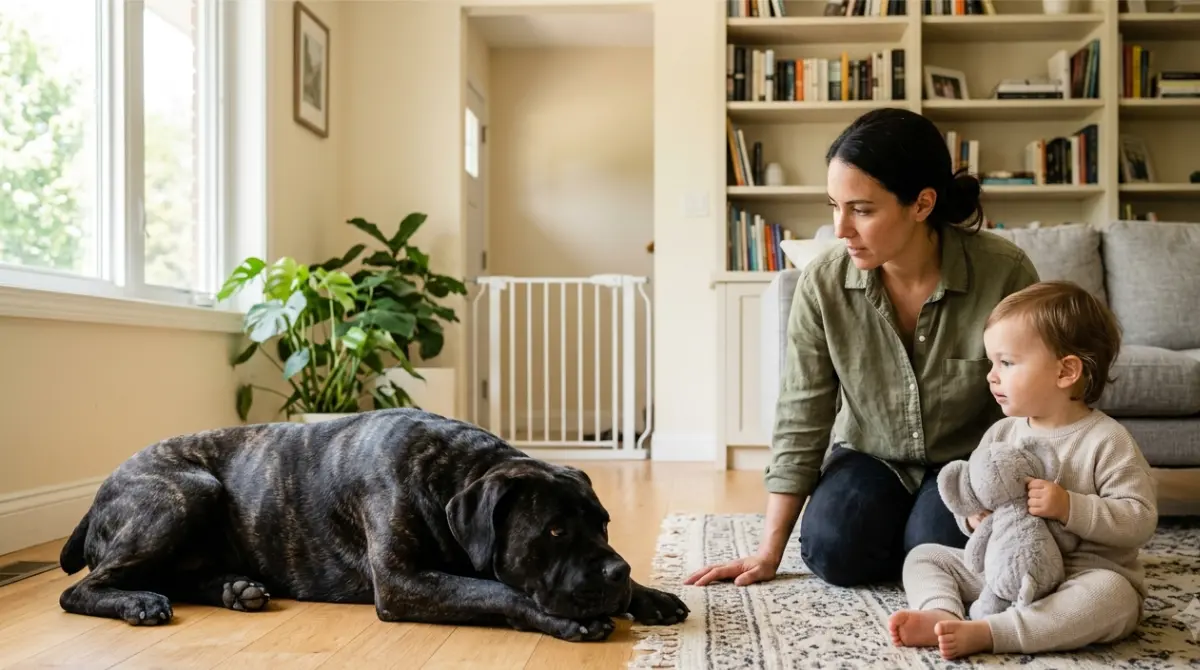
Table of Contents
Cane Corso and toddlers: start with your situation
Yes, a Cane Corso and a toddler can share a home, but only with management: an adult within arm’s reach, or a closed barrier, every time. The AVMA says any dog can bite, and breed doesn’t decide it.
If you already have both at home
Puppy or grown adult, the rules below apply the same way. Start with the arm’s-reach rule, then set up your zones.
If a baby or puppy is still to come
Still deciding? Our look at whether Cane Corsos are good family dogs comes first. The AVMA suggests waiting until children are older than 4 before adopting a new dog, and says to manage introductions carefully.
🩺 Vet Note: This is general safety guidance, not advice for your dog or child. Pain, illness, and your dog’s history with children all change bite risk, so ask your veterinarian, and a qualified behavior professional if needed, about your own dog.
Arm’s reach or a barrier: the rule behind every other rule
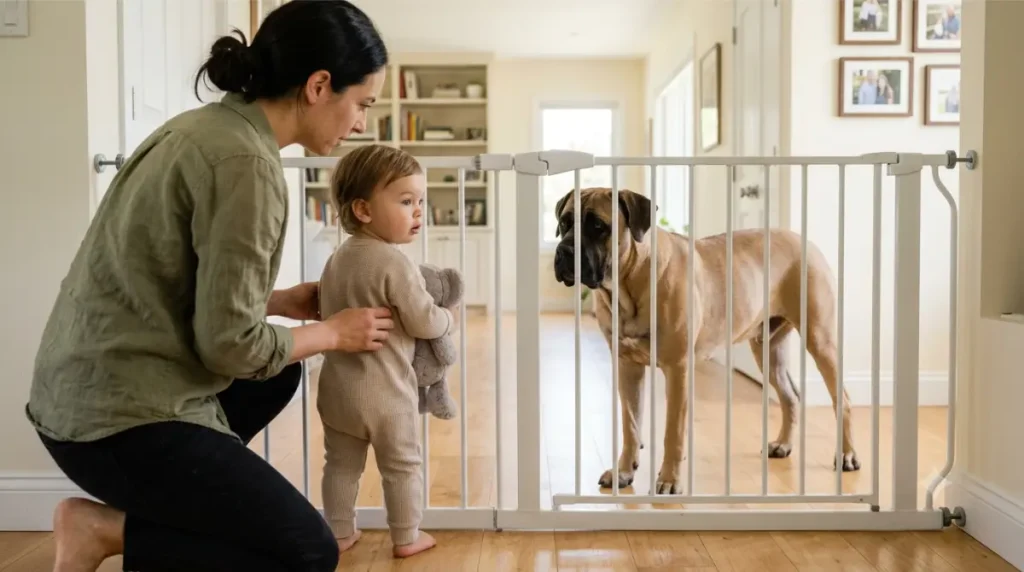
No. The AVMA says never leave a baby or small child alone with a dog, and the CDC says to supervise even trusted family pets, a Cane Corso included. Check three things:
- Is an adult within arm’s reach, watching both?
- If not, is a closed barrier between them?
- If neither, separate them now.
What active supervision looks like
Eyes on both, and one step from touching your toddler. A guarding instinct isn’t supervision.
Our judgment: a phone call, cooking with your back turned, or a toddler asleep doesn’t count.
What counts as a barrier
A closed gate, door, or crate your toddler can’t open.
🏡 Family & Home: Cooking alone? Put the dog behind a closed gate before you start, not after your toddler wanders in.
Three zones that let the house enforce the rules
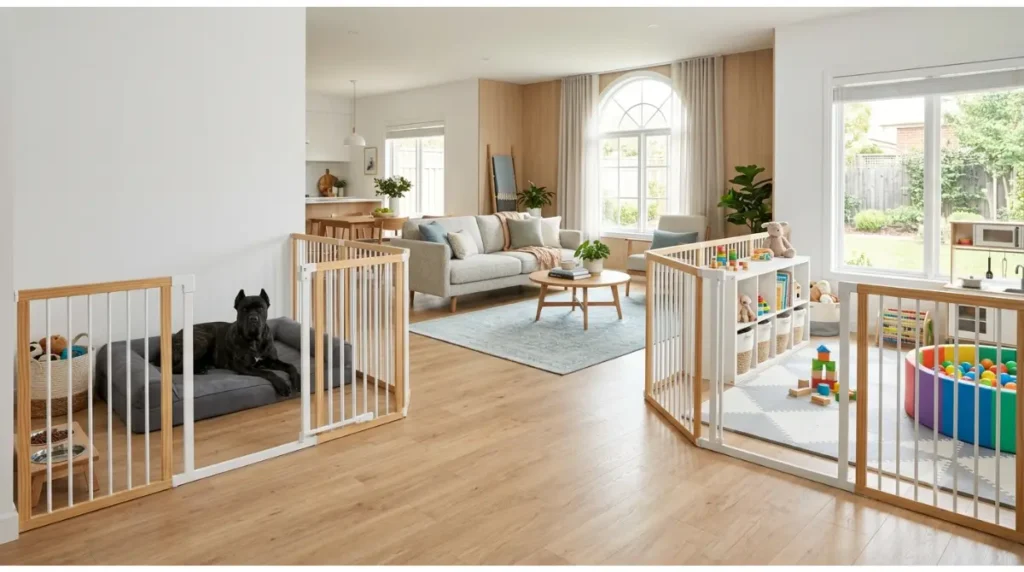
This layout is our design, built on the AVMA’s never-alone rule.
Dog-only, shared and child-only zones
Make a dog-only zone (a gated room or crate area), a shared zone (an adult within arm’s reach), and a child-only zone (a gated play space with no dog access). NC State’s veterinary behaviorist advises giving the dog a safe place out of the children’s reach.
Bedrooms, stairs and the kitchen
Keep the dog out of your toddler’s room at nap time and overnight; under the AVMA rule, a sleeping child is still alone with the dog.
When a visiting toddler comes over
For visiting toddlers, the dog stays gated until an adult takes charge. For the crate itself, see our one-rule guide to a dog crate and a toddler.
🏡 Family & Home: Open-plan home? Use one gate across the living area rather than one per room.
Mealtimes, chews and naps: where toddler-dog trouble starts
The CDC notes most bites to young children happen in everyday moments with familiar dogs.
Food: dropped snacks, high chairs and the dog bowl
The AVMA lists guarding food, toys, or puppies as common reasons dogs bite, so feed your Cane Corso behind a closed gate, away from where your toddler eats.
Chews, toys and the sleeping dog
Give chews in the dog-only zone, and never let your toddler disturb a dog that is eating, sleeping, or hiding.
🏡 Family & Home: Keep tickling and wrestling away from the dog’s zone. The AVMA advises avoiding wrestling with dogs, and we extend that to rough play nearby.
✅ Do This: If your dog stiffens or guards food near your toddler, call your veterinarian today, since pain can raise bite risk, then ask for a behavior professional.
Toddler rules by age: what a 1-, 2- and 3-year-old can do
The AVMA says to teach even toddlers to be careful around dogs, but supervision does most of the work.
| Age (approx.) | What toddlers do | The rule |
|---|---|---|
| About 1 | Crawl, grab, pull up | Never alone; barrier or arm’s reach |
| About 2 | Hug, poke, run, drop food | “Gentle”; no hugging, climbing or riding |
| 3–4 | Repeat rules, then forget | Pet only if the dog comes over and an adult says OK |
Management guide, not a developmental chart; ages approximate; rules are our design.
Crawlers and new walkers
Management does the work: gate, arm’s reach, never alone.
Two-year-olds
Use short words, redirect, and praise leaving the dog alone.
Three- and four-year-olds
They can say the rules but can’t keep them, so the adult stays.
🏡 Family & Home: Older siblings and visiting kids follow the same card.
Signals to act on and cues to teach your Corso
Your dog usually signals early that it needs space.
Signals that mean “give the dog space”
The AVMA lists yawning, ears back, a raised paw, a tucked tail, stiffening, and staring as signs of worry or fear. A growl, snap, or bite means the dog wants to be left alone, so calmly separate them and don’t scold the growl.
Cues to teach, reward-based
AVSAB recommends only reward-based training. Teach “place,” “leave it,” and a calm greeting with treats, never force.
See our week-by-week puppy socialization plan and calm greetings at the front door.
✅ Do This: Mention new or sudden signals to your veterinarian this week, and book a certified reward-based trainer for the cues.
🏡 Family & Home: The nearest adult calmly moves your toddler away and sends the dog to its zone.
If your Cane Corso growls, snaps or bites your toddler
🚨 If This Is Happening Now: If your dog has bitten your child, get your child medical care now. If your dog is growling, snapping, or stiffening toward your child, separate them calmly and call your veterinarian today.
What to do right now
Separate them with a gate or closed door until a professional has assessed your dog. Don’t scold a growl: the AVMA says it means the dog wants to be left alone. A new freeze or hard stare calls for your veterinarian this week.
Who to call and what to tell them
Call your veterinarian first, since the AVMA notes pain can raise bite risk, then ask for a veterinary behaviorist or certified behavior consultant.
✅ Do This: Tell them your child’s age, what your child was doing, your dog’s body language, how often it has happened, and its health history.
🏡 Family & Home: A gate or crate is the plan, not a punishment.
Cane Corso toddler questions, answered
1. Are Cane Corsos good with toddlers?
Only with management. A Cane Corso and a toddler need an adult within arm’s reach or a closed barrier, every time.
2. Can I leave my Cane Corso alone with my toddler?
No. The AVMA says never leave a baby or small child alone with a dog, and that includes your Cane Corso.
3. At what age is a child old enough for a Cane Corso?
No age guarantees fit. Before adding a Cane Corso to a toddler home, the AVMA suggests considering waiting until children are older than 4.
4. How do I introduce my Cane Corso to my toddler?
Introduce your Cane Corso to your toddler with an adult within arm’s reach and a barrier ready. The AVMA says to manage introductions carefully.
5. Will my Cane Corso protect my toddler?
A guarding instinct is a tendency, not supervision. Your Cane Corso can’t replace an adult within arm’s reach of your toddler.
6. Can a toddler hug, climb on or ride a Cane Corso?
No. Our rule is no hugging, climbing or riding a Cane Corso, and an adult stays within arm’s reach of the toddler.
7. What do I do if my Cane Corso growls at my toddler?
Separate your toddler and Cane Corso calmly, don’t scold the growl, and call your veterinarian today. A behavior professional comes next.
8. How do I stop my Cane Corso jumping on my toddler?
Teach your Cane Corso a calm greeting and “place” with treats, never force, while a barrier or an adult within arm’s reach protects your toddler.
9. Can my Cane Corso sleep in my toddler’s room?
Not alone with your toddler. Under the AVMA’s never-alone rule, your Cane Corso stays in its own zone while a child sleeps.
10. Should my Cane Corso eat while my toddler eats?
No. Feed your Cane Corso behind a closed gate, not where your toddler eats; the CDC says not to feed dogs where food is eaten.
A calmer house starts with one rule
You now have a rule, a layout and a routine for your Cane Corso and toddler. For the bigger picture, see the ready-or-wait checklist in whether a Cane Corso fits your family.
If your dog has growled, snapped or stiffened near your child, call your veterinarian this week to rule out pain. We drew on AVMA, CDC, AVSAB and veterinary-school guidance, tested nothing on a Cane Corso, and have no veterinarian on staff.