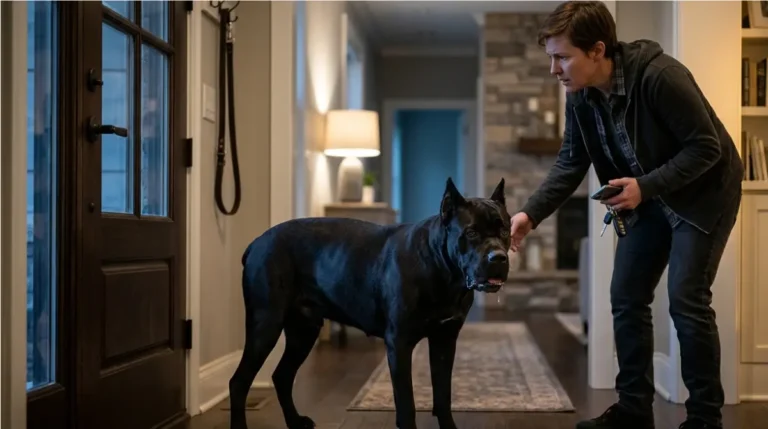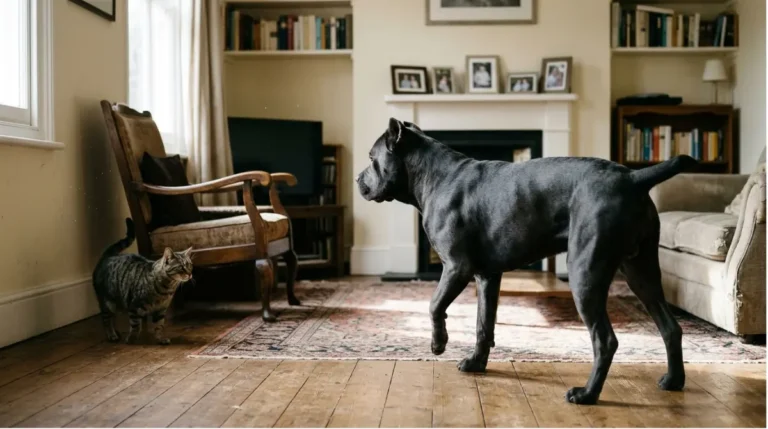
Cane Corso Guarding Visitors? A Gentle Plan for the Front Door

Cane Corso guarding visitors starts at the door. See four rungs, from no greeting at all to a brief hello your dog chooses, and where kids fit.
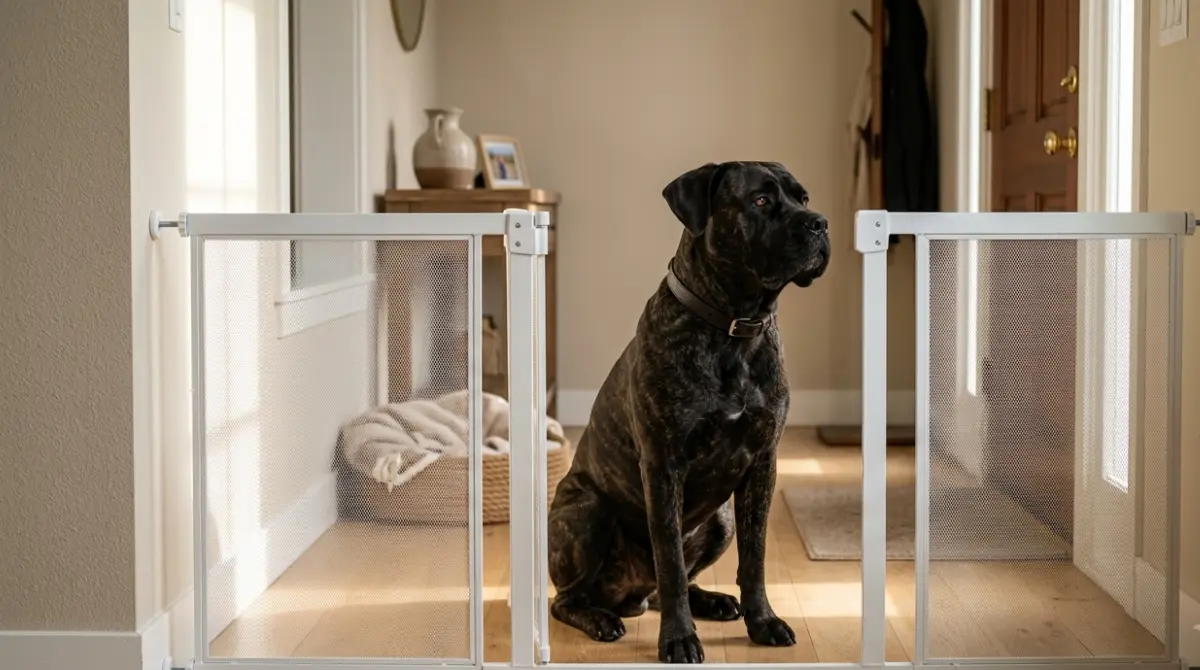
Table of Contents
Should your Cane Corso greet guests at all?
For many Cane Corsos, the kindest plan is no greeting at all. The AKC breed standard calls the breed unequaled as a protector of its property and owners, and docile and affectionate with its own family, while breed profiles describe many as wary of strangers. Those are tendencies; your dog’s history, training and setup decide what happens at the door.
If your Cane Corso is still a puppy
Start with the door setup below, then add the mat routine.
If your dog already barks hard or lunges
If your dog has lunged, snapped or bitten, skip to the last section before anyone else visits.
If kids or a baby live in the house
Children living here or visiting? See how Cane Corsos fit each child age band, then the family section.
🩺 Vet Note: This is general information about behavior and household safety, not advice for your dog. Pain or illness can change how a dog behaves, and young children should never be left alone with any dog. Confirm decisions with your veterinarian and a qualified behavior professional.
Set up the door before the doorbell rings
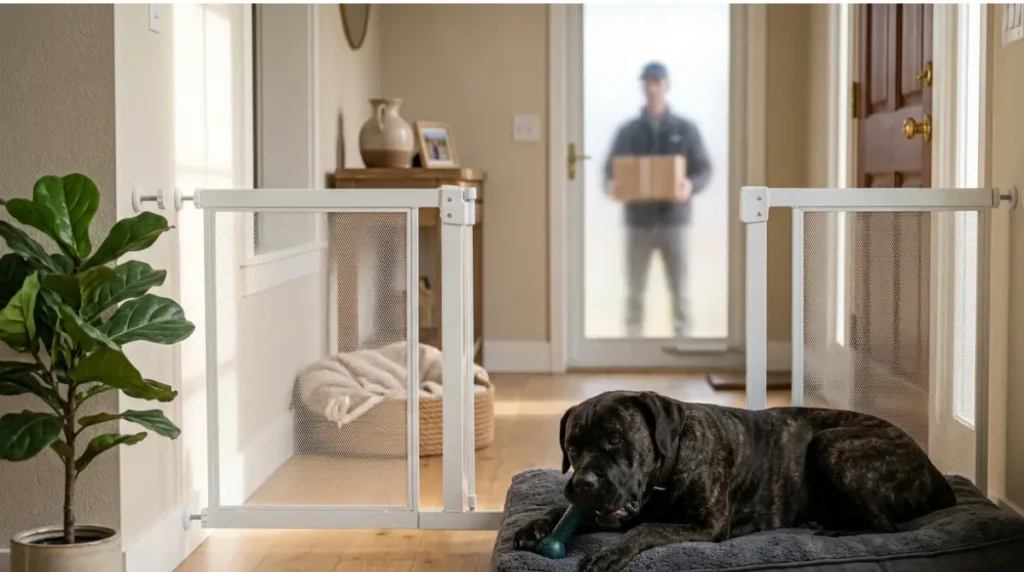
Decide where your dog will be before anyone rings the bell.
Gate, crate or closed door first
Before the door opens, put your Cane Corso behind a gate, in a crate or in a closed room with a chew. Our guide to crate, playpen or baby gate helps you choose which barrier fits your home.
Deliveries and repair visits
The AVMA’s dog bite prevention guidance says to keep the dog in a separate room, crate or fenced area when you expect a delivery, and to set a delivery spot it can’t reach.
Who holds the leash
Use a leash at the door only if your dog has never lunged or snapped at a guest, and let an adult hold it, never a child.
🏡 Family & Home: Gate the hallway so the dog’s retreat room, the kids’ zone and the door zone never overlap. Children don’t open the door, and an adult stays within arm’s reach whenever a child and the dog share a space.
Teach a go-to-mat routine for the doorbell
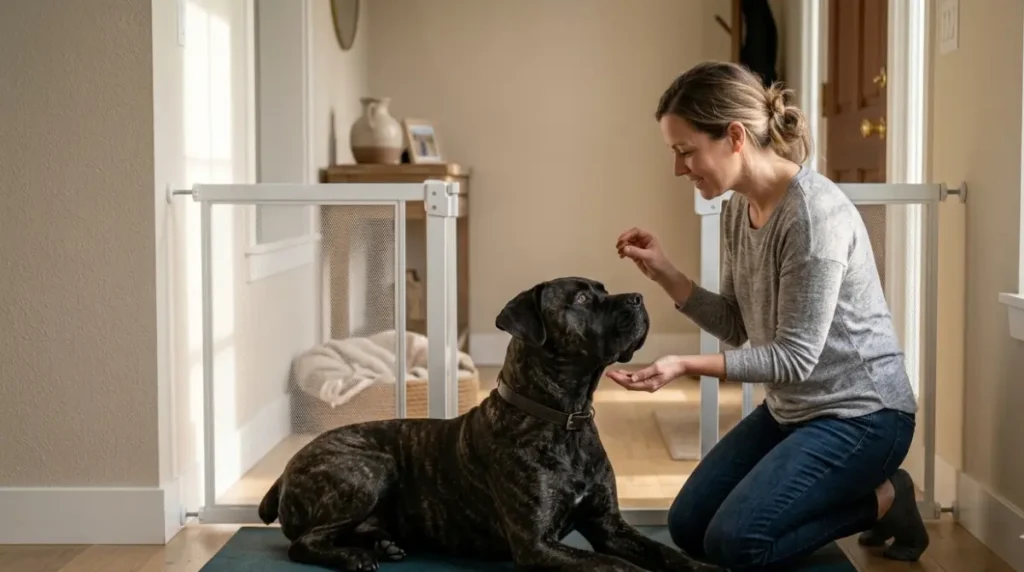
Teach a go-to-mat cue first, add the doorbell sound, then the door. Use treats, never scolding: AVSAB’s humane training statement recommends reward-based methods only.
Teach the mat away from the door
Reward your dog for settling on a mat, then for staying a few seconds.
Add the doorbell sound
Play a recorded doorbell, cue the mat, and reward.
Add the door and a helper
Open the door a crack, then add a helper outside. Our 12-week puppy plan covers mat settle and door waiting.
| Doorbell Ladder (our framework; fail a rung, go back one) | Move on when |
|---|---|
| 1. Mat away from the door | Holds a short stay |
| 2. Recorded bell | Goes to the mat |
| 3. Real bell | Goes to the mat |
| 4. Door ajar | Stays put |
| 5. Helper enters | Stays, then is released |
🔍 Why It Works: AVSAB says training works best when it teaches the dog what to do rather than punishing what it shouldn’t. A bell that reliably predicts a mat and a treat gives your dog a job at the door.
⚠️ Watch Out: Skip prong and shock collars, shouting, compressed-air cans and leash jerks. AVSAB lists pain, intimidation and physical correction as methods to avoid, and says aggression is no exception.
✅ Do This: If your Cane Corso can’t settle on the mat after steady practice, book a certified trainer (CPDT-KA, KPA-CTP or IAABC) and ask which tools they use. Walk away from anyone who uses pain or intimidation.
How should a guest say hello to your Cane Corso?
Start at the lowest rung where your dog stays calm.
Brief your guests before they arrive
Ask guests to ignore the dog, approach slowly without looming, avoid direct eye contact, and skip feeding or petting unless you say so, per the AVMA.
The greeting ladder: skip, mat, leash, release
| Greeting Ladder (our framework, not a veterinary standard) | What happens | Move up after |
|---|---|---|
| 0. Skip | Gate or crate, with a chew | Relaxed visits |
| 1. Mat | Dog on mat; guests ignore it | Calm visits |
| 2. Leash | Adult holds leash; no touching | Calm visits |
| 3. Release | Dog chooses a brief hello | — |
Let the dog choose, and end early
Let your dog choose: CDC guidance says to let a dog approach first and to stop petting if it seems scared, sick or angry. After any growl, snap or lunge, don’t climb a rung; read the last section.
🏡 Family & Home: Keep a three-line card by the door: adults ignore the dog and follow your lead, nobody feeds the dog, and children ask a grown-up before going near it.
Visiting kids, your own kids and the front door
Children raise the stakes at the door, so adults run it.
A visiting child meets your dog
The CDC’s guidance on dogs and children says children are more likely than adults to be bitten and that their injuries tend to be more severe. Keep the dog gated or crated whenever a visiting child is there, unless an adult is within arm’s reach.
Your own kids at the door
One adult answers the door while another holds the leash or keeps the dog gated. Children never open the door or hold the leash. The crate and toddler rule covers the dog’s retreat space.
Tell grown-up guests the rules
Tell visiting adults first: gate stays shut, no feeding the dog, no wrestling. Never leave a baby or small child alone with any dog.
🏡 Family & Home: Use three zones: dog-only (gated room or crate), shared with an adult within arm’s reach, and child-only. A visiting child and your dog share the middle zone only with an adult beside them.
✅ Do This: If your dog has growled at a child, separate them now and call your veterinarian today, then ask for a behavior professional (see the last section).
Barking and jumping at the door: what’s normal?
Expect some alert barking: the AKC standard says the breed has always been a property watchdog.
Barking at the door
Barking that eases once your dog reaches its mat is ordinary alerting. Skip the shouting; AVSAB lists it as intimidation to avoid. Cue the mat, reward quiet, and keep the gate closed until it settles.
Jumping and leaning on guests
A large Cane Corso can knock a guest or child off balance, so reward four paws on the floor and let the gate handle the bounce. A stiff body and hard stare is different: the AVMA says it can signal fear or threat, so go to the last section.
When it’s more than barking: signs to act on
🚨 If This Is Happening Now: A person has been bitten, or your dog has lunged or snapped. Separate dog and people with a gate or closed door, get medical care for the person first, then call your veterinarian the same day. Don’t punish your dog, and follow local rules on reporting bites.
Some door behavior needs professionals, not more practice.
Signs that need help now
- Bite or snap: medical care for the person now; your vet the same day.
- Growling, or a stiff, staring body: call your vet within a few days.
- Ongoing fear or hiding at visits: call your vet this week.
What to do and who to call
Gate your dog away from guests and pause visits until a professional has assessed it. Call your vet first, since pain or illness can contribute. Then ask for a veterinary behaviorist or certified behavior consultant. AVSAB advises against punishment, with no exceptions. Tell them what happened, who was there and your dog’s history.
🏡 Family & Home: Keep dog and children apart until a professional has assessed the dog, and let an adult handle the door in the meantime.
Cane Corso and visitors: quick answers
1. Will a Cane Corso guard the house against visitors?
Some alert barking fits the AKC’s property-watchdog description of the breed. Lunging or snapping at visitors does not; call your vet the same day.
2. Are Cane Corsos good with guests?
Breed profiles call many wary of strangers, so calm Cane Corso greetings depend on the individual dog, its training and your setup. Skipping the greeting is fine.
3. Should I put my Cane Corso away when guests come?
Yes, as a default: gate or crate your Cane Corso with a chew before the door opens. An adult decides on any hello.
4. How do I stop my Cane Corso barking at the doorbell?
For a Cane Corso, teach a go-to-mat cue, then add a recorded doorbell, the real bell and the door, rewarding each success.
5. How do I introduce my Cane Corso to a new person?
Start at the lowest calm rung: gate, mat, leash, then a brief hello your Cane Corso chooses. Guests ignore the dog and never loom.
6. Should guests pet my Cane Corso?
Only if you say so and your Cane Corso approaches first. Guests should stop petting if it seems scared, sick or angry, per CDC guidance.
7. Can my Cane Corso be around visiting children?
Only with an adult within arm’s reach; otherwise gate or crate your Cane Corso. Never leave a baby or small child alone with any dog.
8. How do I stop my Cane Corso jumping on guests?
For a Cane Corso, reward four paws on the floor and use a gate or leash to block the bounce. Avoid shouting and leash jerks.
9. Why does my Cane Corso growl at visitors?
Pain or illness can contribute to a Cane Corso growling at visitors, and a stiff, staring body can signal fear or threat. Call your vet within a few days, or the same day after a snap or bite.
10. Is a prong or shock collar okay for door manners?
No. AVSAB advises reward-based methods only and lists pain-based tools, shouting and leash jerks among methods to avoid for any Cane Corso.
Your door plan for this week
You now have a door plan: a barrier, a mat routine and a ladder that starts at no greeting. This week, set up the gate and brief your next guest, then see how Cane Corsos fit family life in our pillar guide. If your dog has lunged, snapped or bitten, call your vet the same day. Safety claims trace to the sources linked here; nothing was tested on a Cane Corso.