Gentle Cane Corso Leash Training for a Dog That Pulls

Cane Corso leash training gets harder as males near 80 lb at 8–10 months (breed-guide estimates). See the steps and harness research.
Table of Contents
Why a Cane Corso pulls, and when it gets hard to hold
Cane Corso pulling is usually a training gap, not stubbornness, according to UC Davis. Pulls caused about 54% of an estimated 356,746 leash injuries to people in U.S. emergency-room data, 2001–2018.
If your puppy is new
Start with the how-to steps below.
If your dog is already dragging you
Breed-guide estimates put males near 70–80 lb at eight months and 85–95 at ten (the AKC sets no weight), so “80+ pounds” arrives around 8 to 10 months in males and later in females (weight-by-month ranges). That size makes every lunge a safety issue.

🩺 Vet Note: General information, not advice for your dog. Ask your vet about collar comfort, safe exercise for a growing dog, and any growl or lunge at people.
Why reward-based leash training works on a strong dog
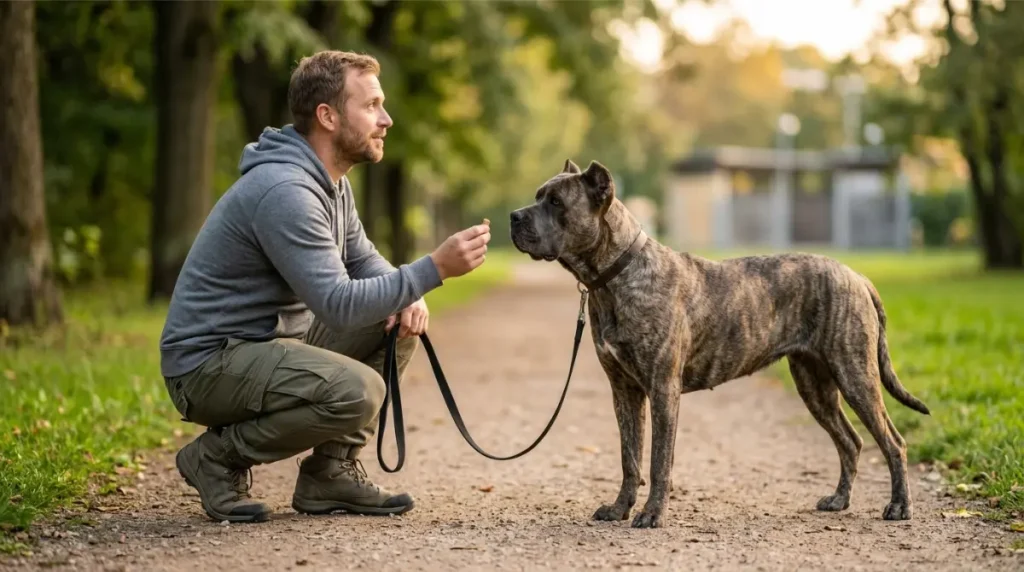
Pulling works because it gets the dog where it wants to go; reward-based training makes a loose leash pay.
Why pulling keeps working for your dog
🔍 Why It Works: Each step on a tight leash teaches your dog that tension moves the walk forward.
What AVSAB says about prong, choke and shock tools
A strong dog makes quick fixes tempting, but the American Veterinary Society of Animal Behavior (AVSAB position statement) recommends only reward-based methods and says to avoid choke chains, prong collars, shock collars and leash jerking. It found no evidence aversive methods are necessary.
Why “just be the alpha” advice fails
AVSAB also names “alpha rolls” and “dominance downs” as methods to avoid, and advises against trainers who rely on “alpha” theories. Teach your dog what to do instead.
How to teach loose-leash walking, step by step
Loose-leash walking has one rule: stop when the leash tightens, wait for slack, then reward at your side, the approach UC Davis’s veterinary school teaches.
Set up: a quiet space, a fixed-length leash and treats
Start somewhere boring, with treats and a leash short enough to keep your dog near you.
⚠️ Watch Out: Never wrap the leash around your hand or wrist; a lunge can trap it and cause injury.
Stop when it tightens, reward when it slackens
- Reward two relaxed steps beside you.
- Leash tightens? Stand still like a tree.
- Slack and back at your side? Reward, then walk on.
Change direction, then add distractions
Still pulling? Turn and walk the other way with no tug, and reward when your dog catches up with slack. Add distractions gradually. Stop every time.
Puppies: start with our 12-week puppy training plan.
🏡 Family & Home: An adult holds the leash; a child can carry treats beside them.
Harness, collar or head halter: what the research shows
What the 2025 review found for dogs that pull
A 2025 review of collars, harnesses and head collars found no single best device, but for dogs that pull, non-tightening front-clip harnesses gave the best comfort-to-pulling balance. We found no Cane Corso-specific study.
Back-clip, front-clip, collar and head halter compared
| Device | Research | Our call |
|---|---|---|
| Front-clip harness | Less pulling; no extra neck pressure | First choice |
| Back-clip harness | Dogs pulled more than in a collar | Non-pullers |
| Flat collar | Neck pressure rises when pulling | Loose walkers |
| Martingale, tightening harness, head halter | More discomfort | Last resort |
| Prong, choke, shock | AVSAB advises against | Skip |
Source: the 2025 review above and AVSAB. “Our call” is the Editorial Team’s judgment, not a test result.
Fit checks and what to skip
Fit one or two fingers under a harness. The review found lab pressure data, not injury rates, so treat collar risks as potential.
🏡 Family & Home: Adults fit and clip all equipment; kids never adjust a harness.
✅ Do This: At your next checkup, ask your vet to check the fit and any eye, neck or breathing concern.
Puppy, teen or adult: where to start at your dog’s age
8 to 16 weeks: start indoors
Clip a light leash on indoors and reward a few steps.
6 to 18 months: size jumps, rules don’t
A teen Corso can look full-sized while still growing. Stick to walks and training games; growing joints need moderate exercise, and no jogging until your vet confirms growth is finished (exercise by age guide).
An adult who already pulls: start somewhere boring
Use the same steps in a quiet place, adding distractions gradually. We found no Cane Corso timeline, so track sessions, not weeks.
✅ Do This: At your next checkup, ask your vet whether growth is finished and when running is okay.
Who should walk a Cane Corso: kids, grandparents and you
Who holds the leash is a safety decision.
Adults hold the leash, kids help from beside
🏡 Family & Home: Children never hold the leash, and young children are never left alone with the dog. They can carry treats beside an adult who stays within arm’s reach. See our child-age supervision guide.
The “can you hold it?” check for any walker
A JAMA Surgery study found US emergency-room fractures in people 65 and over walking leashed dogs rose from 1,671 in 2004 to 4,396 in 2017; it recorded no dog sizes. If a sudden lunge could pull you off balance, don’t hold the leash alone (our judgment).
✅ Do This: Can’t hold your dog with a relaxed arm? Book a certified trainer (CPDT-KA, KPA-CTP or IAABC) this week.
One set of walking rules for every adult
Same cues, same stop rule, same equipment.
When pulling is really lunging: signs and who to call
🚨 If This Is Happening Now: Your dog has bitten or snapped at someone, or lunged with a growl or hard stare. Put distance between dog and people now; for a bite, get medical care first, then call your vet the same day.
Signs this is more than pulling
A growl, hard stare, snap or bite isn’t a pulling problem; fear, anxiety or aggression need a veterinary behaviorist’s assessment, says UC Davis. See our warning signs after a growl or bite.
Who to call and what to tell them
Call your vet first, to check for medical causes, then ask for a veterinary behaviorist or certified behavior consultant. Tell them your dog’s age, when it started, what happened just before, and any limping or yelping.
Why gear won’t fix it
Equipment manages a walk but won’t treat the cause, and AVSAB advises against aversive methods.
🏡 Family & Home: After any growl, snap or bite, keep dog and children apart until a professional weighs in; one adult walks the dog.
Cane Corso leash training questions, answered
1. How do I start Cane Corso leash training?
Cane Corso leash training starts in a quiet place: reward a few relaxed steps beside you, then add distractions gradually.
2. How do I stop my Cane Corso pulling?
Stop when the leash tightens, wait for slack, then reward at your side; walking on while your Cane Corso pulls teaches it to pull.
3. Is a harness or collar better for a Cane Corso?
A 2025 review favors a non-tightening front-clip harness for dogs that pull; we found no Cane Corso-specific study. Ask your vet to check the fit.
4. Should I use a prong collar on a Cane Corso?
No. AVSAB advises against prong, choke and shock collars for any dog, including a strong Cane Corso, and found no evidence aversive methods are necessary.
5. Can an adult Cane Corso learn loose-leash walking?
Loose-leash walking uses the same reward-and-stop steps for an adult Cane Corso: start in a quiet place and add distractions gradually.
6. How long does Cane Corso leash training take?
We found no Cane Corso leash training timeline, so track sessions, not weeks, and stop every time the leash tightens.
7. Can kids walk a Cane Corso?
Children shouldn’t hold a Cane Corso’s leash; an adult does, within arm’s reach, and young children are never left alone with the dog.
8. What if my Cane Corso is too strong for me to hold?
If a lunge could pull you off balance, don’t hold the leash alone: use a non-tightening front-clip harness and book a certified trainer.
9. Why does my Cane Corso lunge at people or dogs?
Lunging at people or dogs may signal fear, anxiety or aggression, which need a veterinary behaviorist’s assessment before leash training. Call your vet first.
10. How big is a Cane Corso when pulling gets hard?
Breed-guide estimates put a male Cane Corso near 70–80 pounds at eight months and 85–95 at ten; the AKC sets no weight.
Where to start this week
You have a method and a way to spot more than pulling. This week, pick one adult handler, fit a non-tightening front-clip harness and practice stop-and-reward somewhere quiet.
At your next checkup, ask your vet to check the fit; after any growl, snap or bite, call the same day. The Cane Corso family guide covers child ages. We cite our sources; nothing here was tested on a Cane Corso.