Can a Cane Corso live in an apartment? What decides it

A Cane Corso puppy of 8 to 10 weeks needs to go out about hourly, so a walk-up means many stair trips. Size, stairs and hallways for apartment life.
Table of Contents
Many Cane Corsos can live in an apartment, because the breed club’s requirements never mention a yard: a brisk walk of a mile or more every morning and evening, at least 20 minutes a day of training or work, and a dog that lives indoors with its family (Cane Corso Association of America). What decides it is the building itself, from the stairs between your door and the grass to the strangers your dog passes in the hallway.
For a puppy under 3 months, the stairs matter most. For an adult, the hallway does.
How big an adult Cane Corso gets
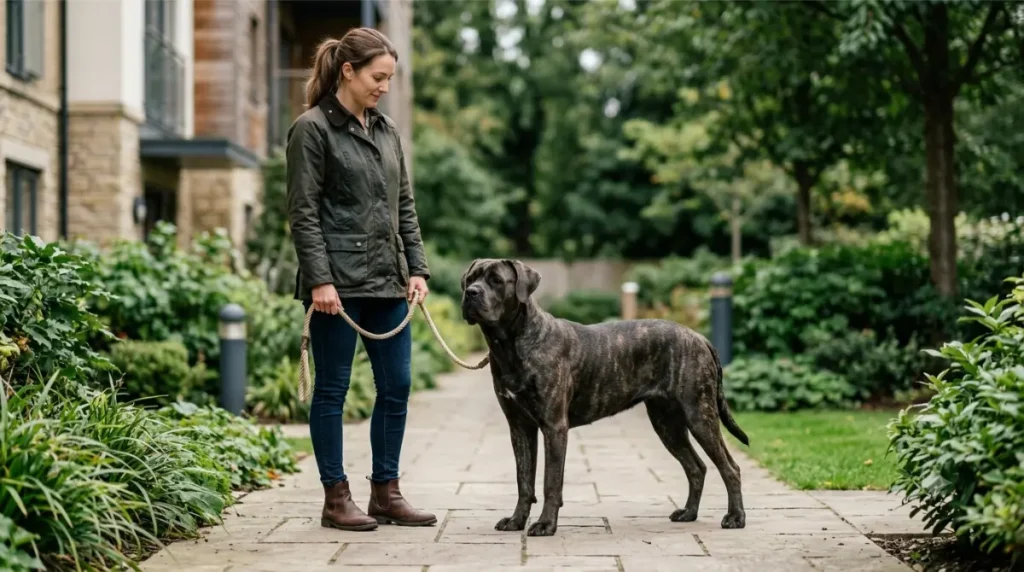
Males stand 25 to 27½ inches (63.5 to 69.8 cm) at the withers and females 23½ to 26 inches (59.7 to 66.0 cm), according to the AKC breed standard. The two other official sources do put a number on weight, and they don’t agree.
| Source | Adult male | Adult female |
|---|---|---|
| AKC standard (US) | No figure; weight proportionate to height | No figure |
| FCI Standard No. 343 (international) | 99 to 110 lb (45 to 50 kg) | 88 to 99 lb (40 to 45 kg) |
| Cane Corso Association of America | About 110 lb or more (one figure for the breed) | Same figure |
Sources: AKC official standard, FCI-Standard No. 343, CCAA.
Some apartment roundups call the Corso medium-sized. Both standards describe a medium-large mastiff type, and the FCI weights put a grown male close to or past 100 pounds. That is the figure a pet application wants when it asks for expected adult weight, and a 16-week-old puppy that fits under a building’s cap today will not stay under it.
Rental breed lists, weight caps and getting a landlord’s yes in writing are covered in Cane Corso insurance and lease rules.
Does a Cane Corso need a yard?
“Big dog, no yard” is the usual reason renters rule this breed out. The breed club’s guidance runs close to the opposite: a Corso belongs indoors with its people, ideally sleeping in the bedroom at night, rather than out in a backyard or kennel (CCAA).
Time each day is what counts, meaning the two long outings and the training or nose work. Most Corsos tolerate being left home alone, though the same page steers owners whose jobs keep them away much of the day toward a breed less focused on people. If everyone on the lease works long days away from home, that line matters more than square footage.
Puppies get shorter, slower walks several times a day, which double as house-training trips. In a building with stairs, that detail changes the plan. Amounts for each stage, from puppy to senior, are in how much exercise a Cane Corso needs by age.
Walk-up stairs in a puppy’s first weeks home
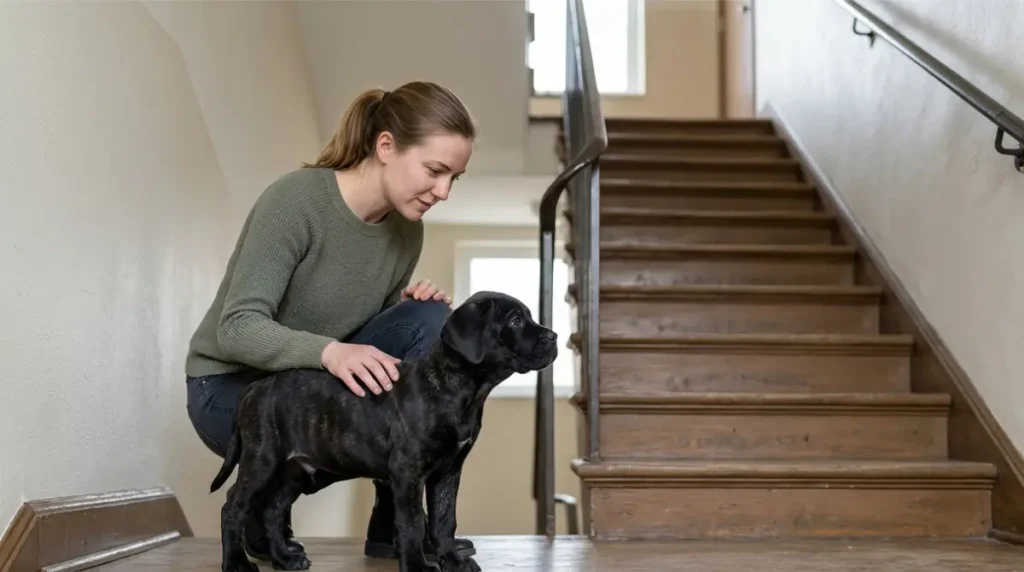
A puppy that comes home at 8 weeks spends about its first five weeks with you inside the window one large study flagged for stairs. That Norwegian cohort followed 501 puppies from 103 litters and found that walking on stairs from birth to 3 months was linked to a higher risk of hip dysplasia on X-ray, while outdoor exercise on soft, uneven ground was linked to a lower risk (Krontveit and colleagues, American Journal of Veterinary Research, 2012).
The puppies were Newfoundlands, Labrador Retrievers, Leonbergers and Irish Wolfhounds. No Cane Corsos were included, and the stair information came from owner questionnaires, so treat the finding as a caution for a puppy of similar size.
Now add house-training. Puppies of 8 to 10 weeks usually need to go out at least once an hour (San Francisco SPCA). If your puppy is awake about 14 hours a day, that is 14 or more trips out and back. Across just those two weeks, 14 trips a day for 14 days comes to 196 or more trips down and up the stairs of a walk-up, before counting any night breaks.
That arithmetic is the strongest case for a ground-floor unit or a working elevator while your puppy is young. Carrying works only for as long as you can do it safely on a staircase. At the bottom, look for grass or dirt rather than pavement for the play part of each outing.
Note: The study did not include Cane Corsos. At your puppy’s first vet visit, describe your building’s stairs and ask how to handle them until 3 months of age.
Once the puppy is older, stairs become a longer-term question about joints and growth, and the screening and feeding evidence for that sits in what lowers hip dysplasia risk in a Cane Corso.
Strangers at arm’s length: hallways and the elevator
A shared hallway puts strangers within a leash length of your door several times a day. For this breed, that is the part of apartment life a house mostly avoids.
Both official standards describe a guardian: an unequaled protector of property and owners in the AKC standard, and a guardian of property and family in the FCI standard. Most Corsos are indifferent to people outside the family and very protective of home, and owners who would be embarrassed by a dog barking at the door are steered toward another breed (CCAA). These are tendencies, and individual dogs vary; early socialization and training shift them in either direction.
The practical answer is distance plus a job to do. Teach a sit-and-watch away from the door first, rewarding it with food, then ask for it when the elevator opens or a neighbor turns the corner. Corsos tend to enjoy training built on positive reinforcement. Wait for an empty elevator when you can, and step into a doorway or a wide spot so others pass with room to spare.
Growling or lunging at a neighbor is different. Stop hallway greetings, call your vet this week to rule out pain, then book a veterinary behaviorist or certified behavior consultant who uses reward-based methods.
With children in the home: An adult holds the leash in every shared space. Children walk beside that adult while neighbors pass, and a neighbor’s child greets the dog only after the adult says yes and the dog looks relaxed.
Barking that carries through a shared wall while you’re out is its own problem, with lease clauses attached; crate placement and barking in an apartment covers it.
Walk the route to the grass before you sign
Do this at the viewing, in order, starting at the unit’s door.
- Count the flights between the door and the street, and ask the manager how long elevator outages usually last.
- Time the walk to the nearest spot where dogs may relieve themselves, and find soft ground close by for a puppy’s play.
- Look at the hallway outside the door for blind corners and a place to step aside.
- Check which walls and floors you share with neighbors.
- Confirm the unit has working air conditioning.
- Ask for the pet policy in writing, naming the breed and the adult weight from the table above, so every adult on the lease can read it.
For the summer side of apartment life, including the signs that mean an emergency vet, see Cane Corso heat and exercise limits. If you are still deciding on the breed itself, start with whether a Cane Corso fits your family and home.
Book the viewing for a weekday morning, when the elevator and hallway are busiest, so you see the building the way your dog will.