An Honest Look at Cane Corso Heart Disease Screening

Cane Corso heart screening can mean a stethoscope or a cardiologist’s ultrasound. Learn which OFA exam a breeder’s paper means, and what it can miss.
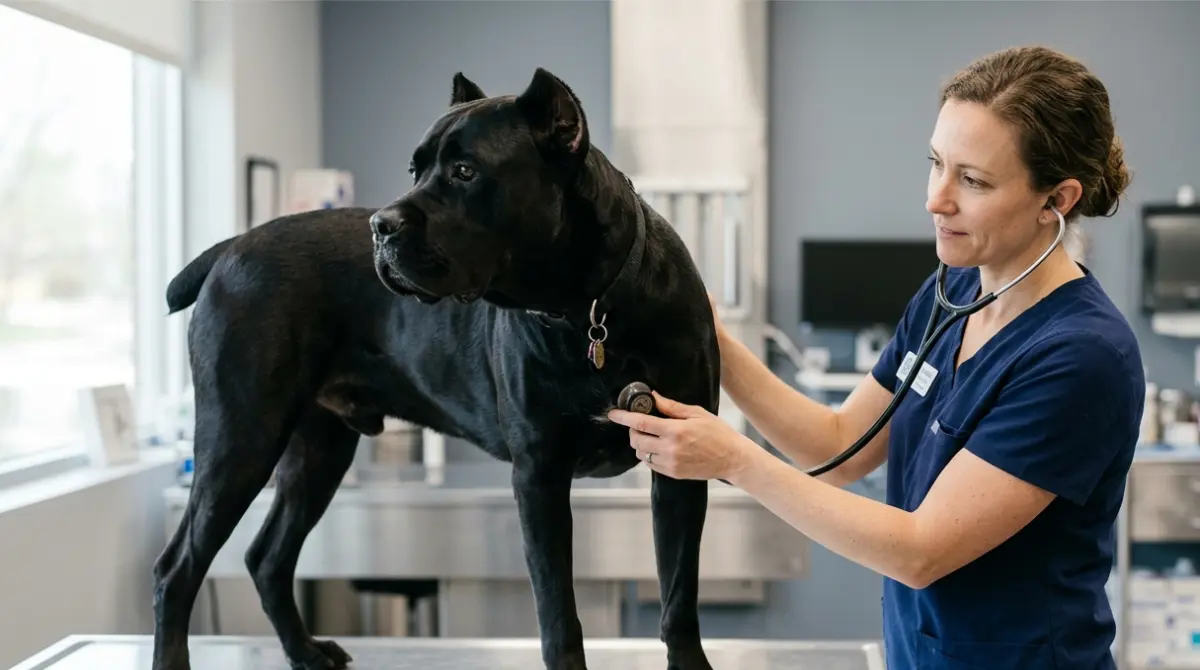
Table of Contents
Is your Cane Corso’s heart tested? What that claim means
Heart tested can mean a vet listened with a stethoscope, or a cardiologist scanned the heart with ultrasound. They are different exams. This guide to Cane Corso heart disease screening sits inside our look at whether a Cane Corso fits your home.
If you’re reading a breeder’s papers
Ask which exam, who did it and when.
If you own a puppy or an adult
The next sections explain what each exam checks.
If something looks wrong right now
Collapse, fainting or hard breathing means an emergency vet now; jump to the last section.
🏡 Family & Home: A large dog is a ten-year household commitment. Knowing which heart paperwork matters helps your family decide.
🩺 Vet Note: This is general information, not advice about your dog. Your veterinarian or a veterinary cardiologist decides which exam your Cane Corso needs and when, and any murmur or symptom needs a vet’s evaluation.
What a heart screening actually checks
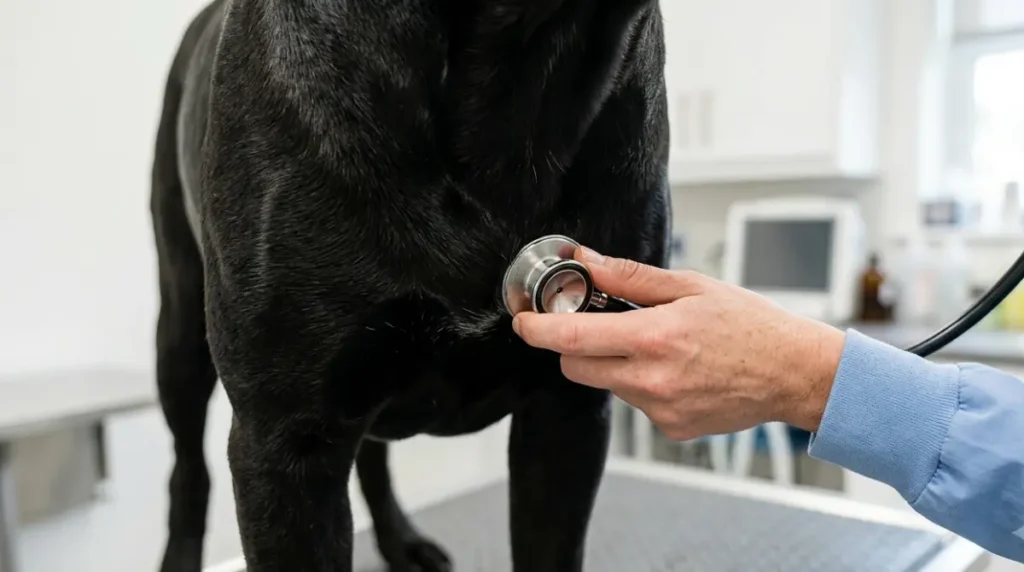
A heart screening checks how the heart sounds, how it looks and how it beats.
Listening with a stethoscope
In auscultation, a vet listens at each valve for a murmur and grades it from 1 to 6. Some murmurs are innocent; an echocardiogram can show whether the heart is otherwise normal.
The echocardiogram
An echocardiogram is a heart ultrasound. The Merck Veterinary Manual calls it the best test for confirming dilated cardiomyopathy, and OFA’s cardiac program requires one for its advanced exam.
ECG and Holter: checking rhythm
An ECG records the heart’s electrical activity and can show arrhythmias. A Holter monitor is a portable ECG worn for about a day; OFA requires one only for Boxers and Dobermans.
✅ Do This: If your vet hears a murmur, ask whether a cardiologist’s echocardiogram is the next step.
OFA basic vs advanced cardiac exam, side by side
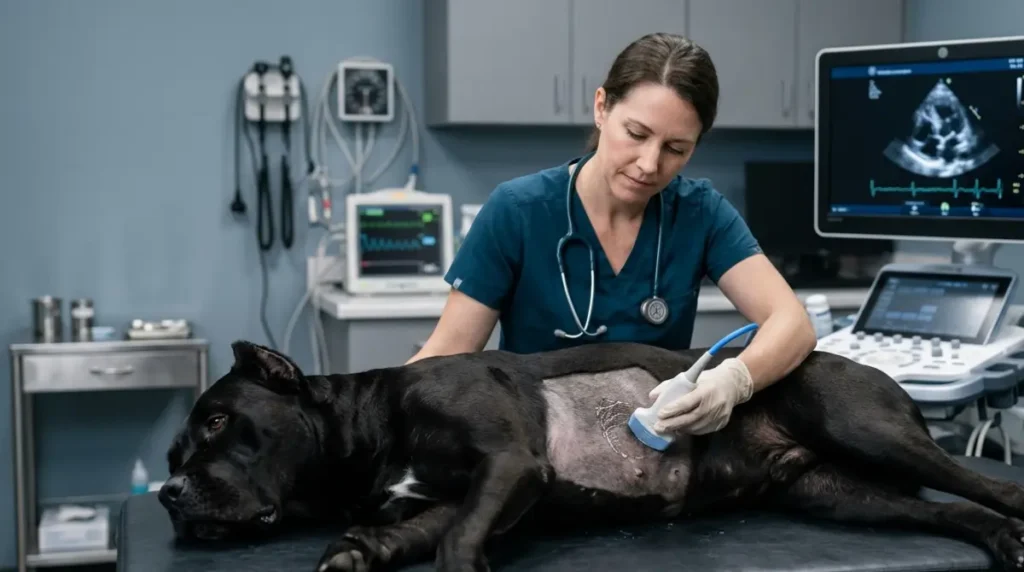
OFA’s basic cardiac exam uses a stethoscope; its advanced exam adds a cardiologist’s ultrasound.
| Basic exam | Advanced exam | |
|---|---|---|
| Who performs it | Any licensed veterinarian | Board-certified veterinary cardiologist |
| Method | Stethoscope only | Exam plus echocardiogram |
| Certified from | 12 months | 12 months |
| How long it lasts | 1 year | Congenital permanent; adult-onset 1 year |
| What it can miss | Disease hard to hear | Disease starting after the exam |
Source: OFA cardiac program page, checked October 2026.
Basic cardiac exam
A basic exam is a snapshot by ear; it can’t see inside the heart.
Advanced cardiac exam
A cardiologist’s echocardiogram has been required since October 2020. Ask the clinic for a quote and add it to your year-one cost breakdown.
What the certificate number tells you
A basic number shows your dog’s age and examiner type (cardiologist, specialist or practitioner); advanced numbers start with ACA.
When to test: puppy exams, 12 months and rechecks
OFA certifies a Cane Corso’s heart from 12 months of age; earlier exams are for the owner’s information only.
Puppy exam at 8–10 weeks (information only)
OFA calls 8 to 10 weeks the best time, before pups go home. It earns no certificate.
From 12 months: a certified result
At 12 months or older, a dog found normal receives a certificate number.
Yearly rechecks
Adult-onset clearances last one year because acquired heart disease can appear after a normal exam. OFA recommends yearly basic exams.
✅ Do This: At your next checkup, ask your veterinarian when to screen your own dog and whether a basic exam or a cardiologist fits.
What the Cane Corso breed club asks breeders to test
The Cane Corso Association of America’s health panel lists six screens, including an OFA cardiac evaluation.
The CHIC health panel
Alongside hips, elbows, kneecaps and two DNA tests, the club lists that cardiac evaluation. The page doesn’t say whether that means the basic or advanced exam, so ask the breeder which was done.
What we couldn’t verify: breed-specific rates
The Merck Veterinary Manual names other large breeds as particularly at risk for dilated cardiomyopathy, not the Cane Corso. We found no verified Cane Corso-specific rate, so we don’t quote one.
That isn’t an all-clear. Our Cane Corso lifespan and health risks article covers the wider picture.
What a clear result does and doesn’t promise
A normal exam is a snapshot of one day, not a lifetime guarantee.
A normal exam is a snapshot
Dilated cardiomyopathy has a very long early phase with no detectable signs, per the Merck Veterinary Manual, so a healthy-looking dog can still have disease. A clear result also can’t rule out every cause, such as taurine deficiency.
Ask for both parents’ dates and results
Ask for each parent’s exam type, examiner, date and result; a clearance over a year old no longer covers adult-onset disease. Which health-test papers to ask a breeder for breaks the paperwork down.
🏡 Family & Home: A certificate is paperwork, not a safety guarantee. Every adult at home should know the warning signs below.
Signs your Cane Corso needs a vet now
🚨 If This Is Happening Now: Collapse, fainting, trouble breathing or a swollen belly — contact your veterinarian or nearest emergency vet immediately and call ahead. Don’t give medications or try to make your dog vomit unless a veterinarian tells you to.
Go now: collapse, fainting, hard breathing
The Merck Veterinary Manual’s owner guide lists weakness or collapse, fainting and difficulty breathing among the signs of dilated cardiomyopathy. A swollen belly can mean fluid buildup or bloat; see the bloat emergency section of our family-dog guide.
Call your vet today: coughing or unwillingness to move
Coughing and unwillingness to move are on the same list; call your veterinarian today.
What to tell the vet
Say when it started, what your dog was doing and which cardiac exams the breeder’s records show.
🏡 Family & Home: Every adult should know these signs and the 24-hour clinic’s number; children just tell an adult right away.
Cane Corso heart screening questions, answered
1. What does a Cane Corso heart screening check?
A Cane Corso heart screening checks sound with a stethoscope, structure with an echocardiogram and rhythm with an ECG. Your veterinarian chooses which apply.
2. What is the difference between OFA basic and advanced cardiac exams?
In a Cane Corso, OFA’s basic exam is a stethoscope check by any licensed vet; the advanced exam adds a cardiologist’s echocardiogram.
3. Does a Cane Corso need an echocardiogram?
An OFA advanced cardiac exam requires an echocardiogram. Beyond that, your veterinarian decides whether your Cane Corso needs one.
4. How old must a Cane Corso be for an OFA cardiac clearance?
OFA issues a Cane Corso heart clearance at 12 months or older; younger puppies can be examined for the owner’s information only.
5. How long does an OFA cardiac clearance last?
A Cane Corso’s basic heart clearance lasts one year; an advanced one is permanent for congenital disease and one year for adult-onset.
6. Is dilated cardiomyopathy common in Cane Corsos?
We found no verified Cane Corso-specific rate, and the Merck Veterinary Manual doesn’t list the breed as particularly at risk. Ask your veterinarian about screening your dog.
7. Does a heart murmur mean my Cane Corso has heart disease?
Not always. Some murmurs are innocent, but a Cane Corso’s murmur still needs follow-up; an echocardiogram can show whether the heart is otherwise normal.
8. Can a clear test guarantee my Cane Corso won’t get heart disease?
No. A Cane Corso’s normal exam covers one day, and adult-onset disease can appear later, so OFA’s adult-onset clearance lasts only a year.
9. What are the signs of heart disease in a Cane Corso?
Signs of Cane Corso heart disease include weakness or collapse, fainting, difficulty breathing, coughing and unwillingness to move. Collapse or hard breathing means an emergency vet now.
10. Does a Cane Corso need a Holter monitor?
OFA requires a Holter monitor only for Boxers and Dobermans, not Cane Corsos. Ask your veterinarian whether your dog needs one.
The honest bottom line on Cane Corso heart tests
Ask any breeder which exam, by whom and when, and ask your veterinarian which exam fits your own dog at your next checkup. If you ever see collapse or hard breathing, go to an emergency vet now. Next, read our guide to whether Cane Corsos are good family dogs. Every fact here traces to cited sources; nothing was tested with a dog.