Crate training a puppy at night, from alarms to sleeping through

Night crate training for 2- to 6-month-old puppies: alarm times for an 8-hour night, a workday break plan, and when the crate can leave your bedroom.
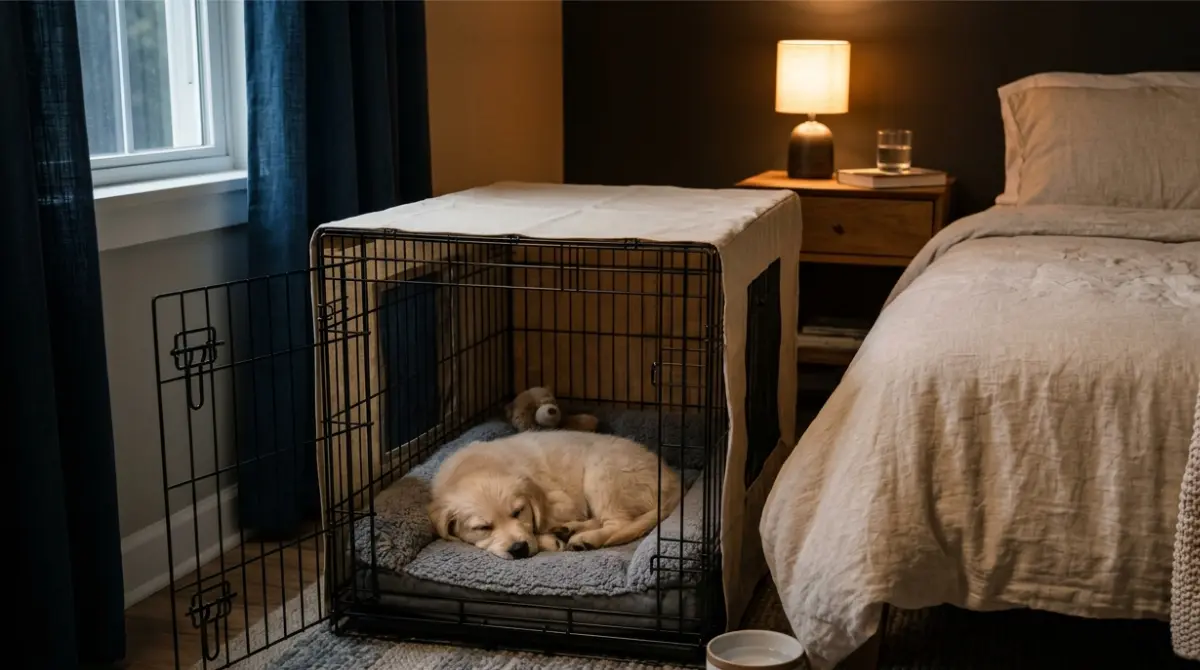
Table of Contents
A 2-month-old puppy needs a trip outside at least every 2 hours, even overnight, and a 3-month-old every 3 hours (VCA Animal Hospitals). VCA also notes that a puppy may not be comfortable spending the whole night in the crate until around 6 months, so the night alarms shrink as the puppy grows.
This part of crate training a puppy at night runs from the first scheduled wake-up to the first full night, and then to the crate’s move out of your bedroom. If your puppy only came home today, start with the plan for a puppy’s first night in the crate and come back once the first week is behind you.
How often a puppy needs to go out at night
The gap between trips is set by your puppy’s age. Counting forward from the last trip before bed turns that gap into alarm times. The example night below runs from a 10:30 p.m. last trip to a 6:30 a.m. wake-up, which is 8 hours.
| Puppy’s age | Longest gap overnight | Trips during an 8-hour night | Alarm times |
|---|---|---|---|
| 2 months (about 8 to 9 weeks) | 2 hours | 3 | 12:30, 2:30 and 4:30 a.m. |
| 3 months (about 12 to 13 weeks) | 3 hours | 2 | 1:30 and 4:30 a.m. |
| 4 to 5 months | 3 to 4 hours at most | 1 or 2 | 2:30 a.m., or 1:30 and 4:30 a.m. if the crate is wet |
| Around 6 months | VCA’s point for a full night in the crate | None planned | Go out if your puppy wakes and signals |
Sources: the 2- and 3-month gaps and the 6-month point come from VCA. VCA gives no separate gap for 4 to 5 months, so that row uses the 3 to 4 hour limit for puppies younger than 6 months from Humane Colorado’s crate training guide. Shift the times to match your own bedtime.
A puppy who came home at 8 weeks spends about a month in the top row, which is why the early nights feel so long. Some puppy pages say puppies can sleep through from about 8 weeks. The veterinary figure puts a 2-month-old at three trips in a night like this one, and planning for those trips is what keeps the crate dry.
Set the alarm before your puppy wakes you
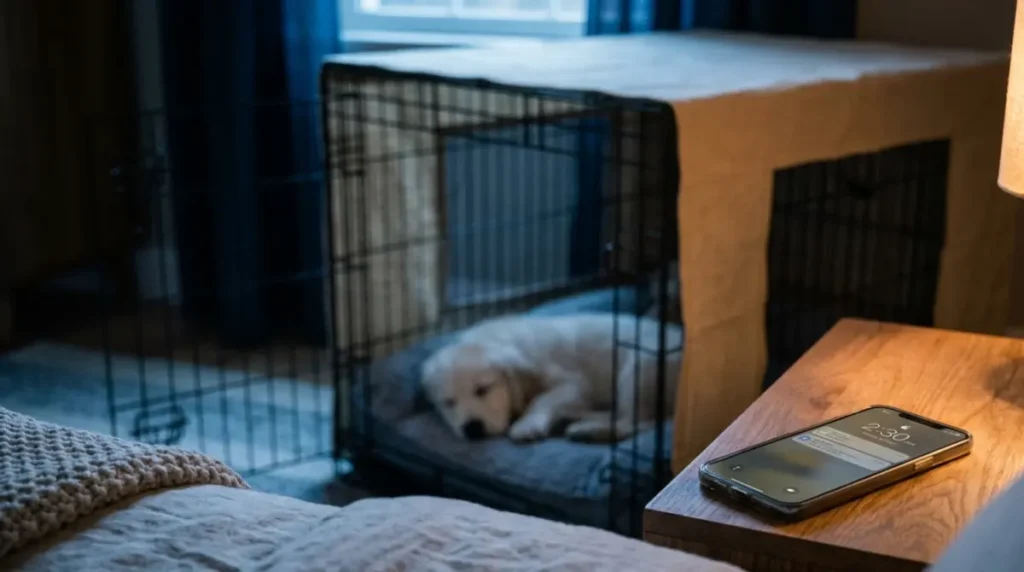
A puppy who wakes with a full bladder has one way to tell you, and it’s loud. An alarm set to the gap in the table gets you there first. The door then opens for a quiet puppy, and crying never becomes the thing that earns a trip outside.
- Take your puppy out just before the crate door closes for the night, to the same spot each time.
- Set the alarm for the gap that matches the table, counted from that trip.
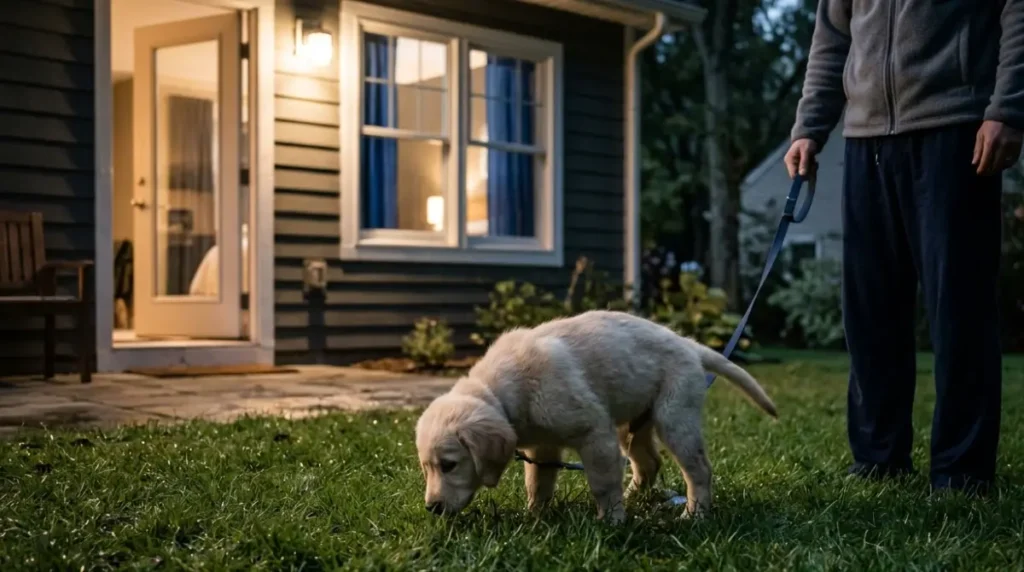
- When it goes off, carry or walk your puppy straight outside with the lights low and few words. Humane Colorado’s guide treats a night trip as business only, with no play.
- After your puppy goes, put them back in the crate and set the next alarm.
Agree before bedtime who takes which alarm. Two adults can split the night at the halfway point. Where a baby is also waking, timing the puppy’s trip next to a feed saves the house one extra wake-up.
With children in the home: An adult handles every night trip and opens the crate in the morning. Children greet the puppy only with active adult supervision, and they don’t open the crate themselves.
Wakings between alarms are a separate question, and the sound your puppy makes tells you a lot about them. Which night cries mean a potty trip and which are protest covers how to respond to each.
Stretching the gaps as your puppy grows
Sleeping through arrives with a bigger bladder, so the alarm moves as the puppy gets older. At 3 months, switch to 3-hour gaps. Somewhere in the 4-to-5-month stretch, try one trip instead of two.
The sign that a gap is working shows up at the alarm itself: a dry crate and a puppy still asleep. A wet crate means the gap went past what the bladder can hold. Go back to the shorter gap for a while before trying again.
Until 6 months, no single crate stretch should run past 3 to 4 hours, at night or during the day. Most puppies get used to the crate within one to two months, though accidents can still happen after that (VCA).
When can the crate leave your bedroom?
Humane Colorado ties the move to one sign: your puppy sleeping through the night, at ease, with the crate near you. Until then, the bedroom or a hallway just outside it lets you hear a puppy who needs to go.
Move it in two stages, first to the hallway outside your door and then to the spot where it will stay. Give each spot a run of full, dry nights before the next move. If night waking starts again, take the crate back one stage. For the final spot, five checks for where to put a dog crate go through choosing the room.
The bedroom was there so you could hear a puppy who needed to go. Once the nights are full, that reason has gone.
Workdays plus nights can add up to too much crate time
Daytime crate hours count against the same puppy. A dog crated through the workday and then again all night is confined for too much of the day (Humane Colorado).
The same limit splits a workday the way it splits a night. A 9-hour workday divided by 4 hours is 2.25. That rounds up to 3 crate stretches, with at least 2 breaks between them. Planning puppy breaks around a work schedule goes through it age by age. A lunchtime visit covers one of those breaks.
A good week of nights, then accidents again
A run of dry nights followed by a wet crate usually traces back to something in the routine that changed:
- the gap was stretched before the puppy was old enough for it
- night trips turned into play, which made waking up worth it
- the crate moved out of the bedroom before full nights were reliable
- a medical cause
Any medical condition that makes a dog need to go more often, more urgently or in larger amounts can show up as house soiling. That is why veterinary behaviorists rule it out before anything else (Veterinary Partner).
Note: Call your vet this week if a puppy who had been dry at night starts wetting the crate with no change in routine, or suddenly needs to go out far more often. Why a dog pees in the crate explains how to read where and when the accidents happen.
Frantic attempts to get out, or an injury from trying, point to a different problem. A crate does not resolve separation anxiety, and a dog can hurt themselves trying to escape (Humane Colorado). Start with your vet, then ask for a board-certified veterinary behaviorist or a certified behavior consultant. Scolding through the night or banging on the crate makes things worse. Reward-based methods are recommended for every kind of dog training, behavior problems included (AVSAB).
Crate covers and water bowls
Should the crate be covered at night?
For a timid dog, a sheet or blanket over the crate can make it feel more like a den (Austin Animal Center). Leave the front partly uncovered so air moves through and you can see your puppy at each alarm.
Should water stay in the crate overnight?
Humane Colorado’s guide gives two answers. It says to provide water whenever a dog is crated. Its night section says healthy puppies can have water taken up a few hours before bed to cut down on night trips. Ask your vet which fits your puppy, especially in hot weather or if your puppy has a health condition.
Set tonight’s alarm from your puppy’s age
Count forward from tonight’s last trip using the gap from the table, and set every alarm before you go to sleep. Move to the next gap only after the crate stays dry at the alarm. Once full nights hold and the crate has left the bedroom, when to stop crating a dog covers how the crate’s role winds down from there.