Helping your puppy settle on the first night in a crate

A puppy’s first night in the crate runs on its bladder: at 8 weeks, plan two to three trips out across an 8-hour night.
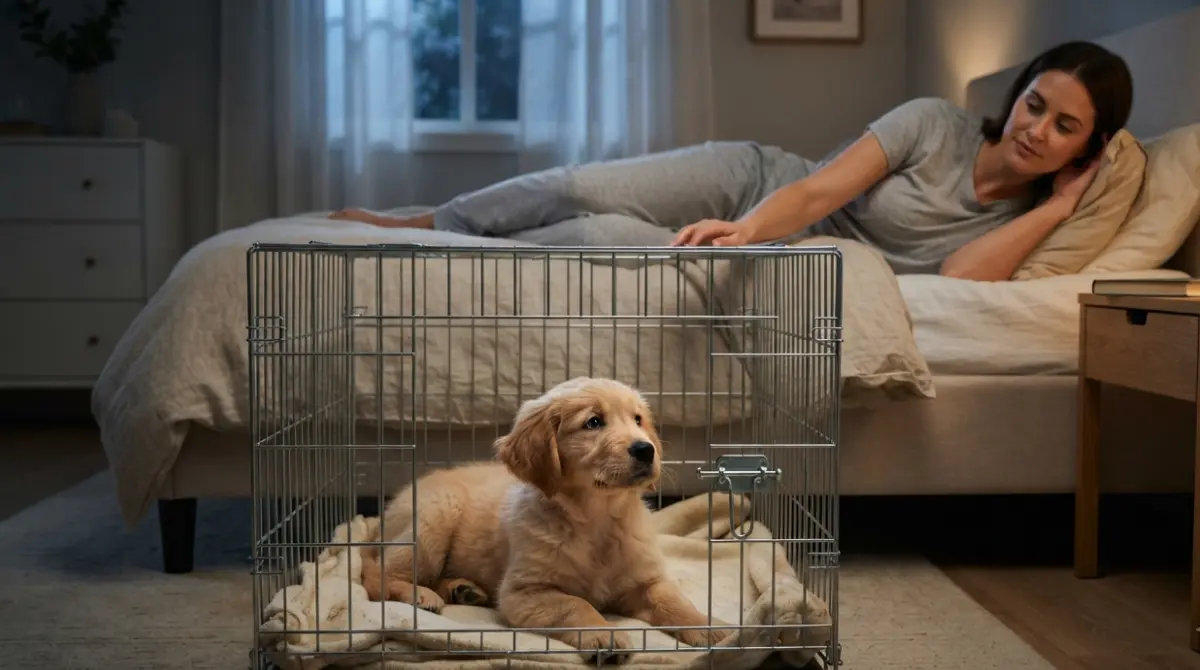
Table of Contents
Put the crate in your bedroom, close enough to your bed that you can reach the door, and take the puppy out to toilet right before it goes in. A puppy under 16 weeks probably can’t last the whole night, so plan to get up at least once (Calgary Humane Society).
This covers the drive home through tomorrow morning. Later nights, and the alarm times that shift as a puppy grows, belong to the full routine for crate training a puppy at night.
Before the car ride home
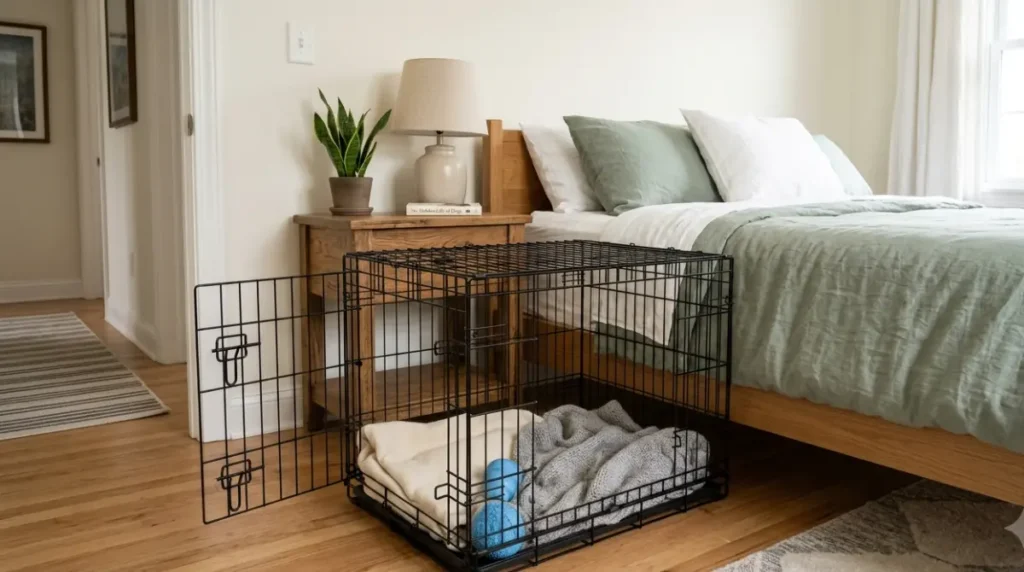
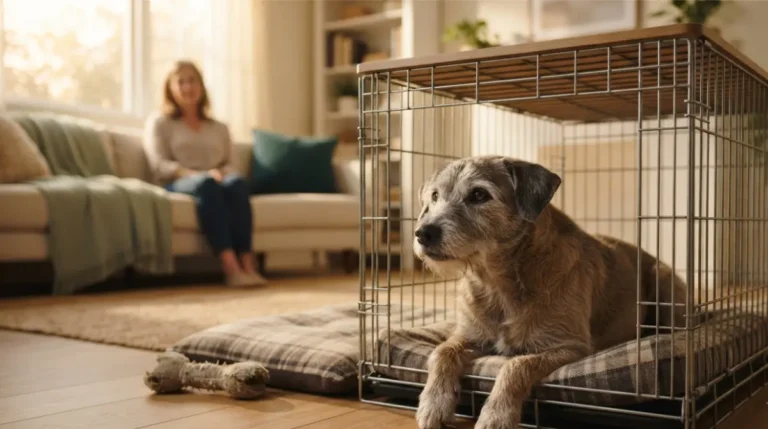
Set the crate up before you leave to collect the puppy. A bedroom or the hallway outside it lets you hear the whine that means a puppy needs to go out, and it keeps the crate from being tied to being shut away alone (Humane Colorado).
Ask the breeder or shelter for a blanket or toy that smells of the mother, and put it wherever the puppy sleeps (PDSA). The crate itself only needs room for the puppy to stand up and turn around. If you bought one for adult size, block off the spare length with a divider set to the puppy’s size today.
Decide now which adult does tonight’s toilet trips. Rules that everyone in the house knows and keeps make a puppy’s learning easier, and one person handling the dark hours keeps each trip the same.
One shelter handout raises the crate for the first three nights so the puppy can see you while it adjusts. The crate goes on the bed for night one, on a chair beside the bed for night two, and then on the bedroom floor (Calgary Humane Society).
The first hours at home shape bedtime
The first stop after the car is the spot outside where you want the puppy to toilet, before it goes indoors at all (PDSA). Inside, show it where it sleeps and eats first, keep voices low, skip visitors for a few days and leave most rooms closed for now.
Expect a sleepy puppy. Some sleep 18 to 20 hours a day, so let the afternoon naps happen instead of keeping the puppy busy until bedtime.
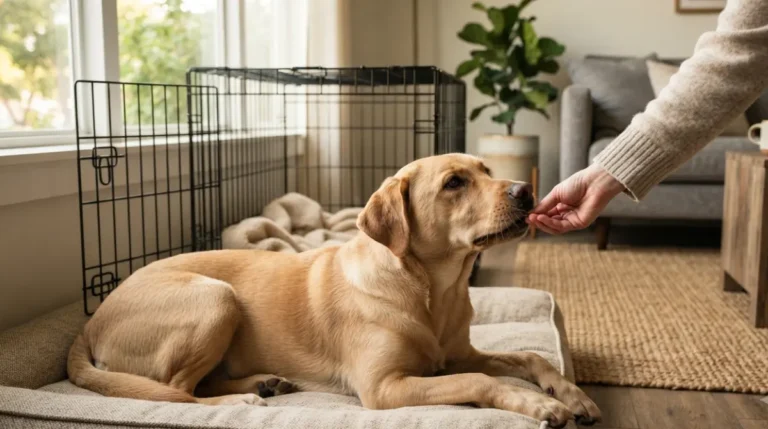
Use the waking time to make the crate familiar. Fasten the door open so it can’t swing shut. Then drop small treats near the crate and gradually further inside, letting the puppy walk in on its own without being pushed (Humane Colorado). Put a meal down near or just inside the crate as well. A few short visits like these mean the puppy has walked in by choice before it ever sleeps there.
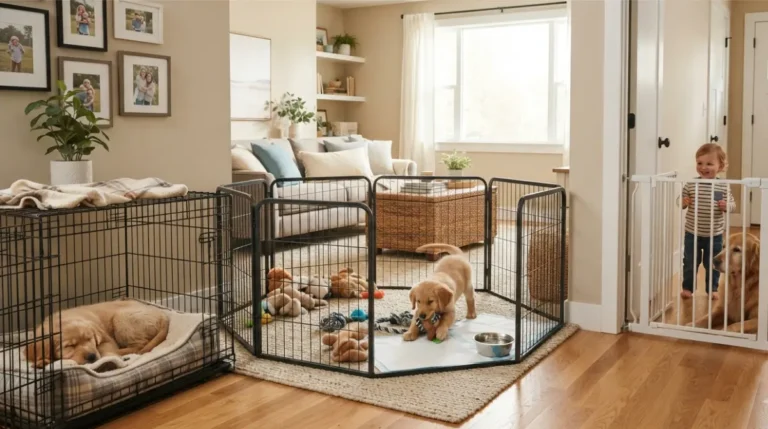
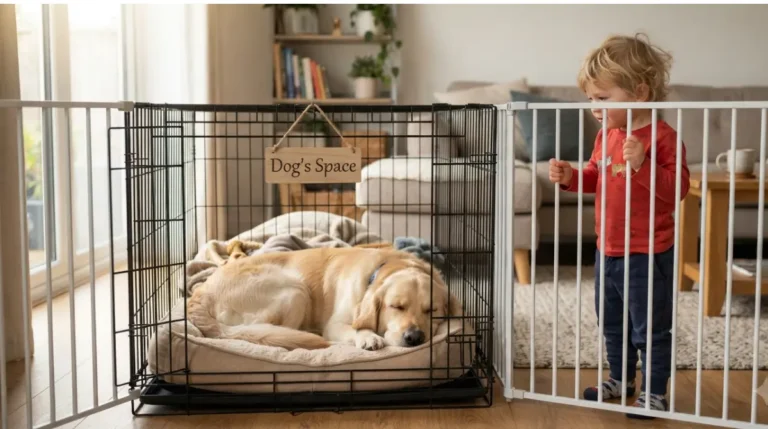
With children in the home: keep the arrival quiet for them too, one child at a time with an adult right beside them, and keep an adult present whenever children and the puppy are together. Children don’t open the crate or reach into it, at night or any other time. The crate rule for toddlers sets out how to hold that line.
Night one bedtime, in order
About an hour before you go to bed, start winding the evening down.
- Keep the last hour quiet, with no new people and no rough play.
- Take the puppy to its toilet spot just before the crate. Puppies often need to go after a nap or a meal (Penn Vet), so one that has just woken from an evening doze needs this trip even if it went recently.
- Put the puppy in with the scent blanket and a chew toy suited to its size.
- Turn the lights off and go to bed with the crate door within arm’s reach.
Some crying once the room goes dark is normal. Until today the puppy slept against its mother and littermates, and losing them is a big change at first (PDSA).
How often will a young puppy need to go out tonight?
Penn Vet’s behavior medicine handout puts it at one hour for each month of age, give or take an hour. That works out to three to four hours for a 3-month-old puppy (Penn Vet). Calgary Humane Society’s daytime limits sit close to that: up to 3 hours at 2 months and up to 4 hours at 3 months.
| Age on the first night | Longest stretch the sources give | Trips out across an 8-hour night |
|---|---|---|
| 8 weeks (about 2 months) | About 2 hours by the Penn Vet rule; up to 3 hours in the daytime (Calgary) | 2 to 3 |
| 12 weeks (about 3 months) | 3 to 4 hours (Penn Vet); up to 4 hours in the daytime (Calgary) | 1 to 2 |
Sources: Penn Vet; Calgary Humane Society. Trip counts are worked out from those figures for a 10 p.m. to 6 a.m. night.
The arithmetic is short. An 8-hour night cut into 3-hour stretches needs two trips out; cut into 2-hour stretches, it needs three. Penn’s figure allows an hour either way, which is why a puppy that whines or stirs goes outside whatever the time (Calgary Humane Society).
Carry the puppy or lead it on a leash straight to the toilet spot, praise it as it finishes and go straight back to the crate. Keep it a trip with a purpose, with no play or wandering (Humane Colorado).
Comforting a crying puppy on night one
Shelters and vets give different answers here, and the difference matters most on a puppy’s first night home.
What the sources say
| Source | What it advises when a puppy cries at night | What that advice assumes |
|---|---|---|
| Humane Colorado | Ignore it; if it goes on for several minutes, say your potty phrase and take the puppy out if it perks up | The dog has already learned to stay quietly in the crate before sleeping in it |
| PDSA vets | Comforting an upset puppy is fine; ignoring it can leave it feeling isolated and more frightened | The first few nights, with you sleeping in the same room |
| Calgary Humane Society | Take the puppy outside if it whines or stirs, but don’t let it out while it’s barking | A puppy under 16 weeks that can’t yet last the night |
Sources: Humane Colorado; PDSA; Calgary Humane Society.
Humane Colorado’s ignore-first rule rests on its own earlier steps. A dog that has never been let out for whining has nothing to gain from it. The page also moves to overnight crating only once the dog stays quiet for about 30 minutes with you out of sight, which can take days or weeks. A puppy collected this afternoon hasn’t done any of that, and you don’t yet know how full its bladder gets.
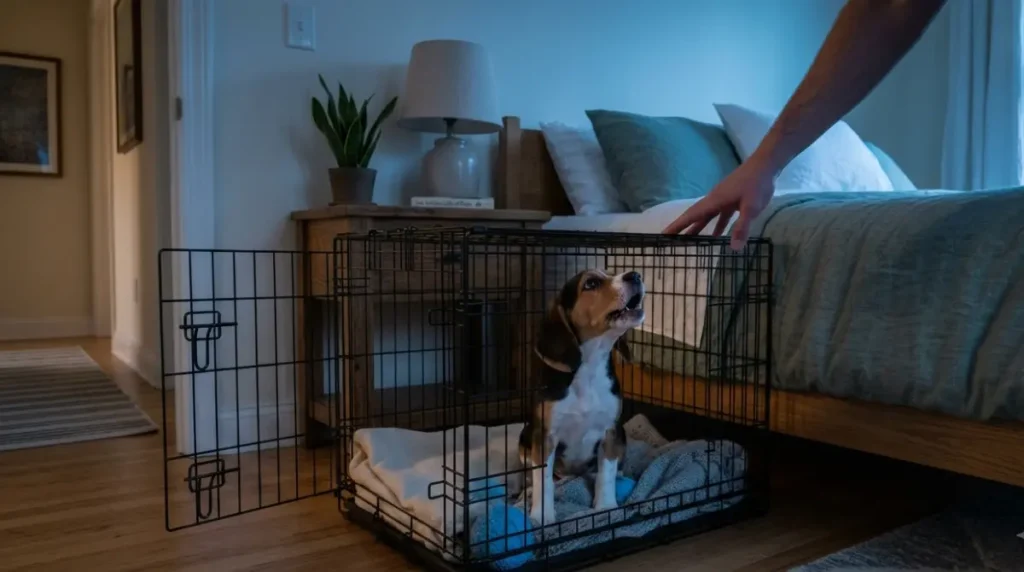
So on the first night, answer from bed. A hand at the door and a low word let the puppy know you’re there. If the crying keeps going, or the puppy keeps turning and stirring, take a toilet trip. Open the door during a pause in the noise, so the door opening follows quiet. Yelling or banging on the crate only makes things worse (Humane Colorado).
From the second night the balance starts to shift, and when to go in to a puppy crying in its crate at night covers that decision.
Some signs need a vet before more training
If the crying comes with frantic attempts to get out, like biting the bars or clawing at the door, treat it as more than first-night protest. A dog can hurt itself trying to escape a crate (Humane Colorado). Anxiety that continues in the crate is a reason to contact a professional trainer (Calgary Humane Society). If the puppy has hurt its mouth or paws on the crate, call your vet. How separation distress differs from fear of the crate helps you describe what you saw.
Call a vet now if: the puppy vomits, has foul-smelling, watery or bloody diarrhea, loses interest in food or seems extremely tired. Those are signs of parvovirus, which puppies are particularly vulnerable to, and PDSA’s vets advise contacting a vet immediately if you see any of them (PDSA).
Tomorrow morning, and getting ready for night two
The first thing out of the crate in the morning is a trip outside, carried or on a leash, straight to the toilet spot (Calgary Humane Society). Through the day, repeat the short crate visits and put meals near or inside the crate again, so tonight starts with a little more practice. At the first vet visit, ask how long this puppy can be expected to go overnight at its age and size. A crate training schedule by puppy age shows how days and nights change over the next few weeks.
Owners also ask about the bed and the cover
Can my puppy sleep in my bed on the first night?
Decide before the puppy arrives and hold to it, since rules that change from night to night make a puppy’s learning harder (PDSA). Calgary Humane Society keeps dogs in the bedroom at night, in a crate or on a mat rather than on the bed.
Covering the crate at night
Some dogs feel more secure with a blanket over the crate. Leave room for air to circulate, and tuck every loose end under the crate so the puppy can’t pull the cover in and chew it (Calgary Humane Society).