Crate training an older dog, starting from its crate history

New to the crate, or crated too long in a past home? An older dog starts with open-door meals, and the door opens only after 3 seconds of quiet.
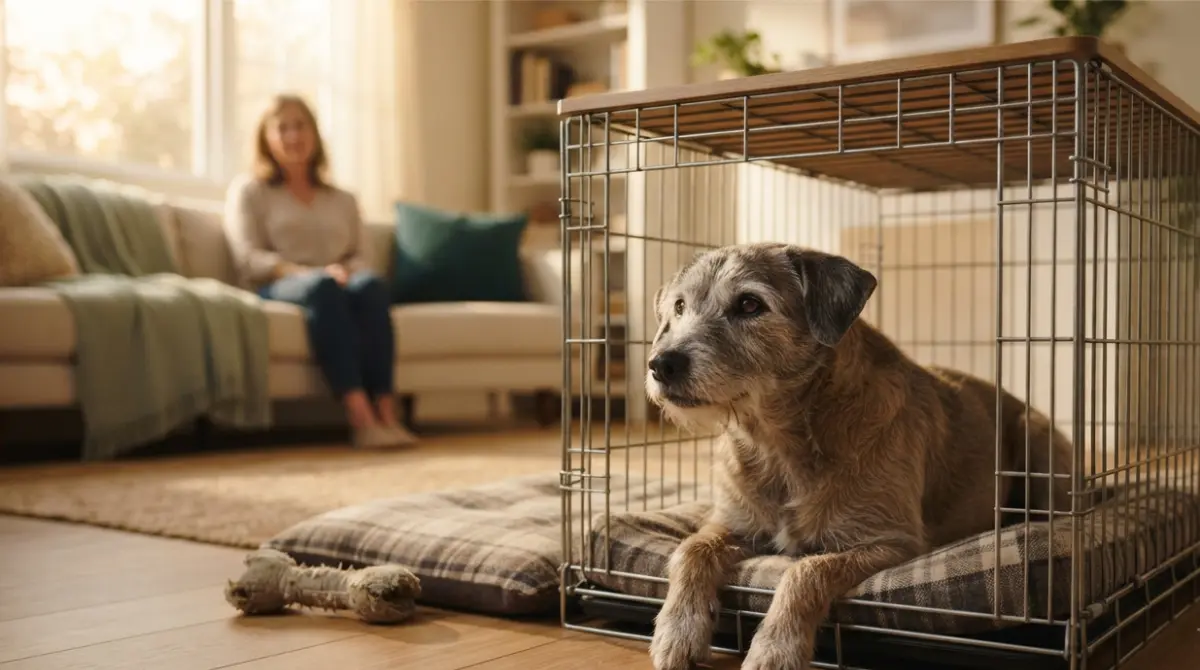
Table of Contents
A dog can be crate trained at any age, though an older dog may take longer to learn it than a puppy (PDSA). Expect a few weeks at minimum, and longer when the dog already connects the crate with something unpleasant.
Nights are usually the smaller problem, since adult dogs can stay crated through a night’s sleep (Maddie’s Fund), so the toilet-break routine behind crate training a puppy at night mostly falls away.
Your dog’s crate history sets the starting point
A dog crated through every workday and every night in a past home may read a closing door as the start of a long stretch alone, in a way a dog fresh from a shelter kennel may not.
Where the crate already frightens an adult, the SPCA of Texas advises against confining the dog in it at first if you can avoid it, and suggests wiring the door open or taking it off (SPCA of Texas crate handout). A start that stalls often traces back to a bad earlier experience, which is the point to slow down and bring in your vet or a certified dog behaviorist (PDSA).
| Crate history | Where to start | Sign to slow down |
|---|---|---|
| Never crated | Stage 1: door open, meals inside | Grabbing food and backing straight out |
| Recently kenneled at a shelter or foster home | Stage 1, moving on as each test is passed | Walking in readily but fussing once the door shuts |
| Crated for long hours in a past home | Stage 1 with the door wired open or removed, bowl a few feet outside | Refusing to approach, or hesitating as the bowl moves closer |
| Unknown | Start as in the row above | Any of the signs above |
Starting points summarize the SPCA of Texas and PDSA guidance linked above.
The crate stages and the test for each one
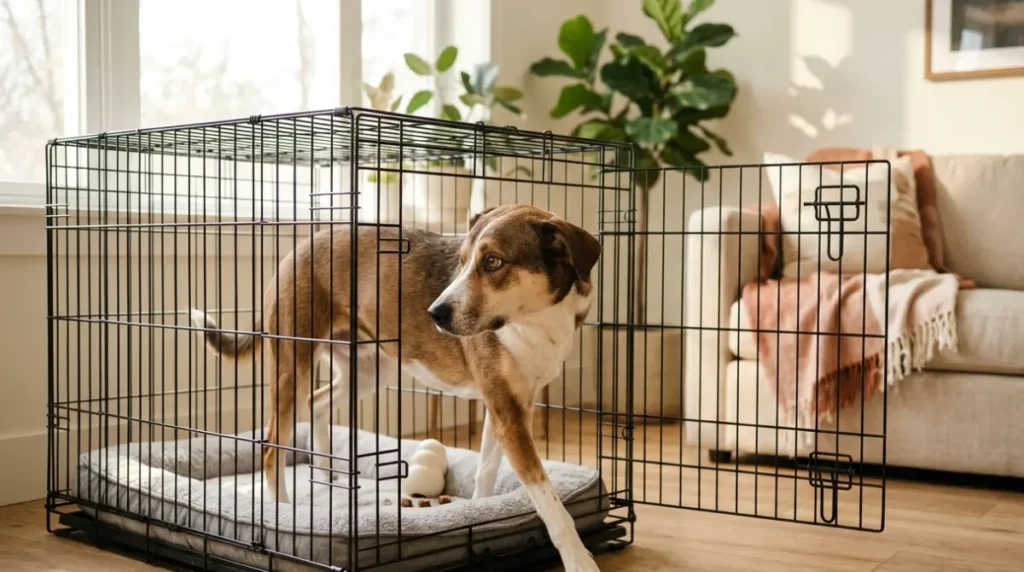
Tie a stuffed food toy to the back of an open crate at mealtime so your dog has to step inside to eat, and drop treats in when nobody is watching (SF SPCA adult-dog handout). Move to the next stage only after the test is passed.
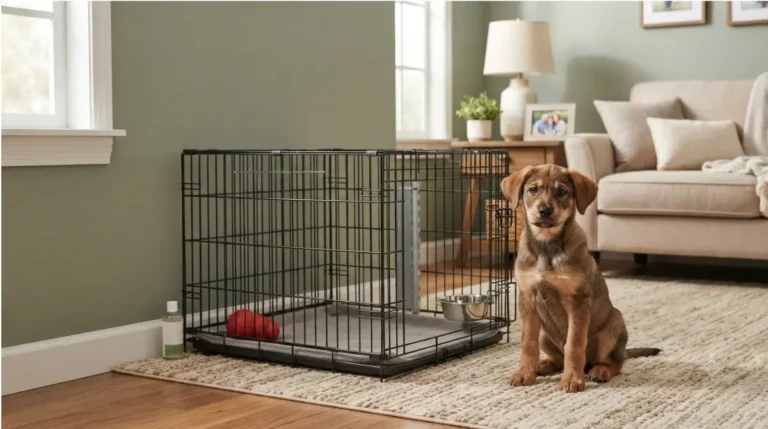
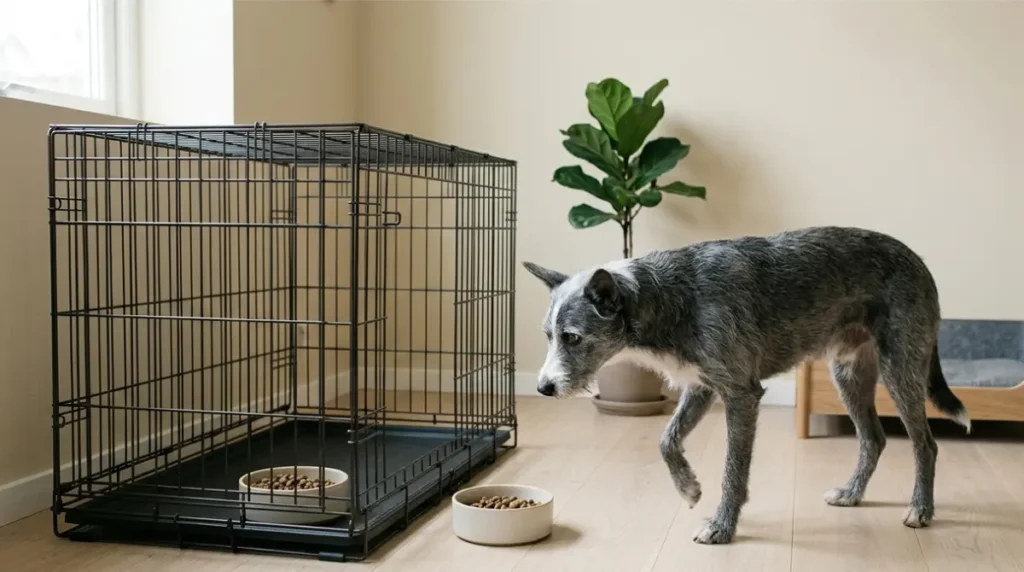
- Open door, food inside. Feed every meal in the crate. For a wary dog, start the bowl a few feet away, bring it closer each meal, then a few inches farther in each day (SPCA of Texas). Test: the dog steps all the way in to eat.
- A word for going in. Say “crate” or “bed” as the dog steps in; after a couple of days, say it first and wait before dropping treats (Maddie’s Fund). Test: the dog walks in on the word.
- Door shut, you in view. Close the door for 5 seconds while treats are eaten, then build toward 10 minutes with a food toy while you move around nearby (Maddie’s Fund). Test: 10 minutes with no pawing or whining.
- You out of sight. Leave the room a few times and come back within about a minute, then spend a few days crating the dog while you do ordinary jobs at home (SF SPCA). Test: going in without fuss, and no more whining or barking.
- Short trips out. Leave the house many times for 1 to 10 seconds, then stretch to 1, 5, 10, 15 and 30 minutes, then 1 hour and on up to 4, mixing in very short trips (SF SPCA). Test: no soiling or escape attempts when you get home.
Whining or scratching at any stage means going back one stage and rebuilding from there (PDSA).
If you adopted this dog in the last few days
Stage 1 can start on day one, because meals in an open crate ask nothing of a dog still learning your house (SF SPCA). Long crate time has to wait. For workdays before stage 5, a pen or a kitchen closed off with a baby gate keeps the dog safer than a crate it hasn’t accepted (Maddie’s Fund). Planning those hours is the subject of crate training while you’re at work.
Is it protest whining or panic?
The SF SPCA tells owners to ignore noise during closed-door practice and open the door only once the dog is quiet (SF SPCA). The SPCA of Texas warns that keeping a dog confined while it cries or tries to break out can lead to self-harm and lasting crate aversion (SPCA of Texas).
Neither opens the door mid-noise, and the Texas handout’s middle path is to wait for 3 seconds of quiet, or a pause for breath, and then open up.
Protest that fades
A short complaint as the door closes, gone once the food toy takes over, is protest. Wait for the pause, open the door, and make the next session a little shorter.
Distress that climbs
End the session and drop back a stage when you see:
- pawing, chewing or digging at the door that keeps going
- attempts to break out
- bedding torn up again and again, a possible sign of separation-related distress (SPCA of Texas)
- soiling in a crate the dog used to keep clean, which also calls for a vet check (SF SPCA)
If those signs keep returning, the crate is the wrong tool for now. Crating a dog with separation anxiety may save the furniture but likely does nothing for the anxiety, and some dogs break teeth or tear out nails trying to escape (UC Davis veterinary behavior handout). Telling crate fear apart from separation anxiety is covered in crate fear versus separation anxiety.
Call a vet now if: your dog has broken a tooth, torn a nail or cut its mouth or paws trying to get out. Ask about a referral to a veterinary behaviorist or a certified behavior consultant before the crate is used again.
A resident dog or young kids at home
Everyone in the home, children included, should treat the crate as the dog’s own space and never as a play area (PDSA). An adopted adult has no history yet with your children’s noise and reaching hands.
A resident dog changes the setup too. Give the newcomer a crate of its own, and keep the resident dog away from the door while a food toy is inside.
With children in the home: children don’t open the crate or reach inside it, and an adult actively supervises whenever children and the new dog share a room, whether the door is open or shut.
More house rules for small children are in the dog crate and toddler rule.
Daytime crate limits for an adult dog
Three hours is the most cautious daytime ceiling, and no source stretches to a full workday.
| Source | Daytime ceiling for an adult | Condition attached |
|---|---|---|
| PDSA | 3 hours | Less if the dog isn’t used to the crate |
| SPCA of Texas | 4 to 5 hours | Phrased as a limit to try not to pass |
| Maddie’s Fund | 4 to 6 hours | Overnight sleep excepted |
Figures as each organization publishes them. They disagree, and none is a target.
During training, the working ceiling is the longest absence passed at stage 5. A senior whose joints stiffen during rest needs shorter stretches and a padded setup, covered in crate training a senior dog with stiff joints.
Owners also ask about covers and gates
Should I cover my dog’s crate?
Some dogs like a light sheet or blanket over it (Maddie’s Fund), and covering the top and sides with the front open can cut noise and drafts (PDSA). If the cover gets pulled in and chewed, take it off.
Does every adult dog need a crate?
No. When confinement distresses a dog, a friend minding it or day care can fill the gap while training goes on (SPCA of Texas). At home, a pen or gated room may suit better; see a comparison of crates, playpens and baby gates.
Tonight’s dinner goes in the open crate
Put tonight’s meal in a food-filled toy, fasten it at the back and leave the door wide open. If several days of open-door meals bring no progress, or panic starts once the door shuts, call your vet and ask about a certified behaviorist before going further (PDSA).