Crate Training a Senior Dog Comfortably When Joints Are Stiff

Senior dog crate training starts with comfort: non-slip footing and supportive bedding, then short reward-based steps paced to what sore joints allow.
Table of Contents
Can a senior dog with stiff joints learn to use a crate?
Yes. A senior dog with stiff joints can learn to rest calmly in a crate at any age. It works best when training uses rewards, moves at your dog’s physical pace, and the crate is set up for sore hips and elbows.
Why old dogs still learn new routines
Dogs keep learning all their lives. The American Veterinary Society of Animal Behavior recommends only reward-based training for all dogs, and that approach works for a 12-year-old just as it does for a puppy.
Who this guide is for
This guide is for a dog you’ve lived with for years who now needs a crate, perhaps because a baby is coming, your vet suggested it, or nights need to be safer. If your older dog is a recent adoption, start with our guide to crate training an older rescue dog. If your vet has ordered strict confinement after surgery, follow their plan first; Section 6 explains the difference.
🩺 Vet Note: Stiffness when a senior dog gets up may be treatable joint pain, not “just age.” New night restlessness or confusion can signal cognitive changes. This guide covers comfort and training only; it gives no medication or supplement advice, so ask your veterinarian about pain relief.
Why stiff joints change the way you crate train
A crate is a place of rest, and for a stiff dog, rest is where discomfort builds.
Stiffness after rest: the crate problem nobody mentions
The Merck Veterinary Manual notes that in dogs with hip dysplasia and osteoarthritis, lameness can be more pronounced shortly after rest. That means the first steps out of the crate may be your dog’s stiffest of the day.
🔍 Why It Works: A dog that circles for a long time, hesitates to lie down, or rises slowly isn’t being stubborn about the crate. It may be protecting sore joints. Training goes faster once the setup removes that discomfort.
When “just getting old” is actually pain
The AAHA’s 2023 senior care guidance warns that owners often read changes in older pets as normal aging when chronic pain may be the cause.
✅ Do This: At your next vet checkup, mention any stiffness when your dog gets up. Call sooner if it’s getting worse. Short phone videos of your dog getting up help your vet see what you see.
How to crate train a senior dog, step by step
Build the crate into a comfort spot first, then add short door-closed stays.
Steps 1–3: comfort before the door
- Leave the crate door open and toss treats near it, then just inside it.
- Feed meals at the entrance, then gradually further in.
- Praise your dog whenever they choose to lie down inside on their own.
Steps 4–6: short stays, then longer ones
- Close the door for a few seconds while your dog is relaxed and eating, then open it before they fuss.
- Lengthen stays slowly, staying nearby at first.
- Add a cue word like “bed” once your dog walks in willingly.
Pace it to their body, not a calendar
End each session before your dog needs to get up and reposition. Never lift or push a sore dog inside. It’s the same short-steps method from our 14-night puppy crate log, slowed down, and it follows the AVSAB’s position on humane dog training.
🏡 Family & Home: Hold sessions when the house is calm, such as when the kids are at school or the baby is napping.
Set up a crate that’s kind to sore joints
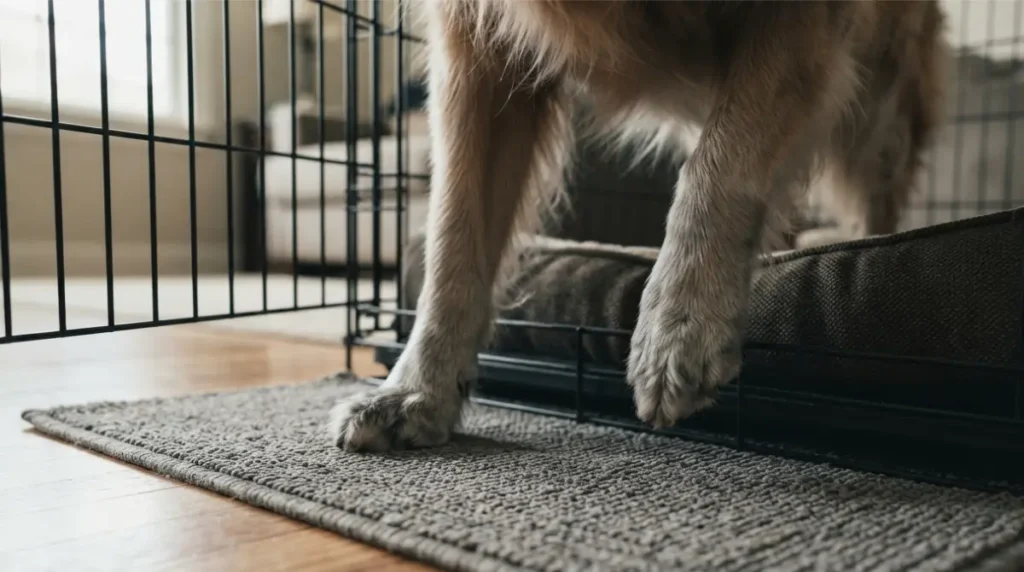
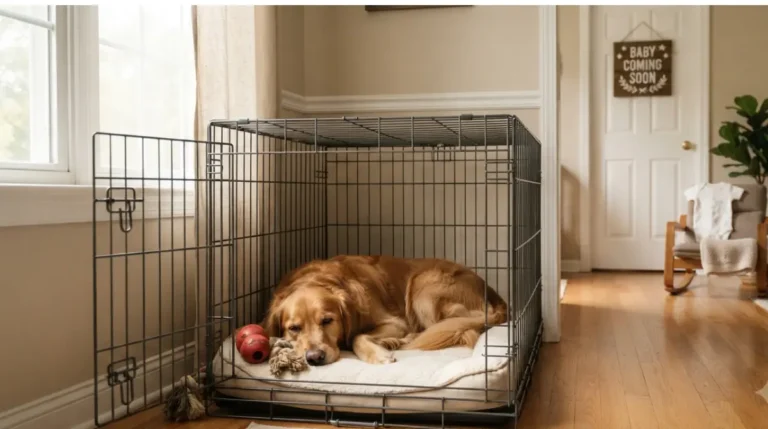
Comfort inside the crate matters more for a stiff dog than any training step. The AAHA’s senior care pain management guidance recommends good footing, such as rugs or yoga mats, and appropriate beds for aging pets.
| Setup Element | What to Aim For | Key Detail |
|---|---|---|
| Entry | A low lip or threshold | Less lifting for sore hips |
| Size | Room to stretch and turn | Measure with our crate size chart |
| Flooring | A non-slip rug under and outside the crate | Traction when rising (AAHA) |
| Bedding | Firm, supportive padding | Padding for aging joints (AAHA) |
The flooring and bedding rows follow the AAHA 2023 Senior Care Guidelines; the entry and size rows are practical guidance.
Entry height, size, and flooring
A lower entry means your dog doesn’t have to step up over a lip with sore hips. Hard floors under the crate door are where stiff dogs slip.
Bedding that supports without sinking
Choose padding that stays supportive under your dog’s weight rather than deep, collapsing cushions, which can make getting up harder.
What we set up for our senior tester
🏡 Family & Home: A non-slip mat outside the crate door also helps toddlers and older relatives, who walk the same slippery spot.
Where the crate should go in a busy family home
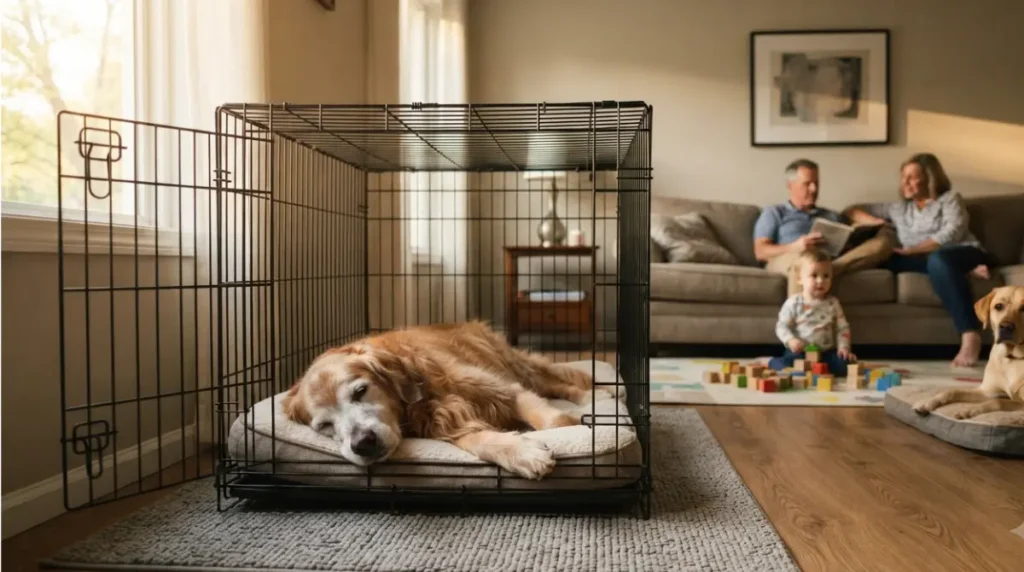
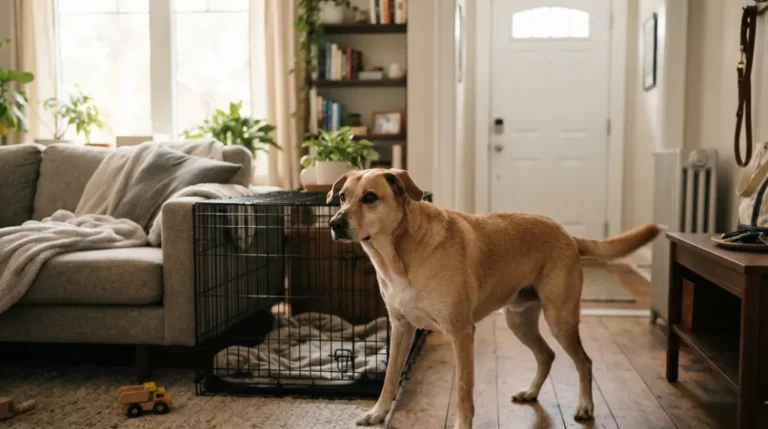
Place the crate where your dog can be part of family life without having to climb to reach it.
Near the family, off the stairs
The AAHA advises watching for home hazards such as stairs, especially since senior pets may see or hear less well. A ground-floor spot in a room people use means no climbing and no feeling shut away.
A retreat from toddlers, grandkids, and younger dogs
Make one house rule: the crate is the dog’s space, so no one reaches in or crawls inside. Adults must actively supervise whenever children and the dog are together, crate or no crate.
🏡 Family & Home: Keep a younger, bouncier dog out of the senior’s crate too. If your old dog growls at a child, separate them calmly and talk to your vet and a qualified behavior professional.
How long can a stiff senior dog stay in a crate?
No single time limit fits every senior dog. Your veterinarian is the right person to set one for your dog.
Why shorter stretches suit sore joints
Because stiffness can build during rest, break up long crate stretches with gentle movement. A few minutes of walking loosens joints before the next rest.
Training crate time vs. vet-ordered crate rest
Everyday crate time and medical confinement follow different rules. If your vet has prescribed confinement, follow our guide to crate rest after surgery and your vet’s exact instructions.
🏡 Family & Home: On long workdays, arrange for a family member or dog walker to give a midday movement break.
When crate trouble is really pain or confusion
Sometimes a dog struggling with the crate is telling you something about their health.
Signs of joint pain in and around the crate
- Yelping when rising or sudden struggling to stand: call your vet today. If your dog can’t stand at all, go to an emergency vet now.
- Slow, stiff first steps that ease with walking: mention this at your next checkup.
Night restlessness and signs of cognitive change
According to the AAHA’s guidance on cognitive dysfunction, common signs include sleeping in the day, restlessness at night, disorientation at home, and anxiety.
✅ Do This: Book a vet visit soon if these signs are new. Note when they started, what time of day they happen, and any changes in toileting.
🏡 Family & Home: Ask everyone at home to jot down changes with the date.
FAQ
1. Can you crate train a 10-year-old dog?
Yes. Crate training a senior dog works at any age when you use reward-based steps paced to the dog’s comfort.
2. How long does it take to crate train an older dog?
There’s no fixed timeline. Move to the next step only when your older dog is relaxed at the current one.
3. Is crating cruel for a senior dog?
No, not when the crate is padded, well placed, used for reasonable stretches, and introduced with rewards instead of force.
4. What bedding is best in a crate for a dog with arthritis?
Firm, supportive padding over non-slip flooring; AAHA senior guidance highlights appropriate beds and good footing. Ask your vet about your dog’s specific needs.
5. How long can a senior dog stay in a crate?
No single limit fits every senior dog; stiffness builds with rest, so break up long stretches. Ask your vet for your dog’s limit.
6. Why is my old dog restless in the crate at night?
Night restlessness in a senior dog’s crate can signal joint pain or cognitive changes. Book a vet visit soon if it’s new.
7. Should an old dog’s crate be upstairs or downstairs?
Put the crate on a floor your family uses, so your senior dog never needs stairs to reach it.
8. What size crate does a stiff senior dog need?
One sized to your dog’s measurements, with room to stretch out and turn without squeezing; use a crate size chart.
9. Can a crate keep an old dog safe from toddlers?
A crate gives an old dog a retreat from toddlers, but it never replaces active adult supervision around kids.
10. When should I call the vet about my senior dog and the crate?
Call today if your dog yelps when rising or suddenly struggles to stand; mention gradual stiffness at the next checkup.
Your senior dog’s crate, done kindly
Your dog has spent years fitting into your family’s life, and a crate can now fit around theirs. Set up comfort first, train slowly, and watch for pain. For the full step-by-step method this is based on, see our 14-night puppy crate log.
The one thing to raise with your vet is any stiffness when your dog gets up, at the next checkup or sooner if it’s worsening. Every health claim here is sourced to veterinary guidance, and nothing is presented as tested unless we tested it.