How much to feed a Cane Corso puppy, by age and weight

Feeding a Cane Corso puppy starts with the bag: pick the line for an 88–110 lb adult, split it into two or more meals, and count treats as food.
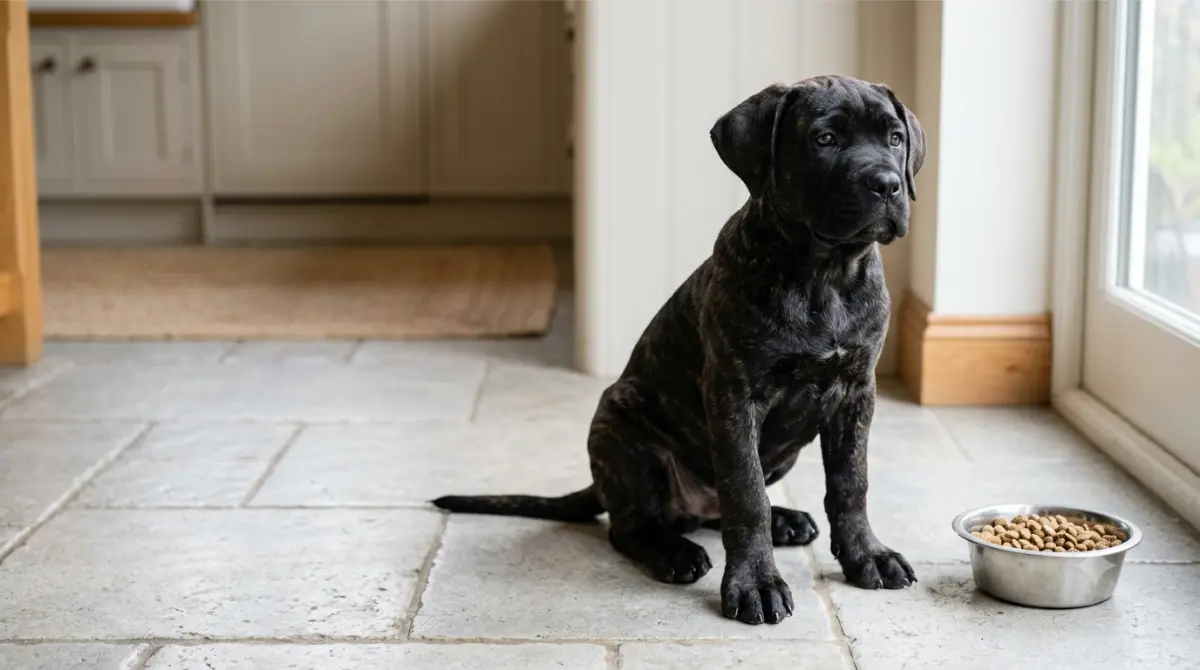
Table of Contents
How much to feed a Cane Corso puppy depends on the feeding chart printed on a large-breed puppy food, read on the line for an adult of roughly 88 to 110 pounds (40 to 50 kg). On one such label, a female heading for 76 to 100 pounds gets 4 to 5⅔ cups a day at 6 to 11 months, while a male heading past 100 pounds gets 4 to 7¼ cups.
The chart gives you a starting range. Your puppy’s ribs and waist decide where in that range you stay, and in a breed this big the numbers keep moving until close to the second birthday.
The feeding chart line for a Cane Corso puppy
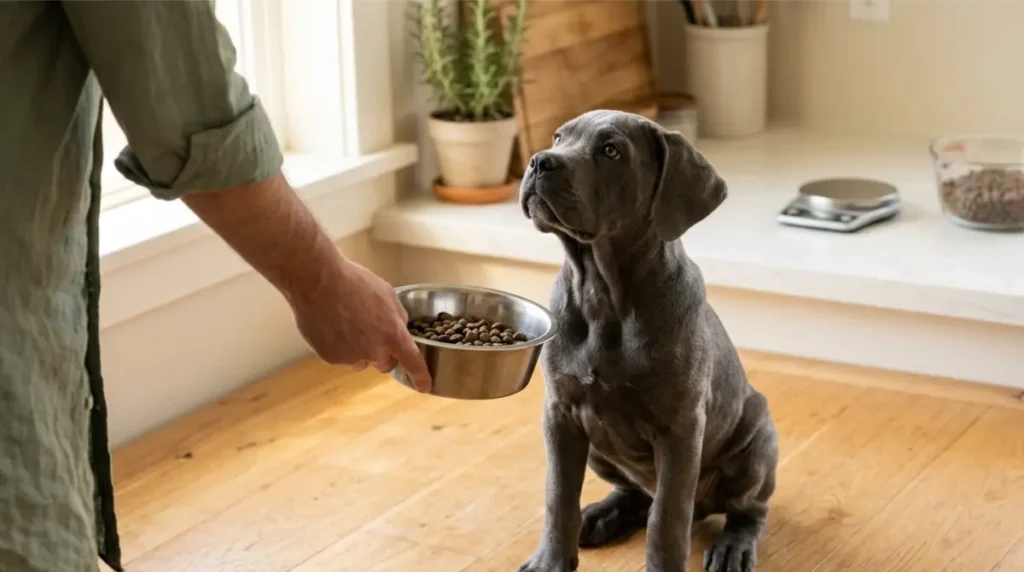
The international breed standard puts adult males at 99 to 110 pounds (45 to 50 kg) and females at 88 to 99 pounds (40 to 45 kg) (FCI Standard No. 343). A Corso built to that standard finishes well above 70 pounds, the weight pet-food labels use to mark large-size growth.
Before you buy: turn the bag over and find the small-print statement. It should name growth of large size dogs, 70 pounds or more as an adult. If that line is missing, the food is not labeled for a puppy that will pass 70 pounds.
The table reads one bag, Pro Plan Puppy Large Breed Chicken & Rice, to show how any large-breed chart works: rows by expected adult weight, columns by age. It shows the format and is not a pick. Grams and calories are worked from the label’s own figures of about 106 g and 419 kcal per standard 8-ounce cup.
| Puppy’s age | Female line: 76–100 lb adult (34–45 kg) | Male line: 101–130 lb adult (46–59 kg) |
|---|---|---|
| 6 weeks to 5 months | 1¾–4⅓ cups (186–459 g), 733–1,816 kcal | 1¾–5¾ cups (186–610 g), 733–2,409 kcal |
| 6–11 months | 4–5⅔ cups (424–601 g), 1,676–2,374 kcal | 4–7¼ cups (424–769 g), 1,676–3,038 kcal |
| 12–20 months | 4–4¾ cups (424–504 g), 1,676–1,990 kcal | 4⅓–6 cups (459–636 g), 1,816–2,514 kcal |
| 21–24 months | 4–4½ cups (424–477 g), 1,676–1,886 kcal | 4½–5½ cups (477–583 g), 1,886–2,305 kcal |
Daily amounts from the label’s feeding table, by weight at maturity. Grams = cups × 106; calories = cups × 419. Another food has other numbers, so read your own bag the same way.
Split the daily total across meals. On two meals at that age, the female line works out to 2 to 2⅚ cups (212–300 g) per meal and the male line to 2 to 3⅝ cups (212–384 g).
Two spots on the chart need care. A male expected to finish near 100 pounds sits where the two lines meet, so either line is only a start and body condition settles it. The first column also covers 6 weeks to 5 months in one range without splitting it, which is why the rib check below matters most in those months.
How many meals a day as your puppy grows?
Three small meals daily is where the label starts younger puppies, dropping to one in the morning and one in the evening as the puppy grows. Most puppies at that stage eat two to three equal meals daily (VCA). None of these sources ties the change from three meals to two to an exact month, so ask at the next puppy visit.
For a Corso, two meals a day is the floor, puppy or adult. Cornell’s canine health center lists feeding once a day, or a large volume in one meal, among the risk factors for bloat, and its prevention advice includes two or more meals daily and limited activity after eating.
In a house with school runs and work shifts, fix the mealtimes and hand one adult the scoop for each meal, so a portion never gets served twice. After eating, the puppy rests instead of starting a game of fetch.
Call a vet now if: your Corso retches with nothing coming up, drools heavily, pants, paces and can’t settle, has a swollen or painful belly, pale gums, or weakness or collapse. These can be signs of bloat (Cornell). Go to your vet or the nearest emergency vet now and phone ahead; give nothing at home and don’t try to make the dog vomit. The page on Cane Corso bloat warning signs covers getting a heavy dog to the clinic at night.
Ribs you can feel and a waist you can see
Run your flat hands along the puppy’s sides. At a healthy weight the ribs are easy to feel under a thin layer of fat without pressing, yet not easy to see; from above, the waist curves in behind the rib cage; from the side, the belly tucks up instead of sagging (VCA).
Check every two weeks while the puppy is in the wide early range. Ribs getting harder to find means trimming the next day’s portions slightly and checking again. Hip bones and spine starting to show means adding a little and calling the vet this week.
Some puppies need a little less or a little more than the bag suggests, and the amounts on the label are printed as a guideline.
At each puppy visit the vet assigns a body condition score. Ask for the number and write it next to that day’s weight. For a puppy too heavy to lift, the Cane Corso growth chart’s weigh-in method shows how to track weight at home.
Treats come out of the day’s food allowance
At 2,000 kcal a day, a figure inside the female range in the table, the treat budget is 200 kcal, because treats should stay under 10% of a puppy’s calories (VCA). On a food with 419 kcal per cup, 200 kcal is a little under half a cup, about 51 g. On a heavy training day, remove that much kibble from the bowl.
Children who want to help can hand out rewards from a small jar filled each morning from that allowance, with an adult standing beside them and the puppy the whole time. The Cane Corso family-fit guide covers how to supervise children around a dog of this size.
Rewards used for training a Corso in its first 12 weeks draw on the same budget.
Skip calcium pills, early adult food and free-feeding
Some puppies go home with breeder instructions to add calcium or to switch at six months. Both ideas come from older thinking about big dogs, and current veterinary nutrition advice runs the other way (Tufts Your Dog).
- Calcium pills: the belief that big puppies need extra calcium is a myth, so leave supplements out unless your vet prescribes one.
- Adult food at six months: Tufts calls this switch incorrect, since the lower protein can shortchange a growing puppy. Timing is covered in the next section.
- A bowl left full all day: free-choice feeding raises the risk of bone and joint problems and obesity, and large breeds that grow too fast face more of that risk (VCA).
Extra weight on growing joints links all three. The page on Cane Corso hip dysplasia prevention covers the other factors behind a Corso’s hips.
When does a Cane Corso switch to adult food?
Eighteen to 24 months is how long large and giant breeds keep growing, per VCA, and a Corso’s adult weight falls where those two groups meet. The sources set the change at different points.
| Source | When to change foods |
|---|---|
| VCA puppy nutrition | Large and giant breeds grow until 18–24 months, leaving plenty of time before a switch |
| Tufts Your Dog | Once growth stops, somewhere between 12 and 18 months; never at 6 months |
| Large-breed puppy label used above | Feeding table runs through 21–24 months for both Corso weight lines |
Ask your vet to choose the month from your puppy’s weight curve and body condition. When it comes, mix the old food with the new over 7 to 10 days, the transition period printed on the label.
Bring the bag and the weight record to the next checkup
Pack the bag, or a photo of its feeding table, along with your notes on portions and weights. Ask the vet for today’s body condition score and for the month to change foods, and if your puppy sits between two lines on the chart, show the table and ask which one fits.