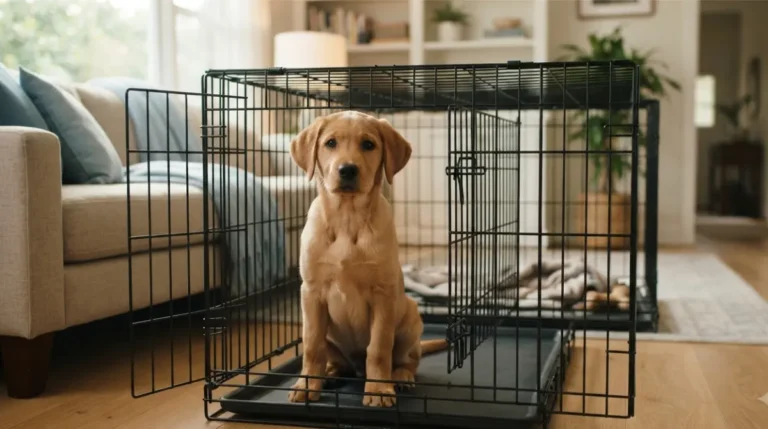
The Smart Crate vs Playpen vs Baby Gate Setup for Family Homes

Crate vs playpen vs baby gate isn’t a contest: each does a different job, and toddler homes need a hardware-mounted gate at the top of stairs.
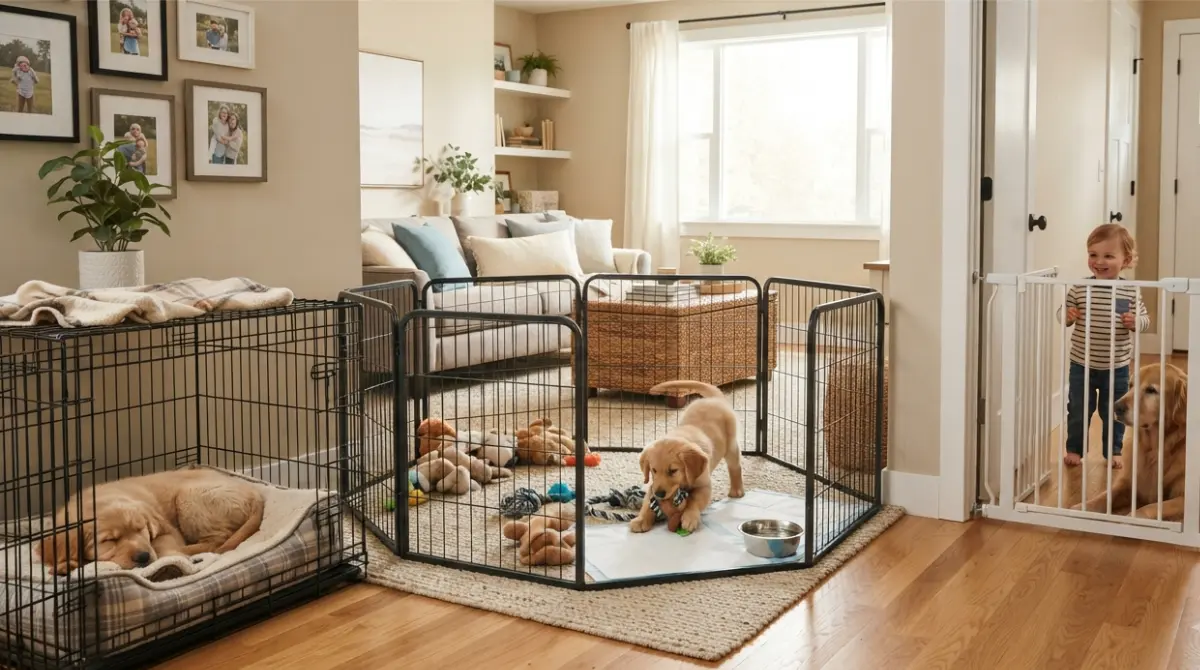
Table of Contents
Crate vs playpen vs baby gate: the short answer
Neither wins outright: each tool does a different job, and most puppy homes need a dog crate plus one of the other two.
| Tool | Best for | Not for |
|---|---|---|
| Crate | Overnight sleep, short stays, house training | Long daytime stretches |
| Playpen | Daytime play and naps in a safe zone | Dogs that jump or climb out |
| Baby gate | Closing off a room, hallway, or stairs | Puppies still chewing or having accidents |
If your puppy is under 6 months old, start with the age section. If budget is the worry, jump to costs. If you have a baby or toddler at home, read the gates section before you buy anything.
🩺 Vet Note: The time limits below are general guidelines for healthy dogs. If your puppy has frequent accidents, strains to pee, or suddenly drinks much more than usual, call your vet this week to rule out a medical cause. If your vet has prescribed crate rest, their instructions override this guide.
What a crate, a pen, and a gate each actually do
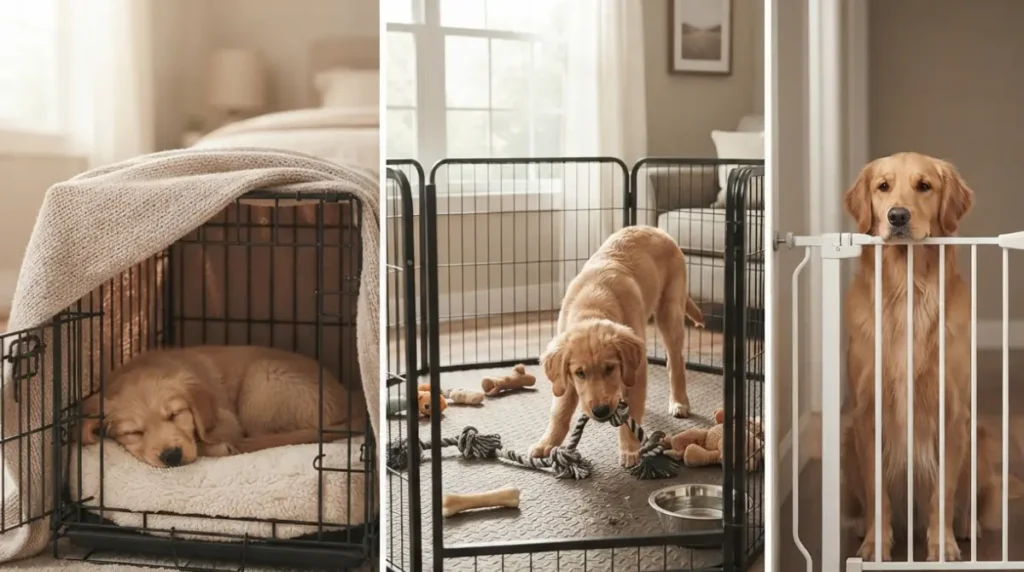
Think of the three tools as a bedroom, a living room, and a door.
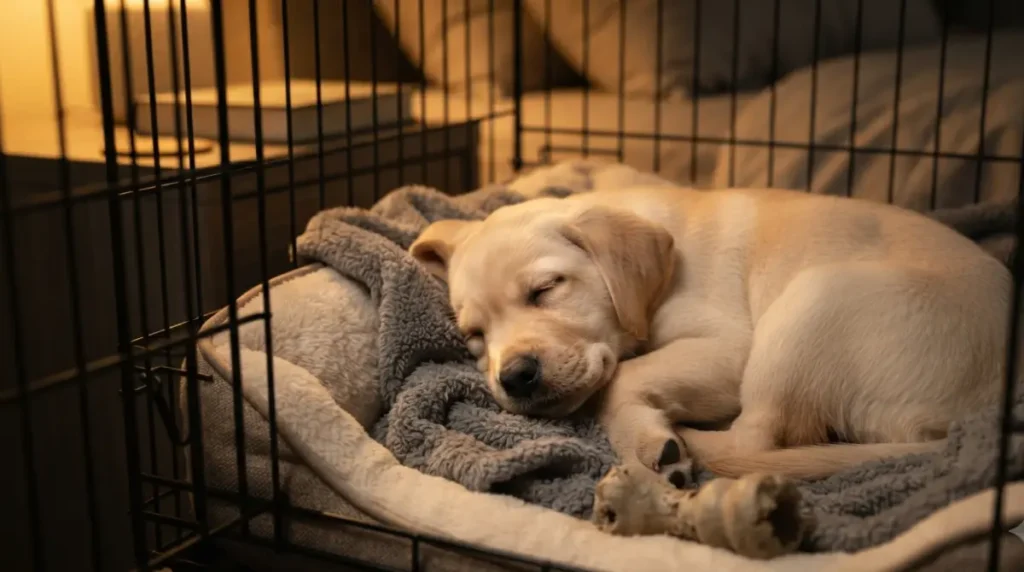
The crate: sleep and short stays
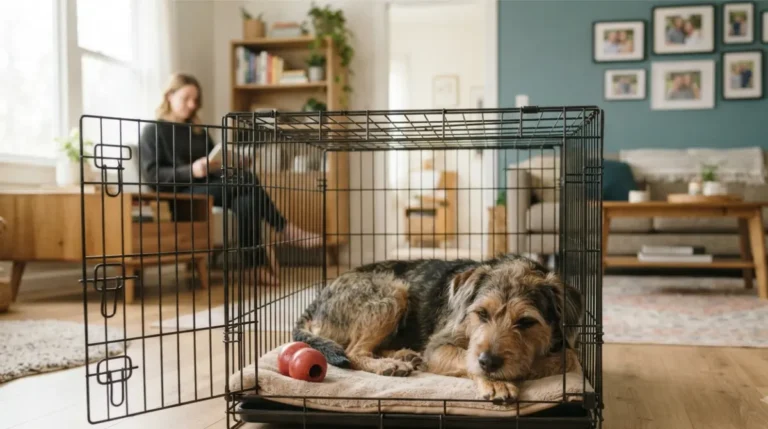
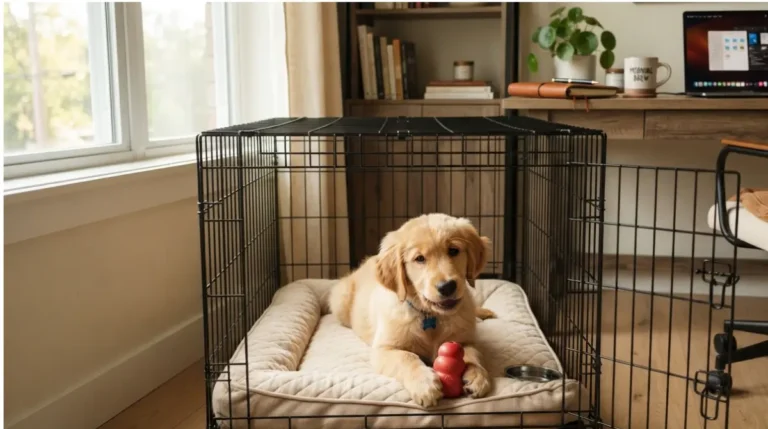
A crate is a small, den-like space that helps a puppy settle and supports house training. It should always feel like a bedroom, never a punishment.
The playpen: a day zone
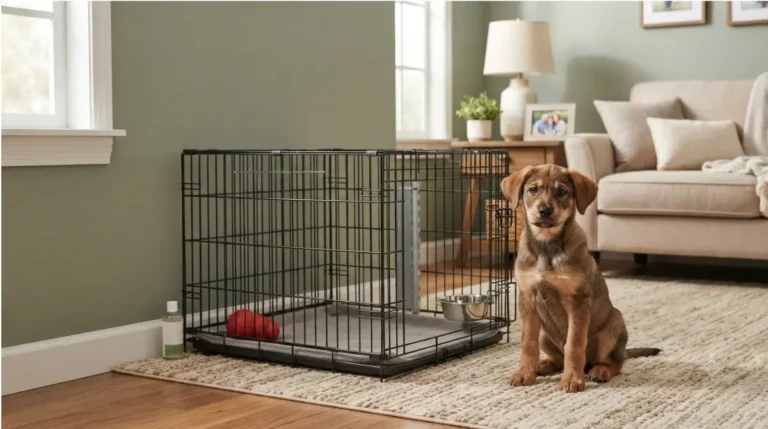
An exercise pen gives your puppy room for toys, water, and a bed. It keeps them safe while you cook or work nearby, but a young puppy still needs you close.
The baby gate: a room-sized boundary
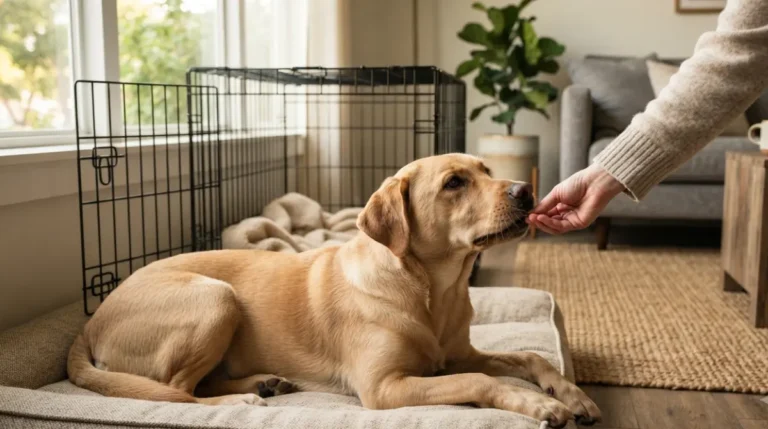
A gate controls where your dog can go rather than giving them a contained space. It works best once your dog is reliably house-trained.
The crate-inside-the-pen combo
Put the crate inside the pen with its door open: the bed goes in the crate, and toys and water go in the pen. Feeding meals in the crate keeps it a favorite spot, even with more space outside it.
🏡 Family & Home: A gated room gives your dog a retreat that doesn’t overlap with a baby’s floor time. The gate separates spaces, but an adult still supervises whenever dog and child are in the same room.
What each setup really costs (including the add-ons)
A basic puppy playpen can cost less than a crate, but the real total depends on your dog’s size and the add-ons you need.
| Tool | Price range | Common add-ons | Key detail |
|---|---|---|---|
| Wire crate | Pad, cover | Many include a divider panel | |
| Playpen | About $18 (fabric pop-up) to $126 (12-panel plastic)* | Extra panels, pee pads | Height matters more than panel count |
| Pet gate | Extensions, hardware kit | Measure the opening first | |
| Certified child gate (toddler homes) | Stair mounting kit | Required at the top of stairs |
*Walmart listings checked September 2026; prices change often.
Before buying a second, smaller crate, look into using a divider instead of buying a second crate. Many wire crates ship with one.
Which one to use at 8 weeks, 6 months, and adulthood
The right tool changes as your puppy’s bladder and judgment grow.
| Stage | Crate | Playpen | Gate |
|---|---|---|---|
| First weeks home | Overnight near your bed; short daytime stays | Main daytime zone | Not yet |
| Under 6 months | No more than 3–4 hours at a time | For longer home stretches | Short supervised trials |
| Adult | No more than 4–5 hours by day | Optional | Gated room once ready |
Crate limits from Humane World for Animals.
The months-plus-one guideline
Humane World for Animals’ crate-time guidance also suggests a puppy shouldn’t be crated longer than their age in months plus one hour. A pen gives more room, but it doesn’t make a puppy’s bladder any bigger, so they still need regular potty breaks. For long absences, see our crate plans for a full workday.
Graduating to a gated room
Move on based on readiness, not on a birthday. The signs are reliable house training and no chewing on household items when unsupervised. For how nights looked in practice, see our 14-night crate training log.
Toddlers and gates: a dog gate isn’t always a child gate
A pressure gate is not safe at the top of stairs. Pediatric gate-safety guidance calls for a hardware-mounted gate there, because pressure-mounted gates can fall over when a child pushes hard.
Pet gates vs certified child gates
Children’s gates in the U.S. must meet the federal gate standard, 16 CFR 1239, which is based on ASTM F1004. A gate sold as a pet product may not carry that certification. Skip old accordion-style gates, whose V-shaped openings can trap a child’s head.
Supervision still comes first
A gate separates your dog and your toddler, but it never replaces an adult actively watching. Pair it with the crate-is-off-limits rule for toddlers.
🏡 Family & Home: Use pressure-mounted or freestanding gates only in doorways or at the bottom of stairs. The top of the stairs always gets a screwed-in child gate.
✅ Do This: Check the gate’s label or box for 16 CFR 1239 or ASTM F1004 certification. If you’re unsure about your stair setup, ask your pediatrician at your child’s next checkup.
Jumpers, climbers, big dogs, and small apartments
Your dog’s size and athleticism decide which pen or gate will actually hold.
Pen height vs a dog that jumps
If your dog can rest their front paws on the top rail, go taller. Some dogs also use horizontal bars as a ladder.
Big breeds and renters
Measure your dog first, starting with how to measure your dog for the right crate size. Renters can use freestanding pens and pressure gates in doorways without drilling, but never at the top of stairs in a home with a young child.
When the crate, pen, or gate isn’t working
Most setup problems are fixable by stepping back, not by giving up.
Peeing in the pen
Extra space can leave room for a potty corner. Shrink the pen, add more breaks, and clean accidents thoroughly.
Crying or climbing out
Go back to shorter stays and reward calm behavior. Scolding only raises stress.
Chewing the gate or doorframe
This is your dog telling you they aren’t ready for a gated room yet, so return to the pen for now.
⚠️ Watch Out: Injuries from escape attempts, heavy drooling, or a damaged crate can signal real distress. Call your vet this week, then work with a certified behavior consultant.
FAQ
1. Can I use a playpen instead of a crate?
A playpen works well for daytime, but a crate is usually better for overnight sleep and short stays during house training.
2. Do I need both a crate and a playpen?
Most puppy homes benefit from both: the crate for sleep and short stays, and the playpen as a safe daytime zone.
3. Should I put the crate inside the playpen?
Yes, many owners do. Leave the crate door open inside the playpen so your puppy has a bed plus play space.
4. Is a playpen cheaper than a crate?
A basic playpen can cost less than a crate, but the final price depends on your dog’s size, panel height, and add-ons.
5. How long can a puppy stay in a crate?
Puppies under 6 months shouldn’t stay in a crate for more than 3–4 hours at a time, according to Humane World for Animals.
6. When can a puppy move to a gated room?
Move to a gated room once your dog is reliably house-trained and doesn’t chew household items when unsupervised.
7. Can a pet gate be used as a baby gate?
Only if it’s certified to 16 CFR 1239 (ASTM F1004), the children’s gate standard. Check the label before relying on it.
8. Is a pressure gate safe at the top of stairs?
No. Pediatric guidance calls for a hardware-mounted gate at the top of stairs, because pressure gates can be pushed over.
9. What playpen height stops a puppy jumping out?
If your puppy can rest their front paws on the playpen’s top rail, choose a taller pen or add a top.
10. Why does my puppy pee in the playpen?
A roomy playpen leaves space for a potty corner. Shrink the area and add more frequent potty breaks.
Your next step
You now know which tool does which job, what it costs, and when to switch. Start with a crate, add a pen for daytime, and bring in a gate once your dog has earned it. The 14-night pillar log linked above shows what those first nights really look like. If accidents persist despite a solid routine, ask your vet at the next visit.