Your Puppy Is Crying in the Crate at Night — Here’s What to Do

Puppy crying in the crate at night sounds the same at 2 a.m., but it isn’t. Three different sounds, three different answers. One you shouldn’t wait out.

Table of Contents
Your puppy is crying right now — here’s the 30-second answer
Puppy crying in the crate at night is normal in the first week, and the decision is simpler than most advice makes it sound. Go in if the crying is escalating, if enough hours have passed that he truly needs to pee, or if anything sounds like pain.
This is written for owners of puppies from 8 weeks to about six months, in houses and apartments, with or without kids asleep down the hall.
Go in if you hear these three things
- Escalating crying — frantic, breathless, getting louder rather than spacing out.
- It has been longer since his last potty trip than a puppy his age can manage.
- Yelping that sounds painful, or crying alongside vomiting, diarrhea, straining, or limpness. Call your vet tonight for that last one.
Wait if it sounds like this
Grumbling. Short bursts with longer gaps. Noise that is slowly winding down rather than building. That puppy is settling, and he is close.
For the full plan behind these calls, see our 14-night crate-training log.
🩺 Vet Note: This is general guidance, not a diagnosis. A puppy whose crying sounds painful, or who is crying alongside vomiting, diarrhea, straining, or lethargy, needs a veterinarian rather than a training answer. If night distress is severe or getting worse, ask your vet to examine him and, if needed, refer you to a veterinary behaviorist or certified behavior consultant.
Protest, potty, or panic: what the crying actually means
Three different things sound similar at 2 a.m., and they need three different responses.
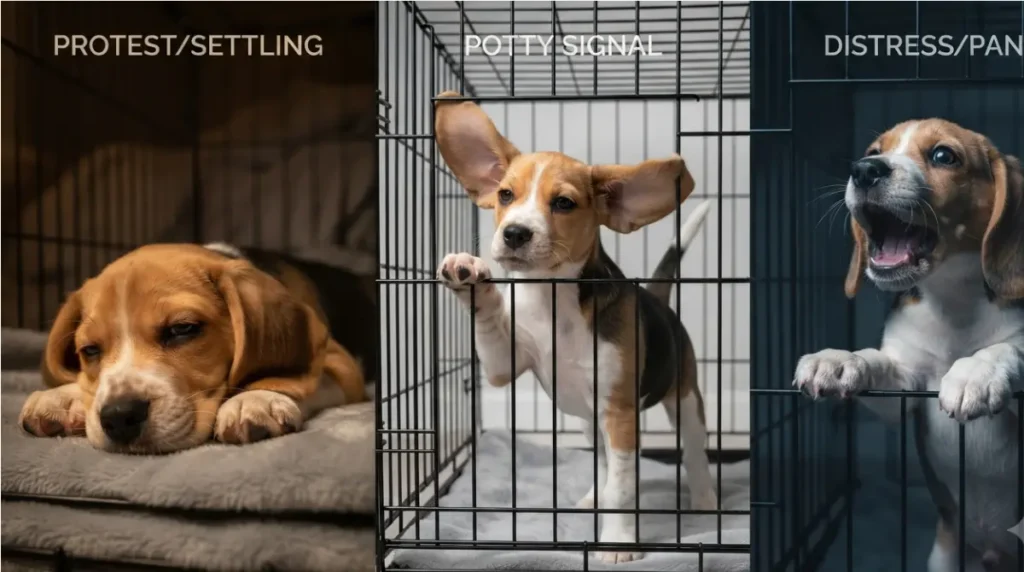
The three sounds, side by side
| Sound | What it looks like | Usually means | What to do |
|---|---|---|---|
| Grumbling, on-and-off | Shifts, sighs, gaps getting longer | Settling | Wait it out |
| Sharp, repetitive, restless | Circling, scratching at the door | Bladder | Silent potty trip |
| Frantic, escalating, breathless | Panting, clawing, no pauses | Distress | Go in and lower the intensity |
General framing, consistent with shelter and veterinary behavior guidance; not a tested result.
Does going in reward the crying?
Only if you open the door mid-cry. Protest crying that gets a door opened teaches a puppy that noise works. Meeting a genuine need quietly — and releasing him during a pause, not a peak — teaches something completely different.
Night one is its own category
An eight-week-old on his first night has never slept alone. Expect crying, and treat it as adjustment rather than a training problem. Our hour-by-hour account of what the first night actually looks like covers that night specifically.
How to go in without teaching him that crying works
The silent potty trip is deliberately boring, and that is the whole point.
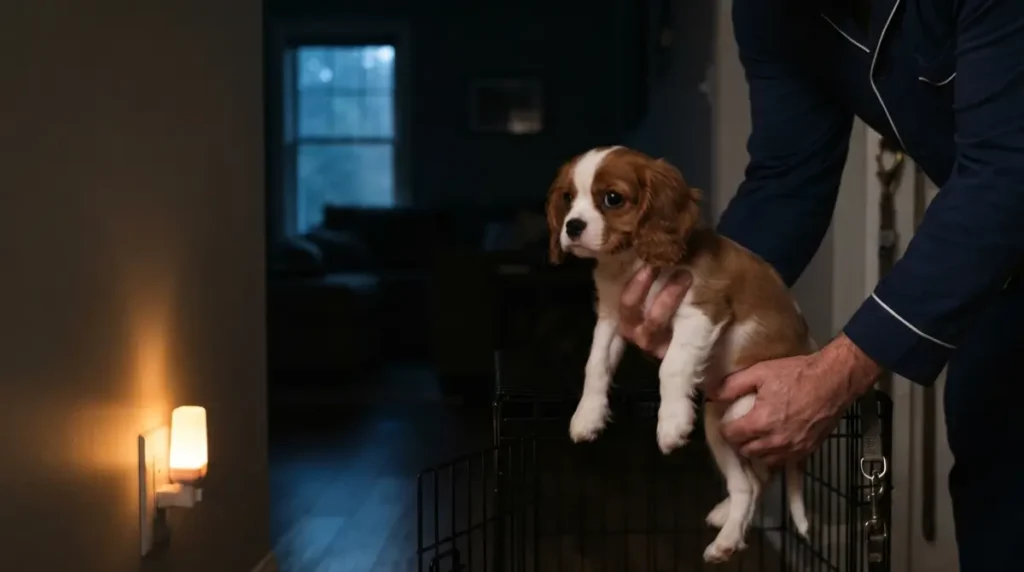
The silent potty trip, step by step
- Keep the lights off or very low.
- Lift him out without greeting, praise, or eye contact.
- Carry him straight outside on a leash.
- Stand still. No walking, no play, no talking.
- Quiet praise the moment he goes, then straight back to the crate.
- Put him in during a calm second, not mid-struggle.
If it’s not potty: the low-key check-in
Sit beside the crate. Rest a hand where he can reach it. Say almost nothing, and leave once the crying drops rather than once it stops completely — waiting for perfect silence usually means waiting through another buildup.
Keeping the crate beside your bed for the first weeks does most of this work for you. The UC Davis Clinical Animal Behavior Service’s crate-training handout also notes that crate training suits most puppies but not all, and that your veterinarian can refer you to a behaviorist or trainer if yours is struggling.
What not to do at the crate door
Don’t scold, bang the crate, or open the door while he is at full volume. An adult runs these trips, not a child — consistency at 2 a.m. is what makes the pattern hold.
How long is too long, by your puppy’s age
The honest limit is not a stopwatch — it is his bladder.
What the age bands mean in practice
| Age | Realistic overnight stretch | What crying usually means |
|---|---|---|
| 8–10 weeks | 2–4 hours | Bladder first, loneliness second |
| 10–16 weeks | 4–6 hours | Mixed; gaps start lengthening |
| 4 months+ | Often through the night | Habit, setup, or something medical |
These bands reflect a rule of thumb used widely by shelters and trainers — roughly one hour per month of age — with wide individual variation by size and breed. It is not a veterinary standard, and small breeds often need more trips for longer.
Our guide to how long a puppy can stay in the crate breaks the daytime version down separately.
Our 14 nights, logged
📊 Tested / Spec: This block holds the 14-night crying log: night number, time of each episode, which of the three sounds it was, the decision made, and what happened in the following 20 minutes — with the puppy’s name, breed, age in weeks, and weight stated.
Why the clock isn’t the real limit
A puppy who still cannot make it through the night at four months should be mentioned to your veterinarian at the next checkup, to rule out a medical cause.
When the crying wakes the baby, the kids, or the neighbors
Most advice assumes you are the only person awake. You usually are not.
🏡 Family & Home: Decide the night rota before bedtime — one named adult per shift, written down. That single step removes the 2 a.m. negotiation between two exhausted people, which is what actually breaks consistency. With a baby in the house, move the crate off the shared nursery wall and run white noise in both rooms.
What to tell the kids before bedtime
Children do not open the crate at night, and any daytime contact between a child and the puppy happens with an adult actively watching. Give kids a job instead — refilling the water bowl at breakfast works.
Apartments and shared walls
Warn neighbors in advance that you have a new puppy and it will take a week or two. Most people are far more forgiving when they were told first. If your work schedule means daytime crating too, our guide to crate training around a working day covers that half.
Still crying on night eight? What to change
Most puppies improve inside two weeks, and rarely in a straight line.
The four things that stall progress
- The door opened mid-cry, even once or twice.
- Crate too far from you, too soon.
- Too much water or activity in the last hour before bed.
- A crate large enough that he can soil one end and sleep in the other — a crate divider fixes this.
Setup fixes worth trying tonight
Move the crate closer, add white noise, and tighten the bedtime routine so the last potty trip is genuinely last. Our age-by-age crate schedule shows what a realistic night looks like at each stage.
What we will never recommend
Shock or prong collars, scruffing, or startle corrections. The American Veterinary Society of Animal Behavior’s position statement on humane dog training holds that reward-based methods carry the most advantage and the least harm to the animal’s welfare.
When crying isn’t a training problem
Most night crying is adjustment. A small amount is not.
The Merck Veterinary Manual describes separation anxiety as panic at being left alone, with confined dogs damaging the crate or door trying to reach their people, and signs typically most severe in the first 15 to 30 minutes. The ASPCA notes that ordinary problems, including incomplete house training, get mistaken for it constantly.
✅ Do This: Film 30 minutes of the crate from a phone propped nearby. Take it to your veterinarian — today if your puppy seems in pain or is injuring himself, within the week if the nights are getting worse. Tell them his age, how long each episode lasts, and whether it happens only at night or whenever he is left alone.
Puppy crying in the crate at night: quick answers
1. Should I ignore my puppy crying in the crate at night?
Not entirely. Ignore brief grumbling that is settling; check on frantic, escalating crying. Answering genuine distress does not spoil a puppy.
2. How long should I let my puppy cry in the crate?
Minutes, not hours. If the crying is still escalating after roughly 15 minutes, go in — and never let waiting override a needed potty break.
3. Will going to my puppy teach him that crying works?
Only if you open the door mid-cry. Meeting a real need quietly, and releasing him during a pause, teaches something different.
4. How long does puppy night crying usually last?
Most puppies settle within one to two weeks, rarely in a straight line. Nights getting worse after two weeks deserve attention.
5. Should the crate be in my bedroom?
For the first weeks, yes. Being close to you lowers the distress behind most night crying, and the crate can move gradually later.
6. Does covering the crate help?
For some puppies. Use a breathable cover, leave one side open, and watch for overheating. If crying increases, uncover it.
7. How do I know if he needs a potty break?
Count the hours since his last trip against his age. Restless, escalating crying after a long stretch usually means bladder, not protest.
8. Could this be separation anxiety?
Rarely this young, but possible. Panic in the first 15 to 30 minutes alone, escape attempts, or self-injury are the signs. Ask your veterinarian.
9. What do I do when the crying wakes the baby?
Set the night rota before bedtime, move the crate off shared nursery walls, and run white noise in both rooms.
10. Can I just let him sleep in my bed instead?
You can, but it drops the confinement that supports house-training and night safety. A crate at bedside height is the middle ground.
Tonight, and the next thirteen nights
Tonight you are not deciding whether you are a good owner. You are deciding one thing: escalating, or winding down.
Run that check, use the silent potty trip when the answer is bladder, and log what happened. Our night-by-night crate-training log walks the full two weeks.
One thing to raise with your veterinarian: any crying that sounds painful, or that keeps worsening past two weeks.