A puppy crate training schedule for 8, 12 and 16 weeks

Sample crate training days for puppies at 8, 12 and 16 weeks, split between two adults, with the meal-to-trip window of 10 to 15 minutes built in.
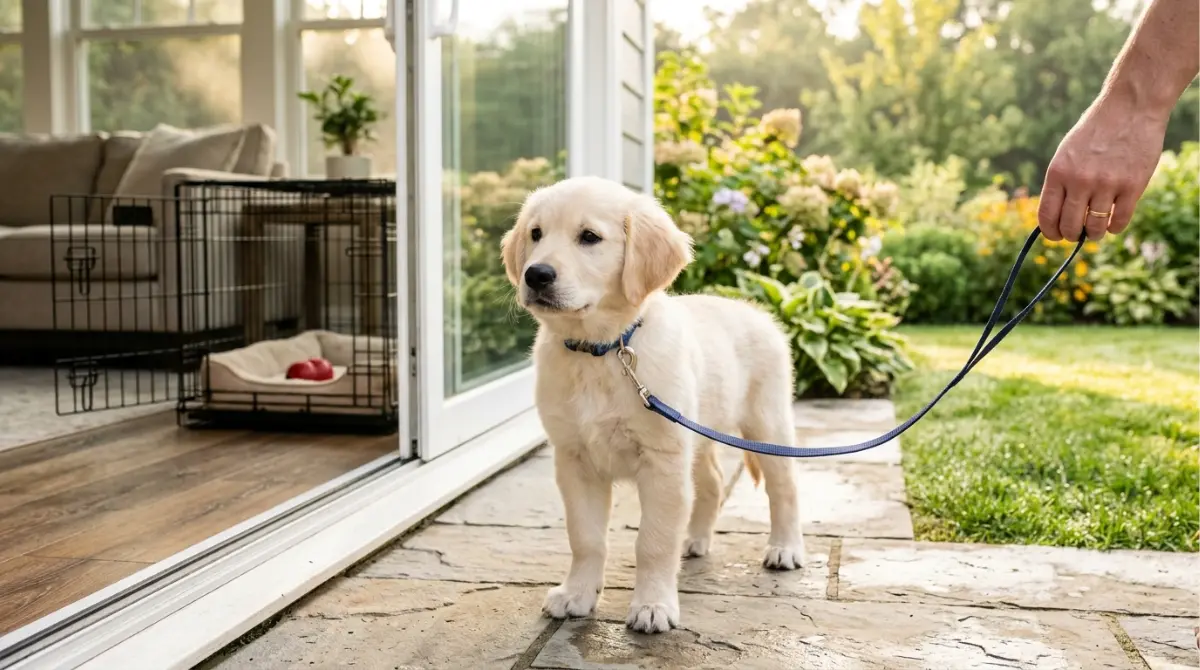
Table of Contents
A puppy crate training schedule works when every crate nap follows a trip outside: out when she wakes, after each meal and after play, then into the crate to sleep. At 8 to 10 weeks most puppies need to go out at least once an hour (SF SPCA), and from three months that gap can grow by an hour every week or two while she stays dry.
Puppies house-train at different speeds depending on their size and anatomy. Treat the times below as a starting frame and adjust them from your own puppy’s record.
The loop behind every puppy schedule
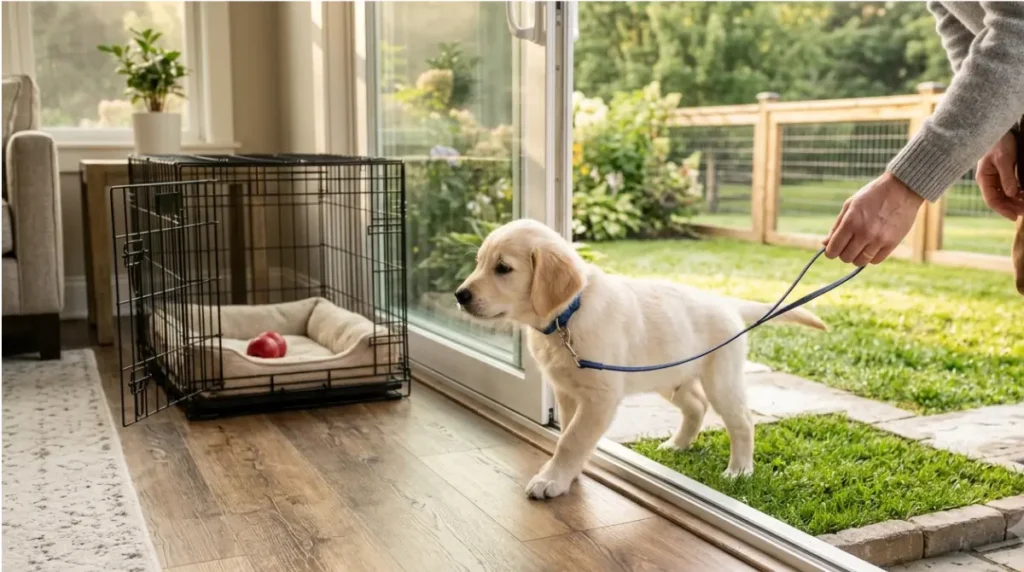
Most printed puppy schedules list clock times. The ones that hold up repeat a single loop whatever the clock says, because puppies tend to need to eliminate after eating, after naps, after hard play and whenever their activity changes (Penn Vet Behavior Medicine).
Each turn of the loop runs in this order:
- Take her out on leash to the same spot as soon as she wakes.
- Reward her the moment she finishes, before she wanders off to sniff.
- Offer a meal, or play with a little training mixed in.
- Take her out again afterward. After a meal, puppies generally need to go within 10 to 15 minutes (VCA).
- Put her in the crate with a food-stuffed toy for the next nap.
Meals and stuffed toys served inside the crate turn it into a place she walks into on her own. The crate is never used as punishment (Ohio State Indoor Pet Initiative).
One habit is worth dropping early. Waiting for a young puppy to ask to go out leaves the timing to her, and Penn Vet notes that not every dog learns to signal in a way owners recognize. The schedule does the asking for her.
What does a day look like at 8 to 10 weeks?
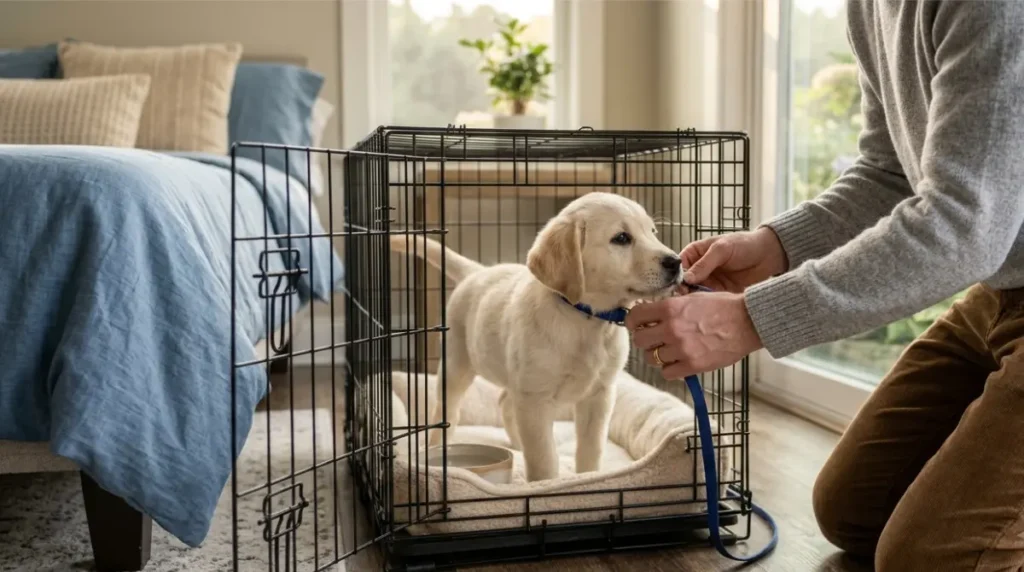
At this age the loop turns over at least once an hour while she is awake, so the day below holds far more trips outside than it has rows.
| Time | What happens | Where she is | Who, in a two-adult home |
|---|---|---|---|
| 6:30 am | Wakes; carried or leashed straight out | Outside | Adult A |
| 6:45 am | Breakfast, crate door open | Crate | Adult A |
| 7:00 am | Out again after eating | Outside | Adult A |
| 7:10 am | Play and a short training session, then out | Floor, watched | Adult A |
| 7:45 am | Nap with a food-stuffed toy | Crate, door closed | Either |
| Each wake-up | Out first, then play, then out | Outside, then floor | Whoever is home |
| 11:30 am | Second meal, then out | Crate, then outside | Adult B |
| 3:30 pm | Third meal, then out | Crate, then outside | Adult B |
| 6:30 pm | Fourth meal, then out | Crate, then outside | Adult A |
| 7:00–9:30 pm | Chews and low-key play, with trips out | Floor or pen | Adult A |
| 10:30 pm | Last trip out, bedtime treat | Crate beside your bed | Adult B |
Four meals sits inside the three-to-four-a-day range VCA’s nutrition authors give for puppies, whose stomachs are small. Each meal adds a trip. So does each nap, since she goes out the moment she wakes.
Splitting the day by meals keeps one adult from carrying every trip: whoever serves a meal takes the trip that follows it.
The bedtime crate goes beside your bed. A puppy settles more easily sleeping near you, and you will hear the restless whimper that means she needs a trip outside. Give her a special treat inside the crate at bedtime (Ohio State). Night trips are normal for an 8-week-old, and what the first two weeks of crate nights look like follows them night by night.
What changes at 12 weeks
Sources split on how quickly the gap between trips should grow once she turns three months.
| Source | Guidance | At 3 months |
|---|---|---|
| SF SPCA | From three months, add one hour between outings every week or two; after accidents, return to more frequent outings for a couple of weeks | The gap grows only as fast as she stays dry |
| Ohio State and Penn Vet | About one hour of holding per month of age, give or take an hour | 2 to 4 hours (3 × 1 hour, plus or minus 1); both use 3 to 4 hours as their example |
Read the formula as the outer edge of what a 3-month-old can hold. Schedule from the shorter interval, and add time only after a full week with no accidents.
Meals stay at three to four a day through this stage; ask your vet before dropping one.
By 16 weeks, trips out spread further apart
At four months, the one-hour-per-month rule (Ohio State) puts the outer edge for holding it at 3 to 5 hours (4 × 1 hour, plus or minus 1). The loop stays the same while the blocks get longer, with a fuller play or training stretch between a trip out on waking and the trip before the next nap. Set the gap from her record of dry days and start below the formula.
Two questions sit just outside a home-day schedule. The longest single stretch is covered in how long a puppy can stay in a crate at each age, and a full workday needs midday help, which crate training while you’re at work plans out.
If evenings turn bitey and wild
Between roughly 8 and 10 at night, many puppies nip at hands and won’t settle. Tom Candy, a clinical animal behaviorist at Dogs Trust UK, links that pattern to an overtired puppy. In an AAHA Trends interview about his review of dog sleep research, he recommends moving walks and active play earlier in the day, then switching to low-key outlets such as chews and snuffle mats as evening comes on, rather than one hard burst of exercise just before bed. Trends articles share viewpoints, not official AAHA positions.
The sleep numbers are less certain than most schedules suggest. Popular guidance gives puppies 18 to 20 hours of sleep a day, while the sleep data cited in the same article, including a 2020 study of puppies up to 12 months old, points closer to 11. Quality is easier to judge at home: a puppy sleeping well lies flat and stretched out and breathes deeply.
Candy also prefers a pen to a crate in the evening, since a pen lets a puppy get up, chew something and drift back to sleep. The vet-school handouts linked above use crates, and a pen with the open crate inside gives her both; how a crate, playpen and baby gate compare covers that setup.
With children in the home: Evening is when children and a wound-up puppy share the same floor. The crate gives a puppy a retreat from too much handling by young children (Ohio State). So children never open it or reach inside, and an adult actively watches every minute a child and the puppy are together. The crate and toddler rule shows the gate setup that backs this up.
Is the schedule moving too fast?
Accidents in the days after you stretch a gap are the clearest sign.
- After an accident on a longer gap, go back to more frequent trips for a couple of weeks, then try again (SF SPCA).
- Crying that builds instead of winding down, or panting, yawning and drooling while crated, means the session has gone past her comfort; end it and return to shorter stretches. Ohio State separates a protesting puppy from a panicking one and suggests a behavior specialist if the signs keep appearing.
- A puppy who was clean and suddenly starts soiling the crate needs a vet visit to rule out a medical cause, and why a puppy pees in the crate sorts the likely reasons.
When you catch an accident as it happens, interrupt her without harshness and take her straight out to finish. Punishing accidents teaches a puppy to hide them behind furniture, which leaves you nothing to reward outside (SF SPCA).
Set tomorrow’s first alarm tonight
Set it for the hour your puppy usually wakes, then write out tomorrow from that time, pairing each meal with the trip that follows it. Put the sheet where every adult in the house will see it before the first trip of the morning.