Is Crating Illegal Where You Live? A Clear Country Guide

Is crating a dog illegal? Mostly no, but the rules differ, and the RSPCA says never crate all day while you work.

Table of Contents
Is crating a dog illegal? The short answer
Crating a dog is legal in the UK and most of Australia. It is restricted in Sweden and Finland, contested in Germany, and was capped at 10 hours in Tasmania. The “illegal in Europe” claim is shorthand for those details.
The one-line answer
Mostly no. It depends on the country, the reason, and the hours.
Quick table: UK, Sweden, Finland, Germany, Australia
| Where | Rule |
|---|---|
| UK | No ban; welfare duty applies |
| Sweden | No crates at home unless the door is removed |
| Finland | Transport, illness, or temporary reasons only |
| Germany | Contested; open-door crates are safest |
| Australia | No national ban; Tasmania set a 10-hour cap |
🩺 Vet Note: This is general information, not legal advice; confirm local rules with your local animal welfare authority. Puppies, seniors, and post-surgery dogs have their own crate limits, so ask your veterinarian.
Is crating a dog illegal in the UK?
England and Wales have no law against crating, only a welfare duty.
What the Animal Welfare Act requires
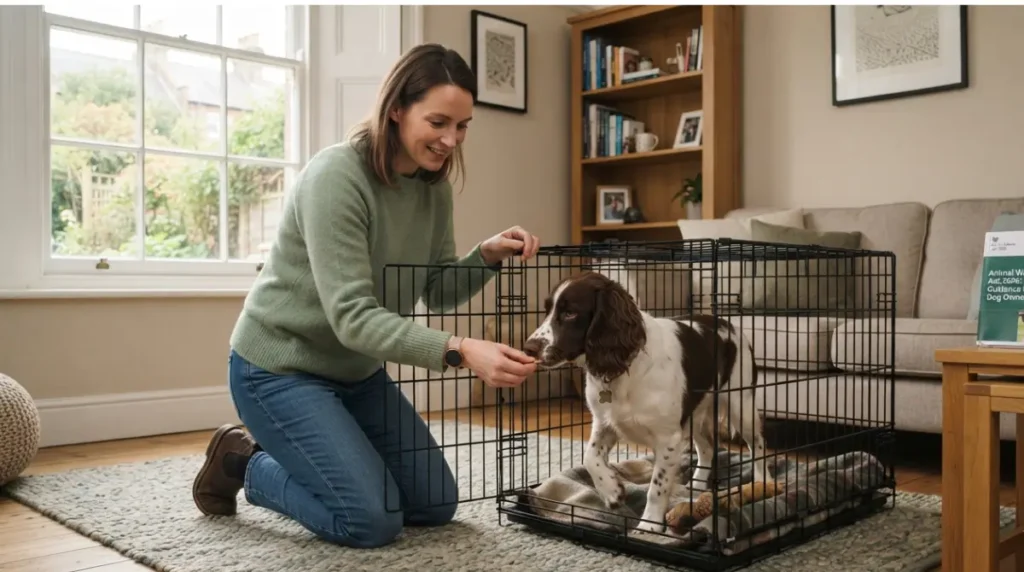
The Animal Welfare Act 2006 requires reasonable steps to meet a dog’s needs, including a suitable environment and normal behavior. A crate isn’t the offence; a routine that fails those needs can be.
RSPCA guidance: never all day
The RSPCA’s crate guidance says shutting a dog in a crate all day while you work is never acceptable; trained adults are normally fine for about three hours. See our guide to crate training while at work. England’s home-boarding licence rules cap crating at three hours in 24, but that binds licensed boarders, not owners.
Sweden and Finland: what the crate rules actually say
These two countries drive the “illegal” headlines, and the real rules are narrower.
Sweden: no crates at home, with exceptions

Swedish rules bar a crate indoors unless its door is removed completely. A crate can serve as a bed if the dog can come and go freely, per the Swedish Board of Agriculture’s inspection checklist. Exceptions include travel, training, competition, and vet-ordered rest, and they must be temporary, supervised, and comfortable.
Finland: temporary, acceptable reasons only
Finnish rules allow a crate only for transport, illness, or another temporary, acceptable reason, and a 2019 court ruling treated a working dog’s repeated crating as not temporary. The Finnish Food Authority’s welfare FAQ applies crate-space rules when a dog is caged other than temporarily.
Vet-ordered crate rest
Recovery is a recognized reason in both countries, so crate rest after surgery isn’t the target.
✅ Do This: Ask your veterinarian to document the medical reason, and your local animal welfare authority if anything is unclear.
Germany and the EU: a patchwork, not one ban
Germany’s law has no line banning crates, so the answer is contested.
Germany: behavior-appropriate housing
German law requires housing that suits a dog’s behavior, and the dog ordinance sets minimum floor space of roughly 6 to 10 square meters. Whether that covers home crates is the dispute.
EU-level rules cover transport
EU rules cover travel. For housing, check national rules; Sweden, Finland, and Germany already differ.
Open-door crates in German homes
One district authority, Landkreis Bamberg, accepts a crate at home if the door stays open and the dog can leave anytime. Other commentators say the door must be removed.
✅ Do This: Moving to Germany? Ask your local Veterinäramt (veterinary office) what it accepts.
Australia: no national ban, but Tasmania caps crate time
Australia sets welfare rules state by state, and we found no national crate ban.
Is crating a dog illegal in Australia?
No blanket ban exists, so “illegal in Australia” is wrong as stated. RSPCA Victoria advises crating only for short periods, never all day.
Tasmania’s 10-hour rule
Tasmania’s 2016 regulations allowed crating only if the dog accepted it calmly, had room to turn, stretch out, sit, and stand, and total time stayed within 10 hours in 24. New regulations took effect August 19, 2026. Start with Tasmania’s dog welfare legislation page.
Victoria and the other states
Victoria’s code requires kennels big enough to stand, turn, and lie comfortably. We couldn’t verify crate-hour rules in other states.
✅ Do This: Check your state’s RSPCA or local council before relying on an hour limit.
What a legal, welfare-first crate setup looks like
A setup that meets the strictest rule above works almost anywhere.
Door-off or fixed-open crates
Remove the door, or keep it fixed open so it can’t swing shut. That satisfies Sweden’s home rule and Germany’s cautious reading.
Short, reward-based crate sessions
Build time gradually with treats and calm praise; use the crate for rest, never punishment. Puppies can’t hold their bladders as long as adults, so keep early sessions short.
A toddler-free retreat, with an adult nearby
🏡 Family & Home: An open crate gives your dog a spot kids don’t enter. An adult should still supervise whenever a baby or toddler shares a room with a dog.
Compare options in crate vs playpen vs baby gate; in Sweden, a small playpen counts as a crate.
Moving or traveling with a dog? Check this first
Moving or traveling changes which rules apply to your crate.
Travel crates versus home crates
Transport is an accepted reason in Sweden, Finland, and Germany. Time limits vary, so check the destination first.
Renting or relocating: who to ask
Ask the destination’s local animal welfare authority about the rules, and your veterinarian about your dog’s age and health.
✅ Do This: Bring a summary of the table above to your vet visit before you move.
Crate legality FAQ
1. Is crating illegal?
Mostly no. Crating a dog is legal in the UK and most of Australia, but Sweden and Finland restrict it.
2. Is crating a dog illegal in the UK?
No. UK law has no crating ban, but owners must meet welfare needs; the RSPCA says never crate all day.
3. Is it illegal to crate a dog in Sweden?
At home, mostly yes: crating is barred unless the door is removed, with exceptions like travel and vet-ordered rest.
4. Is crating a dog illegal in Finland?
Crating is allowed only for transport, illness, or another temporary, acceptable reason.
5. Is it illegal to crate a dog in Germany?
It’s contested. One authority accepts open-door crates at home; closed permanent boxes raise welfare concerns.
6. Is crating a dog illegal in Australia?
No national ban exists. Tasmania’s earlier rules capped crating at 10 hours in 24.
7. How long can you legally crate a dog?
It varies: Tasmania’s earlier cap was 10 hours; the RSPCA suggests about three for trained adults. Ask your vet.
8. Can I leave a crate door open in Sweden?
Not unless it’s fixed open; the door must be removed so the dog can come and go.
9. Can I crate my dog when traveling?
Yes. Transport is accepted in Sweden, Finland, and Germany; check destination limits and ask your vet.
10. Does vet-ordered crate rest break crating rules?
Generally not; both countries accept medical reasons. Ask your vet to confirm.
The takeaway
You now know where crating is legal, where it’s restricted, and which setup works almost anywhere. If you crate train where it’s allowed, our night-by-night crate training log shows the first two weeks, and how long a puppy can stay in a crate covers timing. Ask your vet what your dog’s age and health allow, and your local authority which rules apply.