Crate size for a dachshund or corgi: measure the length first

Crate size for dachshunds and corgis comes from body length. A Cardigan at the top of its standard works out to 22.5 inches from breastbone to hip.
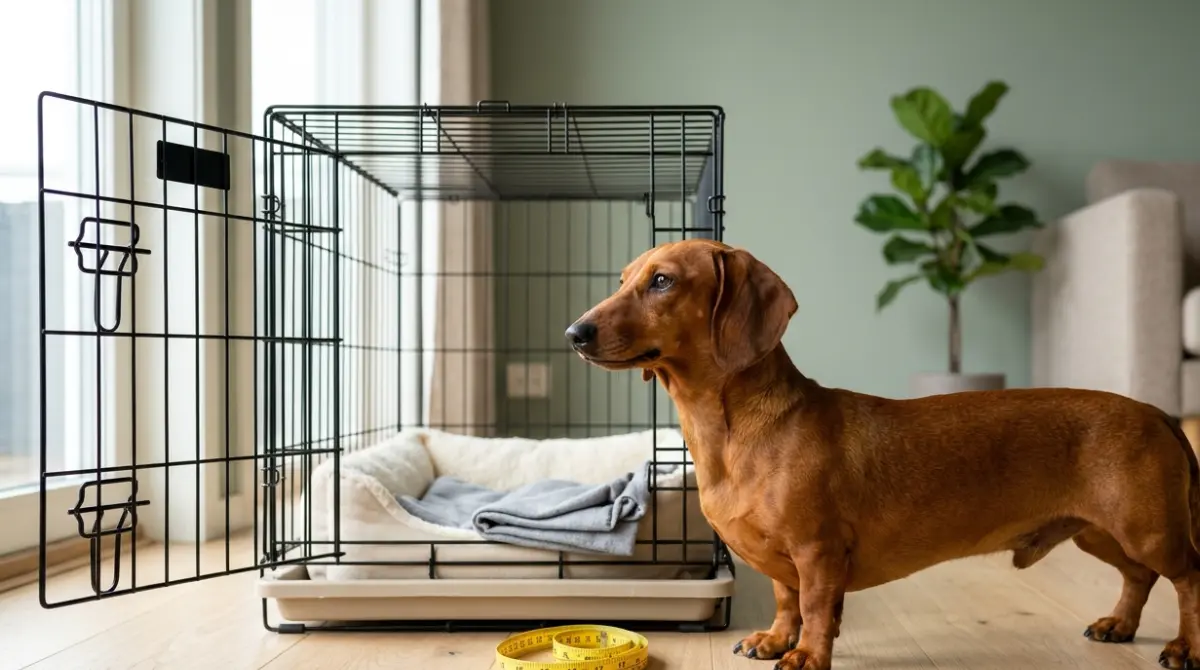
Table of Contents
Measure a dachshund or corgi from the tip of the nose to the point where the tail joins the body, add a few inches for clearance, and buy a crate whose listed length covers that total. Weight is only a cross-check. MidWest’s iCrate listing puts the 22-inch size at up to 12 pounds (5.4 kg), the 24-inch at 11 to 25 pounds (5.0 to 11.3 kg) and the 30-inch at 26 to 40 pounds (11.8 to 18.1 kg). A long, low dog can need more length than its weight band suggests.
The breed standards show why, and the listings show how small the margin gets.
Why the weight band undersells a long, low dog
Weight bands work on the assumption that a heavier dog is a longer dog. Dachshunds and corgis are bred long for their height, so a dog can sit comfortably inside its weight band and still run short on floor.
| Breed | Height at withers | Weight in the standard | Length in the standard |
|---|---|---|---|
| Dachshund, miniature | Not given | 11 lb (5.0 kg) and under at 12 months and older | No ratio given |
| Dachshund, standard | Not given | Usually 16 to 32 lb (7.3 to 14.5 kg) | No ratio given |
| Pembroke Welsh corgi | 10 to 12 in (25.4 to 30.5 cm) | Males up to 30 lb (13.6 kg), females up to 28 lb (12.7 kg) | Withers to tail base about 40% longer than withers to ground |
| Cardigan Welsh corgi | 10.5 to 12.5 in (26.7 to 31.8 cm) | Males 30 to 38 lb (13.6 to 17.2 kg), females 25 to 34 lb (11.3 to 15.4 kg) | 1.8 to 1 against height, breastbone to rear of hip |
Sources: AKC Dachshund standard · Pembroke standard, Pembroke Welsh Corgi Club of America · Cardigan standard, Cardigan Welsh Corgi Club of America.
Run those ratios and the corgi numbers turn into inches. A Pembroke standing 10 to 12 inches works out to roughly 14.0 to 16.8 inches (35.6 to 42.7 cm) from withers to tail base. A Cardigan standing 10.5 to 12.5 inches comes to 18.9 to 22.5 inches (48.0 to 57.2 cm) from breastbone to the rear of the hip.
Neither figure includes the head and neck. Both describe the show-ring ideal, and your own dog may be larger or smaller, so treat them as a floor for body length.
The dachshund standard leaves no such shortcut. It calls for a dog long in body and short of leg and gives no length-to-height ratio. For either variety, the tape is the only way to get a length figure.
Measure to where the tail starts
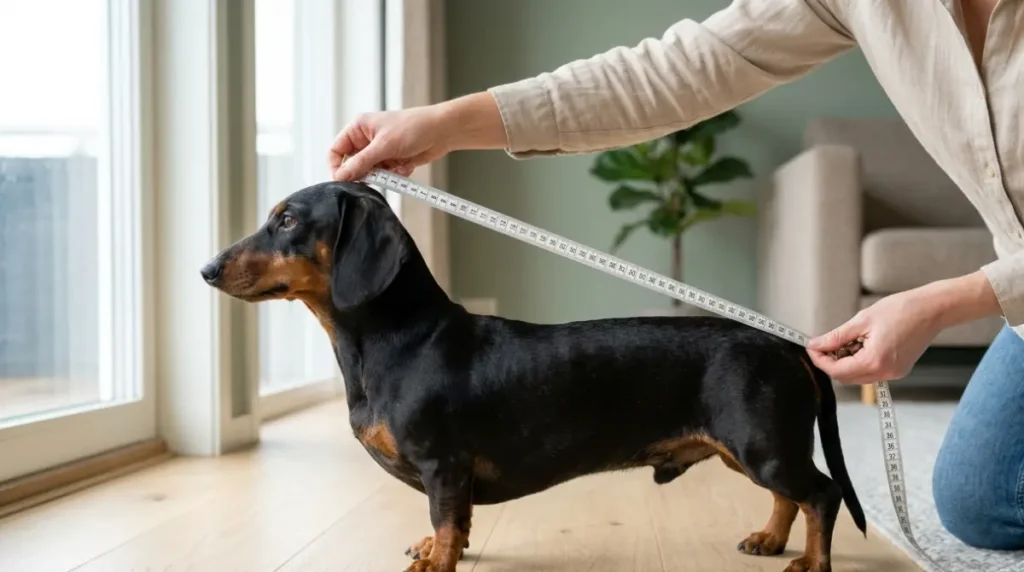
Stand your dog on a hard floor, with small treats in hand to keep a wriggly dog still long enough to read the tape.
- Run the tape from the tip of the nose along the back to where the tail joins the body. This is the length method in MidWest’s crate sizing guide.
- Measure from the floor to the top of the head while your dog stands naturally.
- Add a few inches of clearance to each number. The measure-first crate size chart uses 2 to 4 inches (5 to 10 cm).
- Compare both totals with the length and height printed in the crate’s listing.
Where you stop the tape changes the answer for these three breeds in different ways. The Pembroke standard asks for a tail docked as short as possible, with up to 2 inches (5.1 cm) allowed, so base and tip sit close together; a Pembroke with a full natural tail is measured to the base just the same. A Cardigan’s tail reaches well below the hock, and a dachshund’s runs on as a continuation of the spine. A tape taken to the tip adds the whole tail and steers you toward a longer crate than the body needs.
Some sizing guides do measure to the tip. If yours did, redo the length at the base before you order.
What a 24-inch or 30-inch crate gives you inside
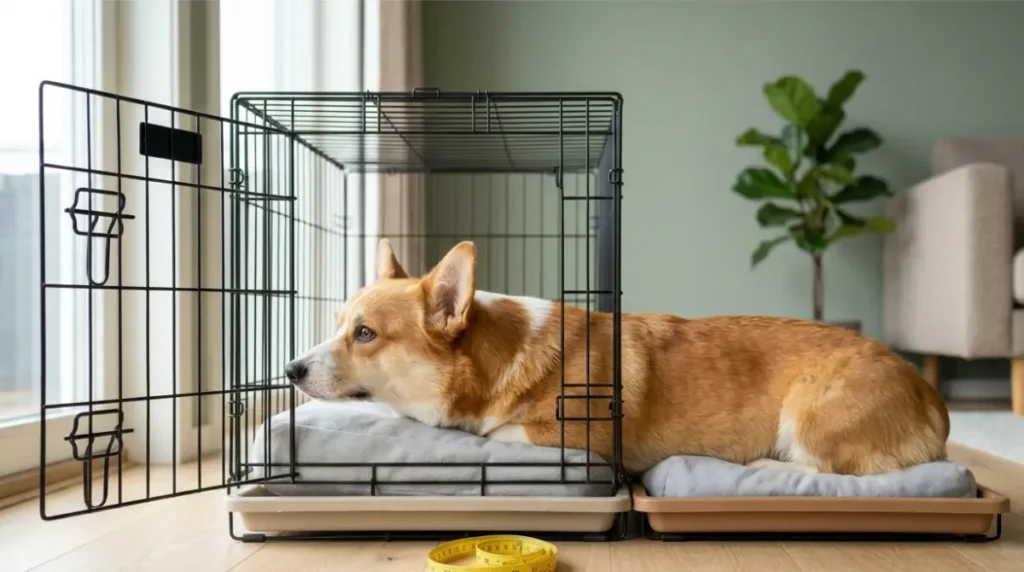
A single MidWest iCrate model sold as 24-inch is listed at 23.63 inches long by one US retailer and 24.8 inches by another.
| Crate | Listed L × W × H (US retailers, checked Oct 24, 2026) | Retailer |
|---|---|---|
| MidWest iCrate single door, 24-inch | 23.63 × 16.74 × 19.30 in (60.0 × 42.5 × 49.0 cm) | Walmart |
| MidWest iCrate single door, 24-inch | 24.8 × 17.5 × 19.5 in (63.0 × 44.5 × 49.5 cm) | PetSmart |
| MidWest iCrate double door, 30-inch | 30 × 19 × 21 in (76.2 × 48.3 × 53.3 cm) | Tractor Supply |
The 30-inch figures come from the retailer’s answer to a customer question. None of the three listings says whether its figures are inside or outside measurements.
Set the top of the Cardigan standard against those numbers. A 22.5-inch body plus even 2 inches of clearance comes to 24.5 inches (62.2 cm). That is longer than the 23.63-inch listing and leaves 0.3 inch inside the 24.8-inch one, before the head and neck are added. Yet a 25-pound Cardigan female still sits inside the 24-inch weight band.
That is where a weight chart and a long dog part ways.
Height is the second check. The 24-inch listings give just over 19 inches (49 cm), and the 30-inch gives 21 inches (53.3 cm), so compare your head-height total with those.
Before you buy: go by the length printed in the listing, since the size in the product name is a rounded label. When your total lands at the top of a size, choose the next size up, as the 24-inch iCrate listing advises. For a long back, look for a low door threshold, which the same listing mentions, so the step in stays small.
Floor level and a low step for a long back
Dachshunds account for an estimated 40 to 75 percent of all intervertebral disc disease (IVDD) cases. The figure is an American College of Veterinary Surgeons estimate published by Cornell’s Riney Canine Health Center. It describes the breed’s share of cases; it does not say how many dachshunds develop the disease.
Keeping a dog trim and fit, and cutting down on stairs and on jumps off a bed or sofa, lowers the odds of a spinal injury. A crate fits that advice when it stands on the floor, never on furniture or on top of another crate, so going in and out never involves a jump.
Back trouble can be quiet at first. A dog with a disc problem may avoid turning its head one way, walk with a wobbly gait or look weak in the rear. Call your veterinarian today at the first sign of back discomfort.
Call a vet now if: your dog cannot get up or use the back legs, or loses bladder control alongside these signs. Go to your vet or the nearest emergency vet now. Cornell notes that when surgery is recommended, waiting lowers the chance the spinal cord recovers. Give no medication unless a vet tells you to.
If the vet prescribes crate rest, the vet decides how much room the dog gets. Crate rest after surgery covers the household routine around those weeks.
Is my dachshund puppy a miniature yet?
Not before 12 months, by the AKC’s measure. The standard places miniatures in a class for dogs 11 pounds and under at 12 months of age and older. Until then, a puppy’s adult variety is a forecast.
Size a puppy’s crate for the expected adult, allowing for the difference between males and females and for the parents’ sizes where you know them (MidWest). The same reasoning covers a corgi puppy, with the Pembroke or Cardigan row of the table as the adult range.
A divider panel keeps the adult crate snug until the puppy grows into it. Crate divider setup for a growing puppy covers where to set the panel and when to move it.
Once it fits, plan the first night
Order the crate only once both totals clear the listing, and set it on the floor where your dog will sleep. A puppy’s first night in the crate walks through bedtime itself. Crate training a puppy at night carries the routine through the weeks after.