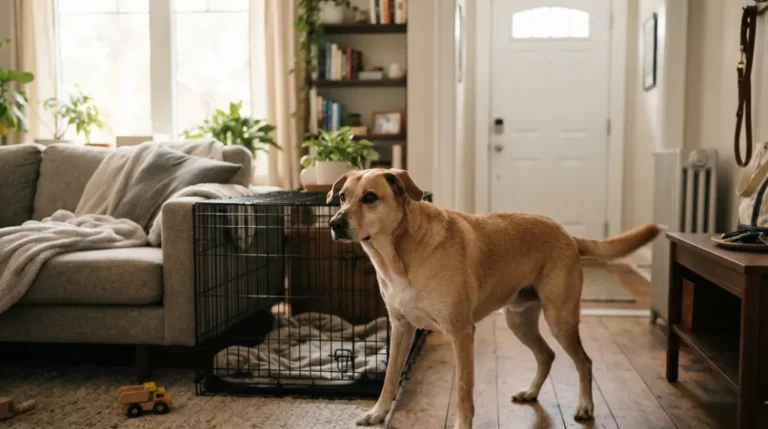
Crate Training While at Work, Made Clear for Long Days

Crate training while at work stops working past about four hours for a young puppy. Here’s the workday clock, coverage options, and what daycare costs.
Table of Contents
Can you crate train a puppy with a full-time job?
Yes — if two things are true. Someone breaks up the middle of the day, and the crate is already a good place before your first solo workday. Crate training while at work goes wrong when either one is skipped.
Which version of this applies to you
- Puppy under about four months, workday of eight hours or more: you need midday coverage from day one, not eventually.
- Puppy five months or older, standard workday: one midday break usually covers it.
- Two adults on different shifts, a hybrid day, or kids home mid-afternoon: split the day inside the household before you pay anyone.
If the crate itself is brand new, start with our night-by-night crate training log — nights are the harder half, and they come first.
🩺 Vet Note: Safe crate time depends on your individual puppy’s age, size, and health. If your puppy repeatedly soils a correctly sized crate, cannot settle, or tries to escape it, book a veterinary visit to rule out a medical cause before treating it as a training problem. This article is general guidance, not individual veterinary advice.
How long your puppy can actually be in the crate
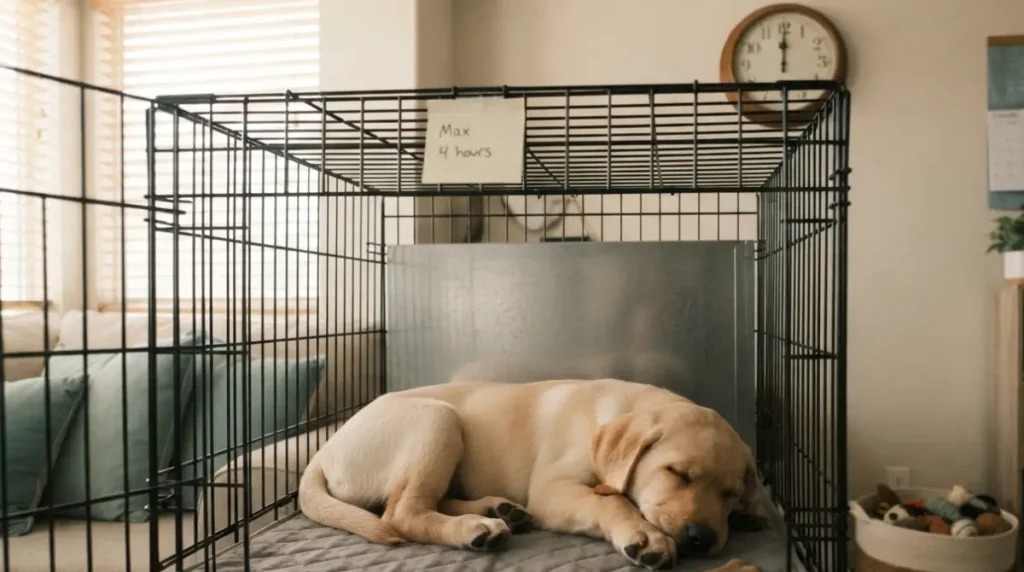
Use the shorter of two numbers: the month-plus-one guideline, or about four hours.
Crate hours by age
| Puppy age | Typical limit between breaks | Left uncovered in a 9-hour day, door to door |
|---|---|---|
| 8–10 weeks | About 1 hour | ~8 hours |
| 3 months | Up to 4 hours | ~5 hours |
| 4 months | Up to 4 hours (cap applies) | ~5 hours |
| 5 months | Up to 4 hours (cap applies) | ~5 hours |
| 6 months and older | Up to 6 hours | ~3 hours |
📊 Sourced: The month-plus-one guideline — your puppy’s age in months, plus one hour — comes from American Kennel Club and humane-society guidance, which also advises that puppies under six months not be crated beyond three to four hours at a stretch. That cap is why rows three to five above don’t keep climbing.
Now subtract your workday
The gap in that third column is the real problem, and it doesn’t shrink because you’re busy. It has to be filled by a person, a different confinement setup, or a different plan.
Is a full workday ever okay?
Not for a young puppy. A puppy forced to soil its crate stops trying to hold it, which makes house-training slower, not faster. Our full breakdown of how long a puppy can stay in a crate by age covers the bladder timing behind these numbers.
Front-load the crate before your first day back
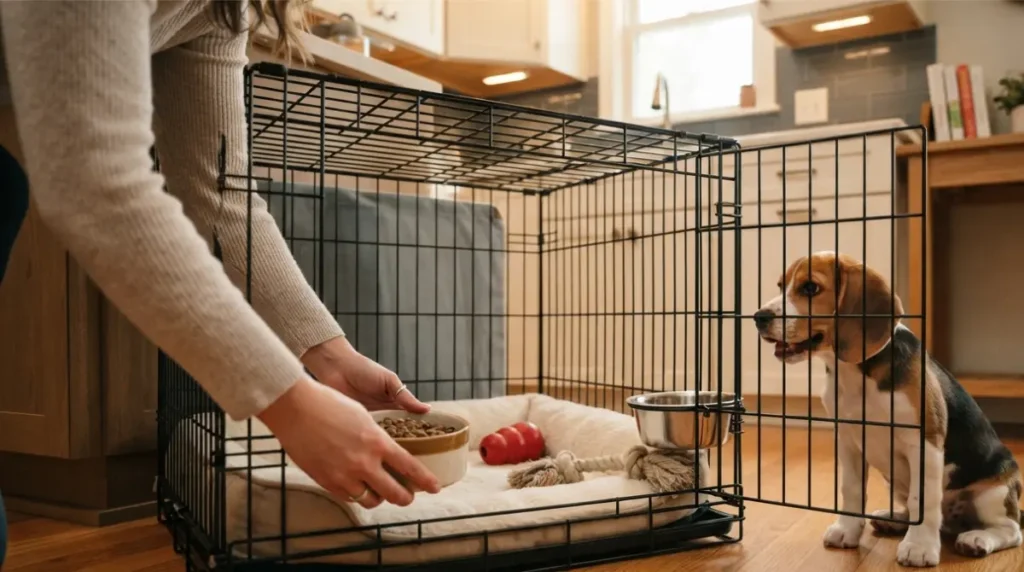
The crate introduction has to happen before the crate has to do a full day’s work.
The days before you go back
- Feed every meal in the open crate for two to three days, door untouched.
- Close the door while your puppy eats, open it the moment the bowl is empty.
- Add a stuffed, frozen chew toy and build from one minute to twenty, with you in the room.
- Leave the house for ten minutes, then thirty, then an hour — on separate outings.
Setting the crate up for a long stretch
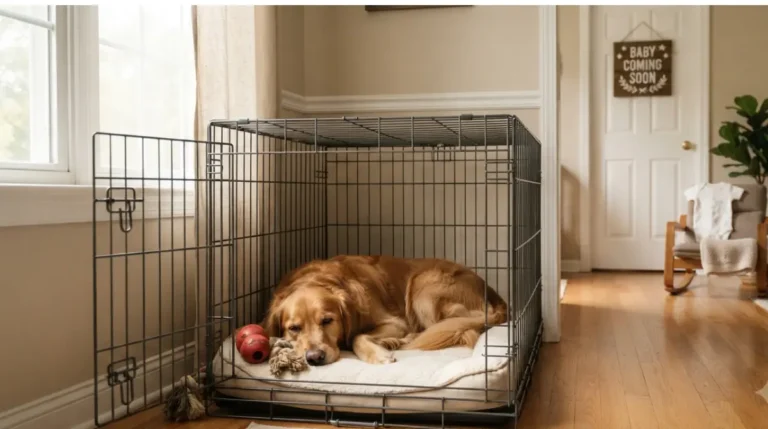
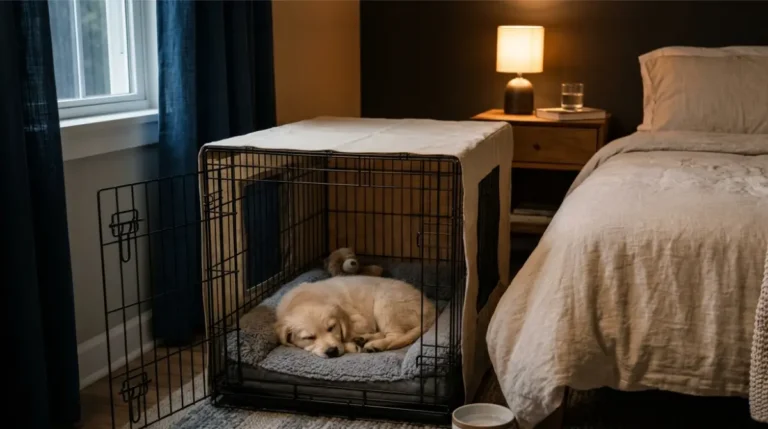
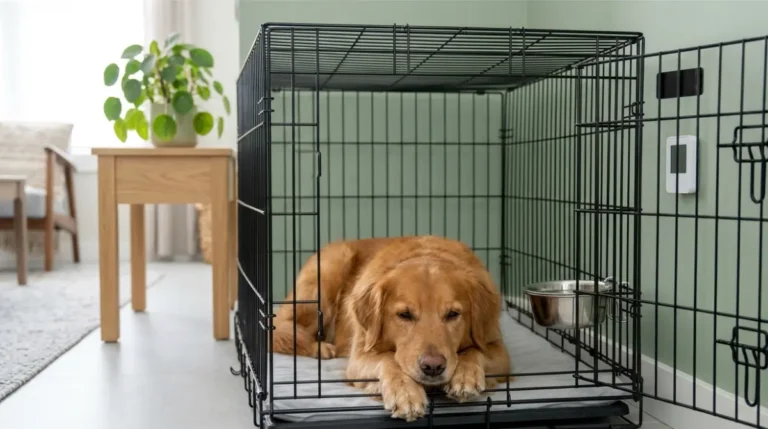
Size it so your puppy can stand, turn around, and lie down, and no larger; use the divider panel while they grow. Put it where the household actually sits, not in a laundry room. Water, safe bedding, one long-lasting chew.
⚠️ Watch Out: The most common mistake is jumping from twenty-minute sessions straight to an eight-hour day on Monday morning. That single jump is what turns a neutral crate into one your puppy panics in.
What not to do
Don’t use the crate as a consequence, and don’t leave a distressed puppy to “cry it out” as a method — veterinary behavior guidance supports reward-based training only. If nights are still rough, our guide to the first night in the crate comes first.
A workday crate schedule that survives a real commute
A workday crate schedule works backward from your door, not from an idealized 9-to-5.
Before you leave
- Potty break outside, on leash, first thing — no play yet.
- Breakfast, then twenty to thirty minutes of walking or training.
- Second potty break, then into the crate with a frozen stuffed toy five to ten minutes before you go.
- Leave without a goodbye routine.
The hours you’re gone
Your midday person repeats the same sequence in miniature: out for a potty break, short play or walk, settle, back in with something to chew. Home again, the first thing is another potty break — not greeting, not dinner.
✅ Do This: Write your own start time at the top and fill in the exact clock times, including your real commute. A schedule with “morning” and “lunchtime” on it fails on week one; one with 6:40, 7:20, and 12:30 on it doesn’t.
Who covers the middle of the day
Four options cover the gap, and the cheapest one is usually a person you already know.
Walker, sitter, neighbor or daycare
| Option | What it does for the puppy | Best for |
|---|---|---|
| You, on a lunch break | One break, familiar handler, no cost | Commutes under 20 minutes |
| Neighbor, family, or older teen | One break, free or low cost, variable reliability | Households with someone nearby |
| Dog walker or pet sitter | Scheduled break plus a short walk | Most 8–9 hour workdays |
| Doggy daycare | Full-day supervision and company | Older puppies, longer days |
What each costs
📊 Sourced: Full-day doggy daycare typically runs about $35–$50 in the US as of 2026, with half-days lower. Dog-walking rates vary too widely by area to quote here — call two or three local walkers and compare, and ask whether they’ve handled puppies mid-house-training.
Daycare has an extra condition: check with your veterinarian first that your puppy’s age and vaccination status suit a group setting.
If nobody can come
Use a pen or a gated area with the open crate inside and an absorbent surface at the far end. It protects your floors and your puppy’s bladder, and it does slow house-training, because your puppy learns that going indoors is sometimes fine. That trade-off is real, and it’s still better than a soiled crate.
Making it work with the rest of the household
A household crate plan beats one person doing everything badly.
Splitting the day between two adults
Whoever leaves last does the pre-crate potty break; whoever gets home first does the release. Hybrid days aren’t days off from the schedule — hold the same crate blocks so the routine stays predictable.
Kids and the crate
🏡 Family & Home: Crate rules for kids: the crate is the puppy’s room, nobody opens the door or reaches inside, and an adult handles every exit. A child arriving home from school doesn’t let the puppy out alone, even if they’re old enough to be trusted with the key. Every interaction between a child and the puppy needs an adult actively watching, not in the next room.
Renting, neighbors and noise
Barking is a tenancy problem as well as a welfare one, so tell your neighbors you’re working on it before they complain. The fix is the same either way: shorter stretches, more coverage, and a slower build.
When the crying isn’t just protest
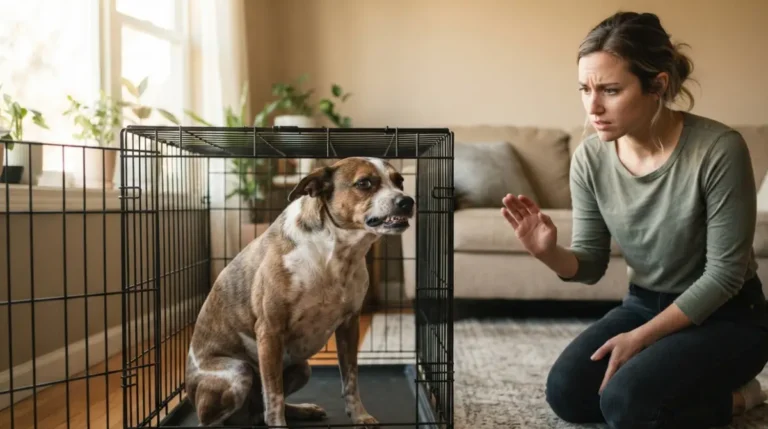
Settling noise fades; distress in the crate escalates or doesn’t stop.
What normal settling looks like
A few minutes of whining or barking after you leave, then rummaging, then sleep. On camera you want to see the noise shortening week over week.
Signs that need a professional
- Vocalizing that continues for most of your absence
- Drooling, heavy panting, or pacing that doesn’t settle
- House-soiling in a puppy who’s otherwise been reliable
- Chewing or digging focused on the crate door or exits
- Escape attempts, which can injure your puppy
✅ Do This: See your veterinarian first to rule out a medical cause — bring the camera footage and note when the behavior starts relative to your departure. Go today if your puppy is injuring itself; otherwise book within the week. If it’s behavioral, ask for a referral to a board-certified veterinary behaviorist or a certified behavior consultant. The ASPCA’s guidance on separation anxiety explains why treatment is gradual and why waiting it out doesn’t work.
Crate training while at work: common questions
1. Can I crate train a puppy if I work 8 hours a day?
Yes, with midday coverage. Crate training while at work fails when a young puppy goes the whole day without a break.
2. How long can a puppy be left in a crate during the day?
Use the shorter of two numbers: age in months plus one hour, or about four hours for puppies under six months.
3. Is it cruel to crate a puppy while at work?
No, when the crate is introduced positively and the day is broken up. It becomes harmful when a puppy is left long enough to soil it.
4. What do I do if I can’t get home at lunch?
Ask a neighbor or family member first, then price a dog walker or sitter. Daycare suits older puppies and longer days.
5. How much does a midday dog walker cost?
Rates vary too much by area to quote reliably — call two or three local walkers and ask about puppy experience.
6. Should I use a playpen instead of a crate while at work?
A pen with the open crate inside works when nobody can come at midday. It slows house-training, but protects your puppy’s bladder.
7. Can I put puppy pads in the crate?
No. Pads in the crate teach your puppy to eliminate where it sleeps. Put them at the far end of a pen instead.
8. How long should I take off work for a new puppy?
Long enough to run the crate introduction in steps — a long weekend at minimum, ideally several days more.
9. Why does my puppy cry in the crate when I leave?
Short protest noise that fades within minutes is normal settling. Crying that continues most of your absence is distress.
10. Will crating all day cause separation anxiety?
Long unbroken confinement can make being alone harder, not easier. If the signs in this article appear, see your veterinarian.
Your first week back
Expect an accident, some noise, and a schedule you adjust by Wednesday. That’s the normal shape of week one, not a sign you’ve failed your puppy.
Start with the night-by-night crate training log if nights are still unsettled, and book the midday coverage before Monday rather than after. If your puppy can’t settle at all, that’s the thing to raise with your veterinarian this week — ask them to rule out a medical cause first.