A Dog Crate Size Chart Built on Real Measurements

Dog crate size charts don’t agree: makers list different weight ranges for the same size. Your dog’s two measurements settle it.
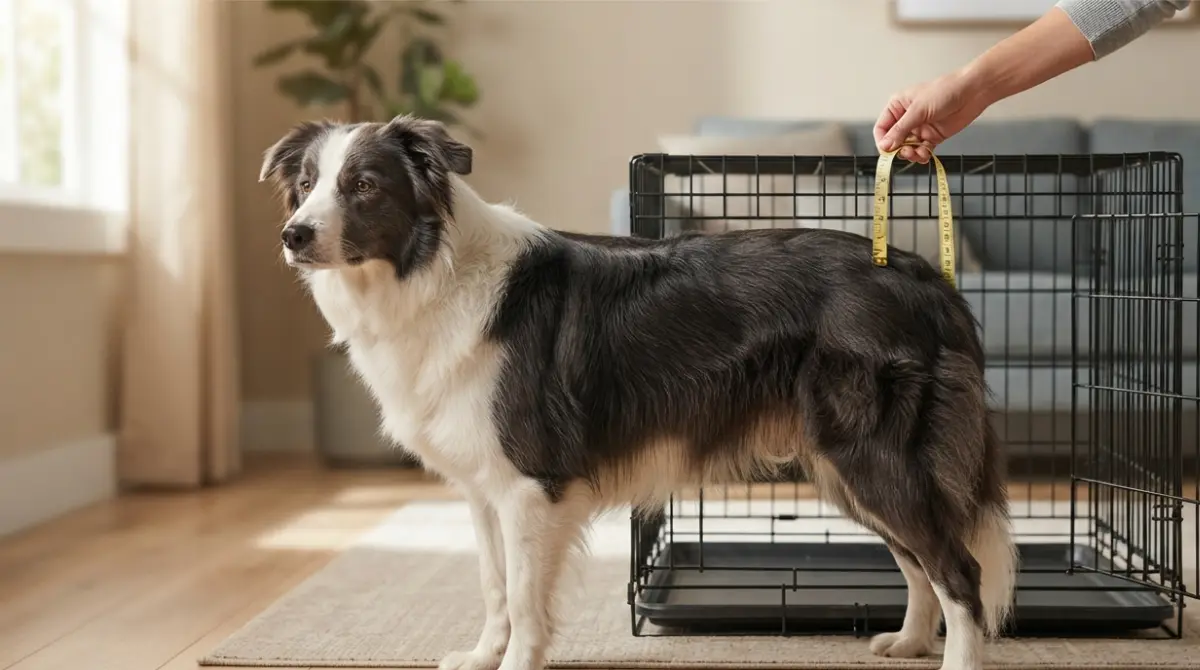
Table of Contents
Most crates are bought by weight, and that is where the returns come from. A 45-pound Basset Hound and a 45-pound Border Collie do not take the same dog crate size — length and height decide the fit, not the scale.
You need two numbers: your dog measured nose to the base of the tail, and floor to the top of the head.
Full-grown dog? Go straight to the chart. Growing puppy? Size for the adult dog and add a divider. Crate already home and looking wrong? Start at the sizing mistakes.
Getting the size right first is what makes the rest of our night-by-night crate training plan work.
🩺 Vet Note: This is sizing guidance, not veterinary advice. A dog who cannot stand, turn, and lie fully stretched needs a different crate, not an adjustment — and brachycephalic dogs, seniors, and dogs with joint or mobility conditions have needs no chart can capture. Any breathing difficulty, physical discomfort, or lasting distress in the crate is a conversation with your veterinarian.
How to measure your dog in two minutes
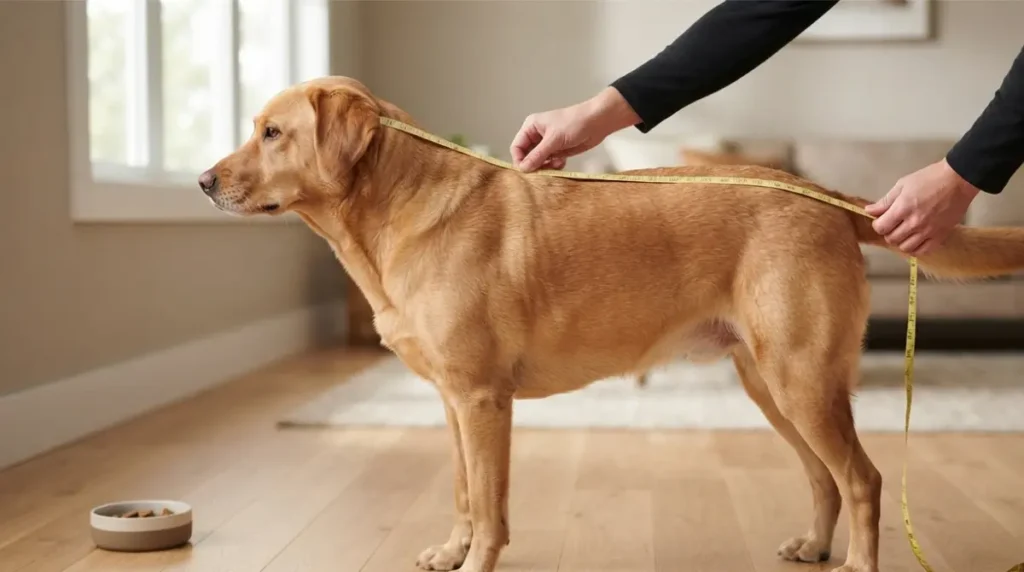
Measuring takes two numbers and about two minutes, with a tape measure and a handful of treats.
- Measure length from the nose to the base of the tail — where the tail meets the body, not the tail tip. Measuring to the tip buys a crate several inches longer than your dog needs.
- Measure height from the floor to the top of the head with your dog standing. On an erect-eared dog, measure to the ear tips instead.
- Add 2–4 inches to both numbers — nearer 2 inches for small dogs, 4 for large ones.
- Match both numbers to the crate’s stated interior dimensions.
Those two measurements, plus a few inches of clearance, are the method MidWest’s published crate sizing guidance uses, and they produce a crate your dog can stand in, turn around in, and lie down in — which is the floor, not the target.
Dog crate size chart: match your measurements to a crate
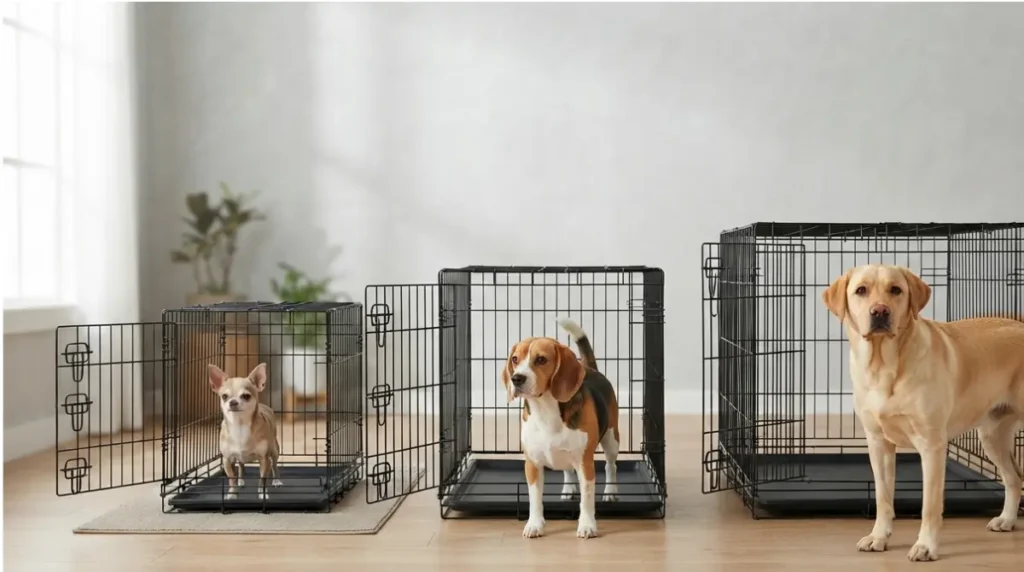
Find your measured length in the middle column, then use the weight band only to sanity-check the row.
| Crate length | Measured dog length it suits | Weight guide (varies by maker) | Example adult breeds |
|---|---|---|---|
| 18–22 in | up to ~16 in | under 15 lbs | Chihuahua, Pomeranian, Yorkshire Terrier |
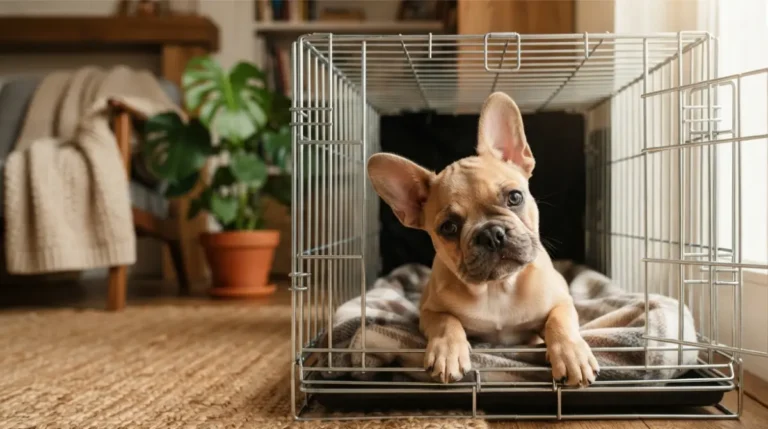
| 24 in | up to ~20 in | 15–25 lbs | French Bulldog, Cavalier King Charles Spaniel |
| 30 in | up to ~26 in | 25–40 lbs | Beagle, Welsh Corgi, Miniature Schnauzer |
| 36 in | up to ~32 in | 40–65 lbs | Border Collie, Cocker Spaniel, Shetland Sheepdog |
| 42 in | up to ~38 in | 65–90 lbs | Labrador Retriever, Golden Retriever, German Shepherd |
| 48 in | up to ~44 in | 90–110 lbs | Rottweiler, Bernese Mountain Dog |
| 54 in | over ~44 in | 110 lbs and up | Great Dane, Saint Bernard |
Length column derived from published nominal crate lengths and the 2–4 inch clearance rule. Breeds are size examples only; individual dogs within a breed vary, so measure.
Weight and breed are a cross-check, not the answer
Published weight bands genuinely disagree between manufacturers — one lists its 42-inch crate for 71–90 pound dogs while another maps 65–85 pounds to the same nominal size. Your tape measure does not disagree with itself.
Is a 36-inch crate big enough for a Labrador?
Most adult Labradors measure past 32 inches nose to tail base, so 42 inches is the usual fit. A small female may fit a 36 — measure before you assume.
Buying for a puppy: size the crate for the adult dog
Buy the crate your puppy will need at full size, then make it temporarily smaller. One crate plus a divider beats two or three crates.
Estimate the adult size first
For a known breed, use the breed’s published adult weight range. For a mixed-breed puppy, take their current age and weight, compare against the breed group they most resemble, and err on the larger side — a divider fixes too big, nothing fixes too small.
Set the divider to today’s dog
Slide the divider so your puppy can stand, turn around, and stretch out with a few inches to spare, and no more. The extra space behind it stays sealed off.
When to move the divider
Move it when that clearance disappears, not on a calendar — then pair the space with a crate schedule matched to your puppy’s age.
Four sizing mistakes that cost people a second crate
Four errors account for most wrong crates, and all four happen after the reader already has the right number.
- The listed size is the outside. A 42-inch crate is 42 inches of exterior length; the usable space inside is smaller. Plastic crates lose more, because the walls curve inward.
- Buying to weight instead of body shape. Long-backed, deep-chested, and tall erect-eared dogs outgrow their weight band.
- Going too big to be generous. Extra floor space lets a dog sleep at one end and soil the other.
- Forgetting the door and tray. A short-legged or senior dog has to step over the tray lip through the door opening.
🔍 Why It Works: A snug crate supports housetraining because dogs avoid soiling where they sleep. Remove the snugness and you remove the mechanism — which is why “size up, then divide” beats “size up and hope.”
Will that crate actually fit your room?
A 42-inch crate is a piece of furniture. Measure the floor space and the doorway before you order, not after it arrives flat-packed.
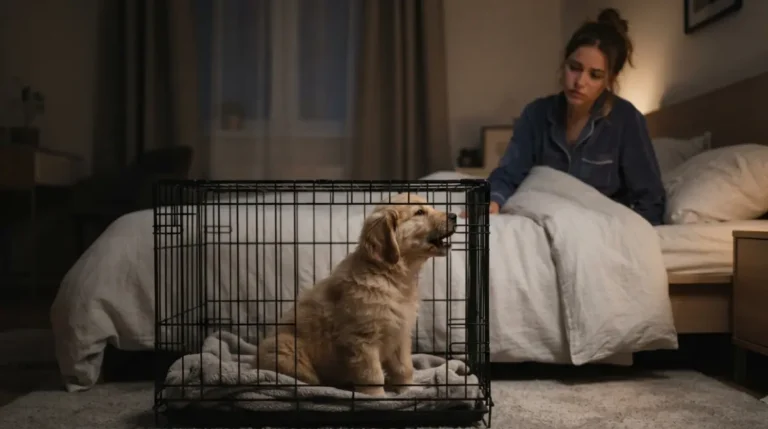
Bedroom crating at night
Night crate training works best with the crate beside you, so the footprint has to clear your bed and your walking route. The ASPCA’s general dog care guidance puts the resting place away from drafts and off the floor’s coldest spots — a corner, not a doorway.
Crates, toddlers and a second dog
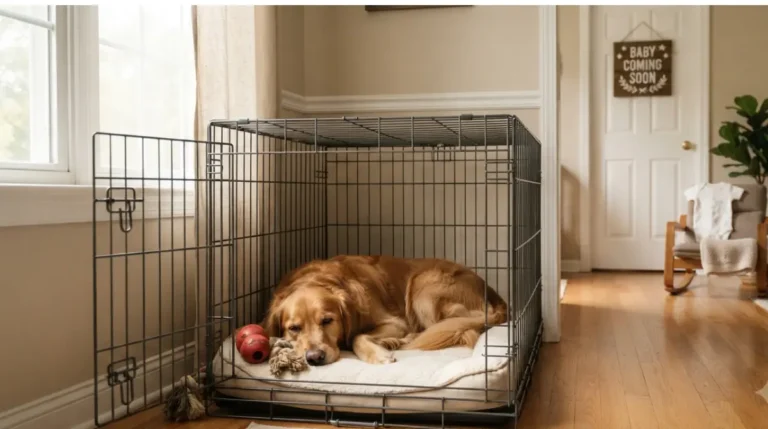
🏡 Family & Home: The crate is your dog’s own space, not a playhouse — small children should not reach into it or wake a dog inside, and that needs an adult actively watching, not a rule kids are expected to remember. In a two-dog household, each dog needs their own correctly sized crate rather than one shared larger one.
Placement matters more the longer the stretch, so check how long a puppy can stay crated before you commit a room.
Signs the crate is wrong — and when it is not about size
Ten seconds of watching tells you more than any chart.
The three-point fit check
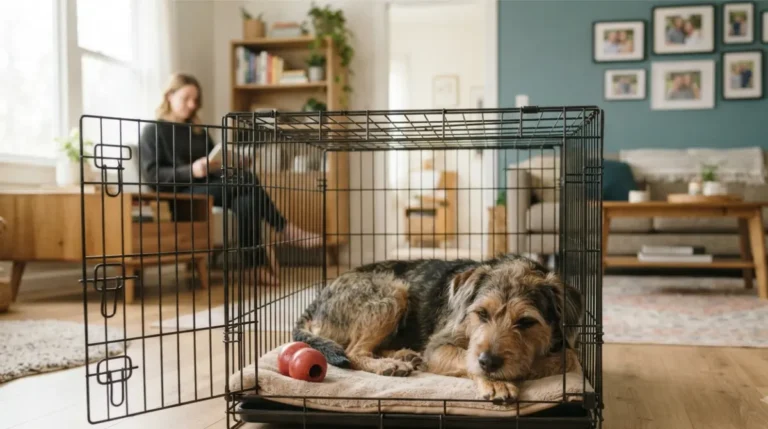
Your dog should stand without the head touching the top, turn a full circle without brushing the sides, and lie stretched on their side without pressing a wall.
Signs the crate is too small
Hunching to stand, repositioning constantly, or reluctance to go in at all. Any of the three means size up — mention persistent discomfort or stiffness to your vet at the next checkup, and breathing difficulty today.
When it is not the crate
If the fit checks out and your dog is still distressed, a bigger box will not fix it.
✅ Do This: Ask your veterinarian, and a veterinary behaviorist or certified behavior consultant, for help — tell them your dog’s measurements, the crate’s interior size, how long your dog is crated, and when the distress starts. AVSAB’s position statements explain why reward-based approaches are the standard of care here. Start with a puppy crying in the crate at night.
Dog crate size questions, answered
1. Is a 36-inch crate big enough for a Labrador?
Most adult Labradors measure past 32 inches, so a 42-inch crate usually fits better. Measure your own dog first.
2. Should I buy a bigger crate for my puppy to grow into?
Yes — buy the adult size and fit a divider, so the space stays snug while your puppy grows into it.
3. What if my dog is between two crate sizes?
Choose the larger size, then reduce the usable space with a divider until your dog is reliably housetrained.
4. Can a dog crate be too big?
Yes. Extra room lets a dog sleep at one end and soil the other, which slows housetraining down.
5. Do crate measurements mean inside or outside?
Listed crate sizes are exterior lengths. Interior space is smaller, so check the product’s stated interior dimensions before buying.
6. When should I move the crate divider?
Move it once your puppy can only just stand, turn, and stretch out with a few inches to spare.
7. How do I know if the crate is too small?
Your dog hunches to stand, cannot turn a full circle, or cannot lie stretched out on their side. If a correctly sized crate still causes distress, talk to your veterinarian.
8. What size crate for a puppy that will be 60 pounds?
Around 42 inches for most 60-pound adults, with the divider set to your puppy’s current measurements.
9. How much headroom should a dog have in a crate?
Enough to stand fully with the head clear of the top. If they hunch or touch it, size up.
10. Is a wire or plastic crate roomier at the same size?
At the same nominal length, plastic crates usually give less usable room because their walls curve inward.
Measure once, buy once
You have two numbers, a row on the chart, and a divider if your dog is still growing. That is the whole decision.
Next, put the crate to work: the first night in the crate is where the sizing pays off.
Our sizing guidance is built from published manufacturer dimensions and veterinary-authority sources, and we say plainly where hands-on testing has and has not happened.