Dog Peeing in Crate? Read the Puddle, Then Fix the Cause

Housetrained dog suddenly peeing in the crate? Book a vet visit first. For puppies, compare crate time with Penn Vet and ASPCA hold limits.
Table of Contents
A dog who pees in the crate is usually doing one of four things:
- holding on longer than her bladder allows,
- using a spare corner of a crate that’s too big,
- reacting to being shut in,
- or showing a medical problem.
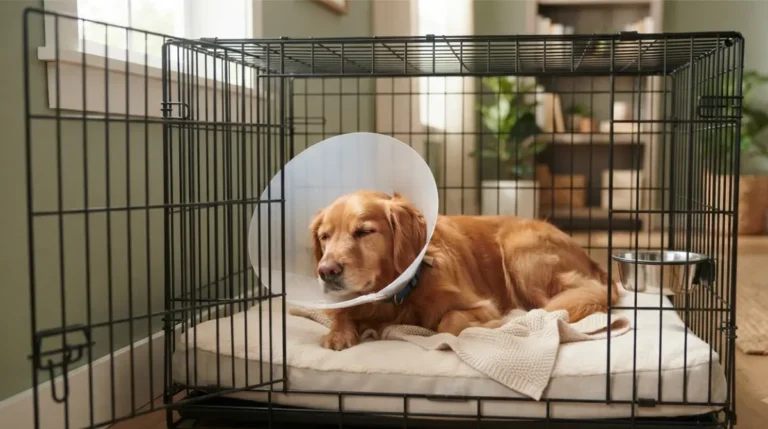
If a dog who was already housetrained starts suddenly, book a vet visit before you change the routine. Some medical conditions make an adult dog need to go more often than before (Penn Vet).
Where the urine ends up, and when, narrows it down quickly.
Where the puddle is tells you most of the story
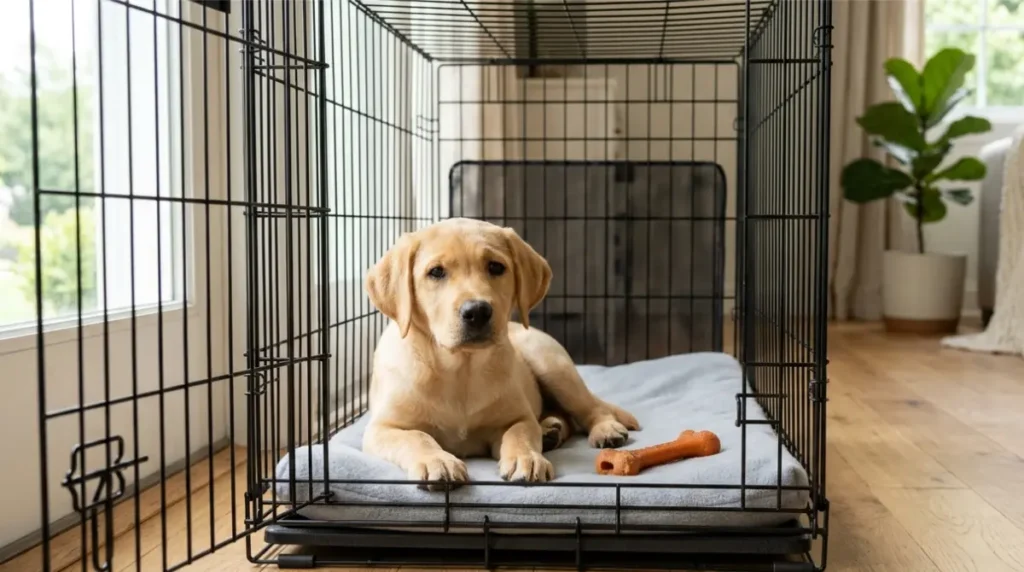
The spot, the amount and the timing of a crate accident each point toward a different cause. Match what you found to the closest row.
| What you find | Most likely cause | First step |
|---|---|---|
| A wet patch where she was lying, and she didn’t get up to go | Leaking (incontinence), a medical problem | Vet visit this week |
| Small puddles often, straining or drips, accidents outside the crate too | A urinary tract problem such as infection or stones | Call the vet today |
| Urine at one end, a dry bed at the other | Room for a toilet corner | Shrink the space |
| Wet only after the longest stretch of the day or night | The stretch outlasts her bladder | Shorten the stretch |
| Urine soon after the door closes, with whining, barking or scratching to get out | Distress at being shut in | Shorter stretches and outside help |
| Lying in the mess without seeming bothered | She learned to soil where she lives | Supervise instead of crating |
Sources: Merck Veterinary Manual, Cornell Riney Canine Health Center, ACVS, ASPCA, Penn Vet.
A puppy can fit two rows at once. One left five hours in an adult-size crate has both a clock problem and a space problem, and fixing only one leaves the other in place.
Sudden accidents in a dog who was housetrained
Urinary tract infections are relatively common in dogs, especially females (Cornell Riney Canine Health Center). The usual signs are straining, frequent small amounts and accidents in the house. In a crated dog, those accidents land in the bedding. A vet who suspects infection will want a urinalysis, which checks the urine for bacteria and blood cells.
Bladder stones can cause similar signs. A partial blockage from stones can show up as small, frequent pees, drips instead of a stream, and urine on bedding (ACVS).
Leaking looks different. Urinary incontinence is urine passing without the dog’s control, either constantly or now and then (Merck Veterinary Manual).
- The most common cause is a weak urethral sphincter. It mostly affects spayed females and can become more noticeable from middle age on.
- A young dog (more often female) who has dribbled constantly since puppyhood may have an ectopic ureter. That’s a tube from the kidney that opens past the bladder’s valve.
Neither problem responds to a smaller crate or a tighter schedule. Book a visit this week for leaking. Call the vet today if you see straining or drips.
Call a vet now if: your dog strains to pee and little or no urine comes out. A dog who cannot urinate needs to be seen immediately, and a total blockage of the urethra can kill within days if it is not relieved (ACVS). If your clinic is closed, go to the nearest emergency vet.
Is the stretch longer than the bladder?
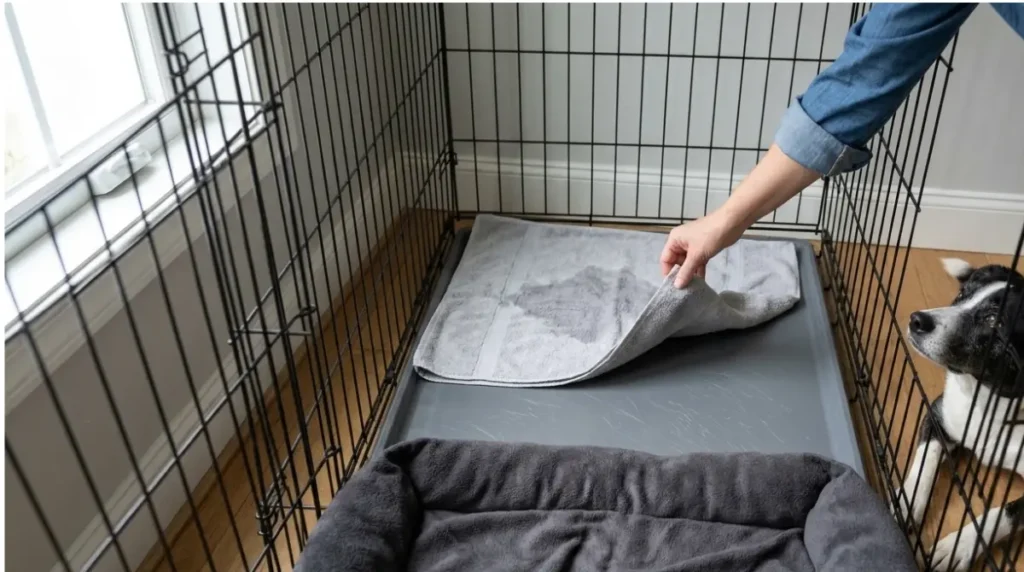
A 4-month-old crated from 8:30 a.m. to 1:00 p.m. has been inside for 4.5 hours. Whether that is too long depends on the guideline, and two widely used ones differ.
| Source | Puppies | Adult dogs |
|---|---|---|
| Penn Vet | About 1 hour per month of age, give or take an hour | A chance to go out about every 4 hours when possible; can reasonably hold urine 8 hours or longer |
| ASPCA | No more than 1 to 2 hours at a time, except at night | No more than 4 hours at a time |
Sources: Penn Vet, ASPCA.
- On Penn’s figure, a 4-month-old’s limit is 3 to 5 hours, so that morning sits near the top.
- On the ASPCA’s, the same 4.5 hours is more than double the limit.
A puppy who wets only during the longest stretch is showing you where the problem is. The full limits by age are in how long a puppy can stay crated.
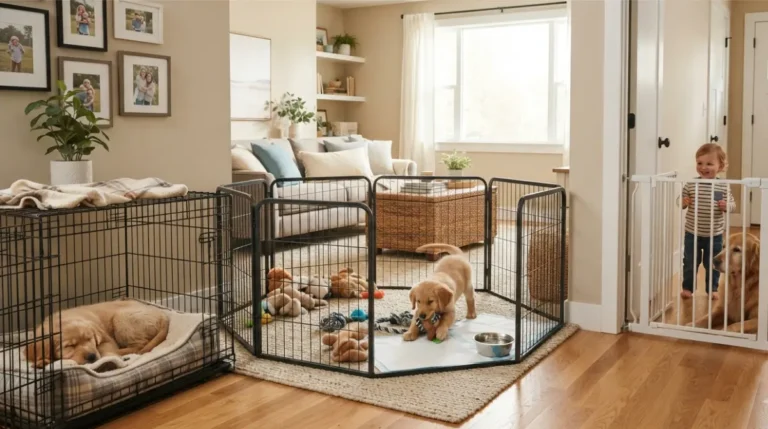
When nobody can be home in time, Penn Vet advises against crating for that stretch. It suggests an exercise pen or a gated laundry room instead, so she can still sleep away from the spot she uses. Night wetting in young puppies runs on its own timetable, covered in crate training a puppy at night.
Note: Pee pads or papers go in that pen, on the spot she already uses and away from her bed (Penn Vet). Inside a crate, a pad hands her a toilet next to where she sleeps.
A crate with a spare bathroom corner
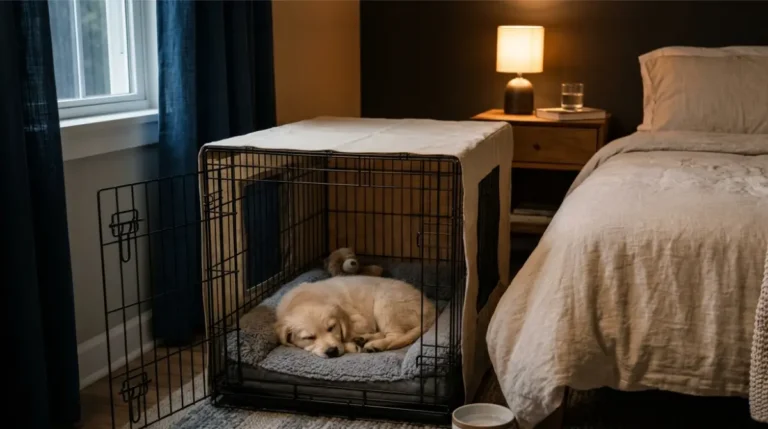
For housetraining, the crate should let the dog stand up, turn around and lie down without hitting the top or sides (ASPCA). Any bigger, and she may pee or poop at one end and sleep at the other.
A growing puppy can still have the crate she’ll need as an adult. Block off the extra floor with the puppy panel and move it back as she grows; the steps are in setting a divider to your puppy’s current length. Once she is reliably housetrained, crate size stops mattering for accidents.
Peeing within minutes of the door closing
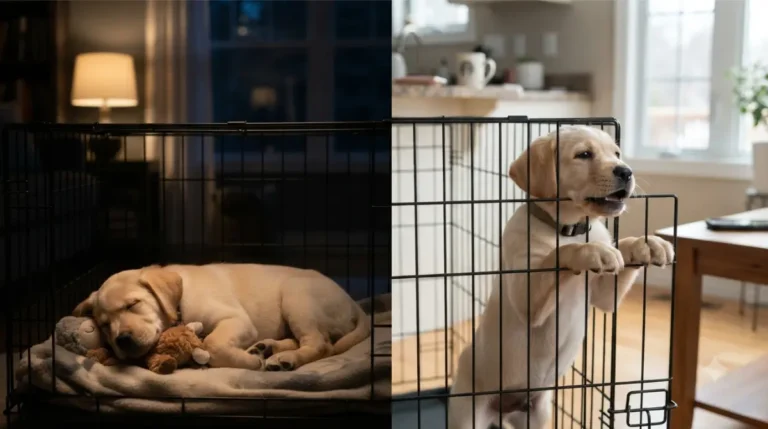
If the urine appears soon after the door shuts, she may be reacting to the crate itself. Repeated whining, barking or scratching to get out points to distress. The ASPCA’s advice is to go back to shorter stretches she can manage without it, then build up slowly (ASPCA). For a dog with a bad crate history, the same page suggests an exercise pen or a dog-proofed room as a less stressful option.
Distress needs its own plan, separate from housetraining. How confinement anxiety differs from separation anxiety helps you tell which one you’re seeing. If it happens every time, involve the vet and a veterinary behaviorist or certified behavior consultant before adding more crate time.
Dogs who learned to live in their own mess
Most dogs avoid soiling where they sleep or eat, and that instinct is why a crate helps with housetraining. The exception is a dog previously confined for long periods in dirty conditions (Penn Vet). A dog shut in longer than she could hold on adapts to eliminating where she lives. Penn notes that such a dog may not be crate-trainable for housetraining at all.
That history can belong to a puppy from a commercial breeding kennel, a dog kept for months in a small pen, or a long-stay shelter dog. Nobody in her new home caused it.
Instead of the crate, keep her near you on a light line about 6 feet (1.8 m) long. That way you see the sniffing, circling or squatting that comes before she goes, and can take her straight outside. If that isn’t practical, keep her shut in whichever room you’re in. More on helping an older dog adjust is in crate training an adult rescue dog.
Cleaning so the smell doesn’t invite a repeat
Dogs tend to go back to places they have eliminated before, and smell is part of that pull (Penn Vet). Wash the tray and bedding with a product made to remove pet urine odor, and let the crate dry fully before she goes back in.
Reward her outside the moment she finishes, while she’s still on the spot. Scolding after the fact works against that. Dogs punished for eliminating indoors in front of their owners may start avoiding going in front of anyone, outdoors included.
What to tell the vet when you book
Have the pattern written down before you call the clinic:
- when the accidents started, and what changed that week (a move, a new work schedule, a spay)
- where inside the crate the urine is, and whether she was lying in it
- how long each crate stretch lasts, overnight and during the day
- whether she is drinking more, straining or passing drips
- what you know about where she lived before you
Ask whether to bring a urine sample, and how the clinic wants it collected.